Hedging with Inverse ETFs: Pros, Cons, Rollover Costs and Foreign Whale Moves
TL;DR: Shorting individual stocks carries unlimited risk, while an inverse ETF can at most go to zero, needs no margin top-ups and no manual rolling, which suits short-term hedging; but the futures rollover cost built into it keeps eroding value, so it should not be held long term.
Key ideas
- Three hedging tools each have limits: stock borrowing (margin shorting) has low leverage and forced buy-back risk; warrants and options lose time value; futures offer leverage of up to 18 times and are not affected by short-sale suspensions, but can easily cause losses beyond your capital.
- Shorting individual stocks is far riskier than going long: Bill Ackman lost about 10 yi USD (yi = hundred million; about 300 yi TWD) shorting Herbalife, and short sellers as a whole lost 910 yi USD on GameStop; Taiwan at least has limit-up and limit-down price rules, while foreign stocks may have no daily limit.
- The 4 main advantages of inverse ETFs are that they can at most go to zero, are not affected by short-sale suspensions, need no margin top-ups and need no manual rolling; the drawback is that rollover costs keep eroding value, and 00632R's previous high was 23, so anyone stuck at that high can never recover, which is why they suit only short-term hedging.
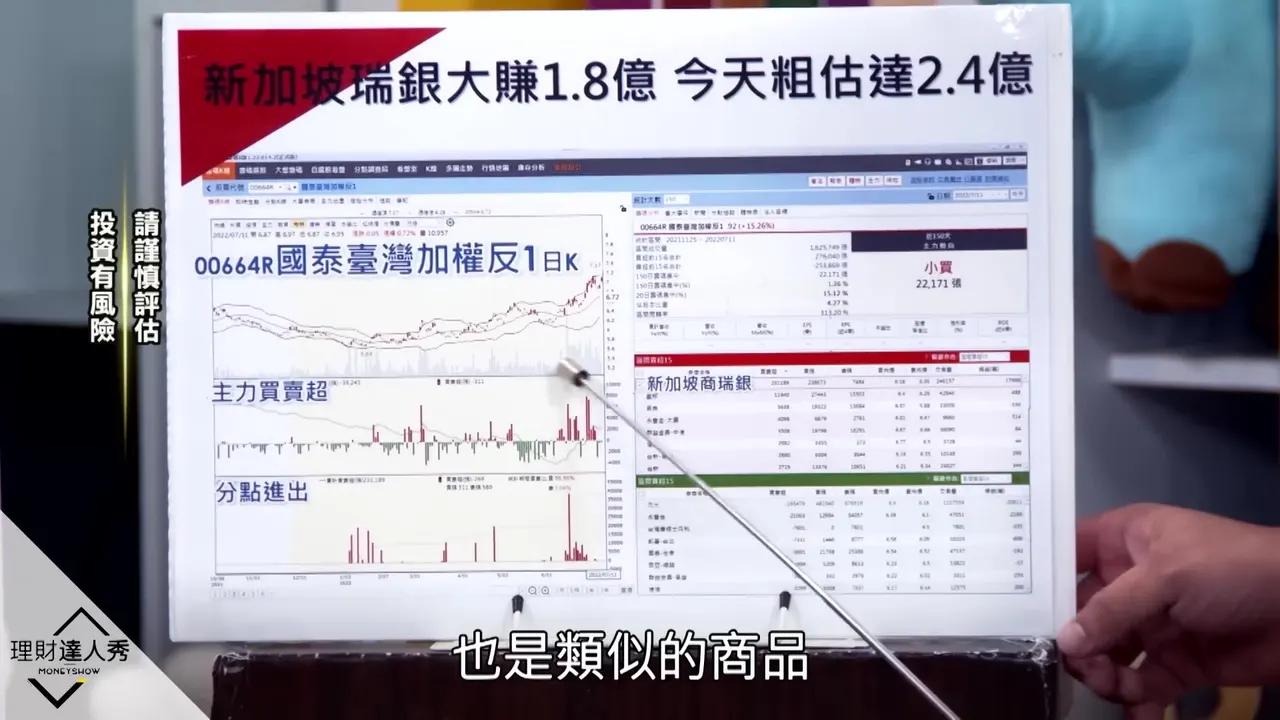
- UBS Singapore started buying 00632R at the Taiwan stock market high, accumulating 96 wan lots (wan = ten thousand), and also bought about 23 wan lots of 00664R, with intraday estimated paper gains of 7.2 yi and about 2.4 yi respectively, showing that big players use inverse ETFs to hedge.
- Foreign net-buy amounts are often parked in the T50 inverse ETF, so don't look only at the total; check what was actually bought. The market can't fall 300 points every day, and a rebound is a humane corridor for trimming long positions, which can be paired with inverse ETFs, futures or puts for hedging.
Section summaries
1:45Opening: A Tough Market Lately
The speaker opens by lamenting how hard the recent market has been; anyone who held long positions from the highs all the way to now without a stop-loss faces painful paper losses. This leads into the episode's topic: how to hedge long positions.
▶ Watch from here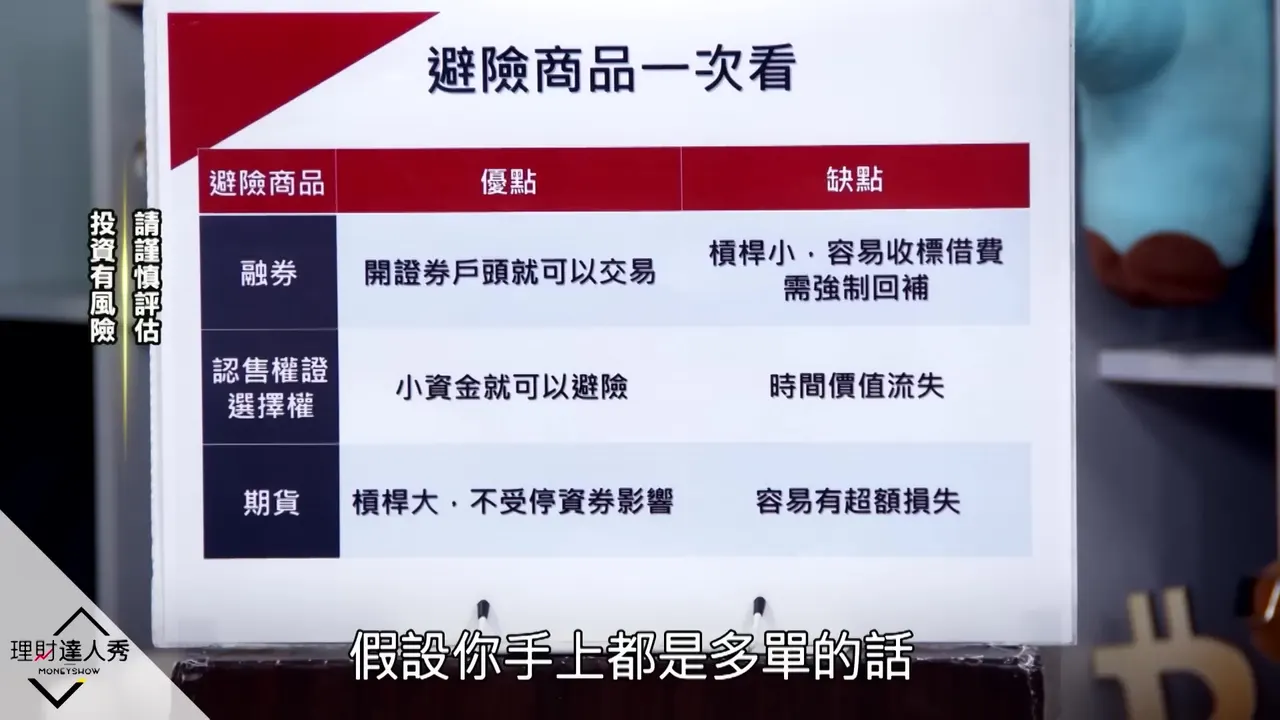
1:55Comparing Three Hedging Tools
Compares three hedging tools: margin shorting, put warrants and options, and futures. Margin shorting has low leverage, borrowing fees and forced buy-back risk; warrants and options can be bought with small capital but lose time value quickly; futures have large leverage and are not affected by margin-trading suspensions, but can cause losses beyond your capital. The speaker stresses that shorting is far riskier than going long.
▶ Watch from here4:25Warning: Disastrous Short Positions
Bill Ackman shorted Herbalife and lost about 10 yi USD (yi = hundred million), roughly 300 yi TWD; Gabriel Plotkin's Melvin Capital shorted GameStop and was squeezed by retail investors coordinating online, losing 70 yi USD, while short sellers as a whole lost about 910 yi USD. Shorting has no upper limit on losses, the biggest fear is the market moving against you, and shorting individual stocks also requires borrowing shares, so losses are often huge.
▶ Watch from here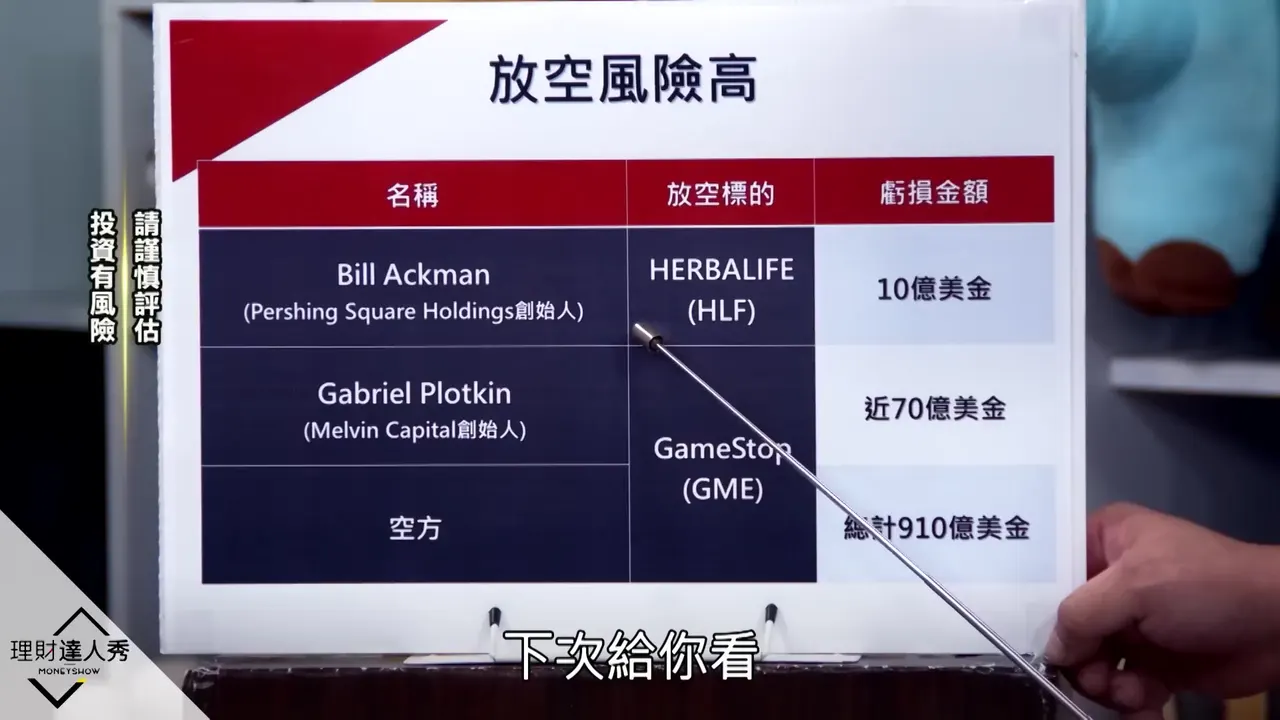
6:30Inverse ETFs: A Safer Alternative to Shorting
Shorting individual stocks requires borrowing shares and is extremely risky, so the speaker introduces a safer alternative, inverse ETFs, which have less risk of a squeeze but also have drawbacks. The longest-established one is 00632R, Yuanta Taiwan 50 Inverse 1, whose volume sometimes reaches 30-something wan lots (wan = ten thousand); others include Yuanta S&P Crude Oil Inverse 1, Cathay Taiwan Weighted Inverse 1 and Fubon Taiwan Weighted Inverse 1.
▶ Watch from here7:45Types of Inverse ETFs and How to Spot Them
Continuing the list of inverse ETFs, including market inverse, S&P500 inverse, yen inverse and gold inverse; they can be identified by an R in the English name and the character 反 (inverse) in the Chinese name, and the monthly moving average of the recently bearish products has quietly turned up by about 0.5%.
▶ Watch from here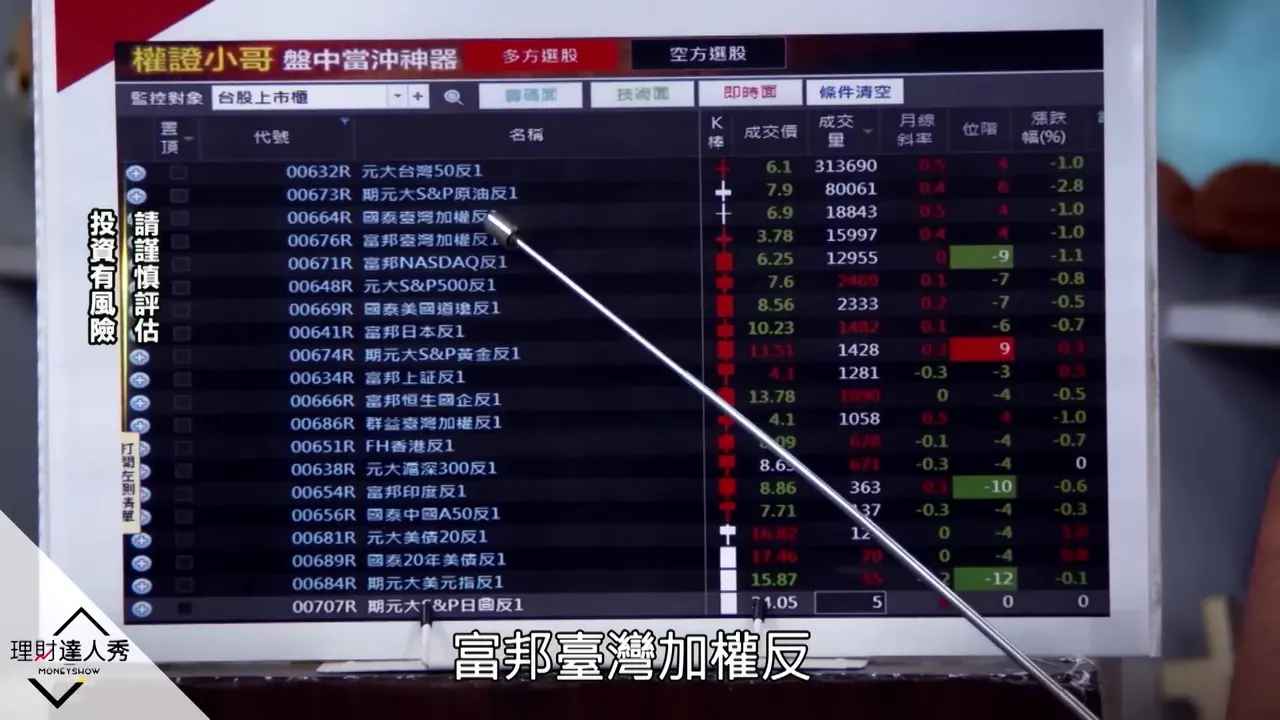
8:41Four Advantages of Inverse ETFs
The inverse ETF's monthly moving average has turned bullish, as the market's weakness attracts buyers. Its four advantages: buying can at most go to zero, so you never lose more than your capital; it is not affected by short-sale suspensions, avoiding forced buy-back and squeeze risk; no margin top-ups for borrowed shares; and no manual rolling, although rollover costs still cause losses.
▶ Watch from here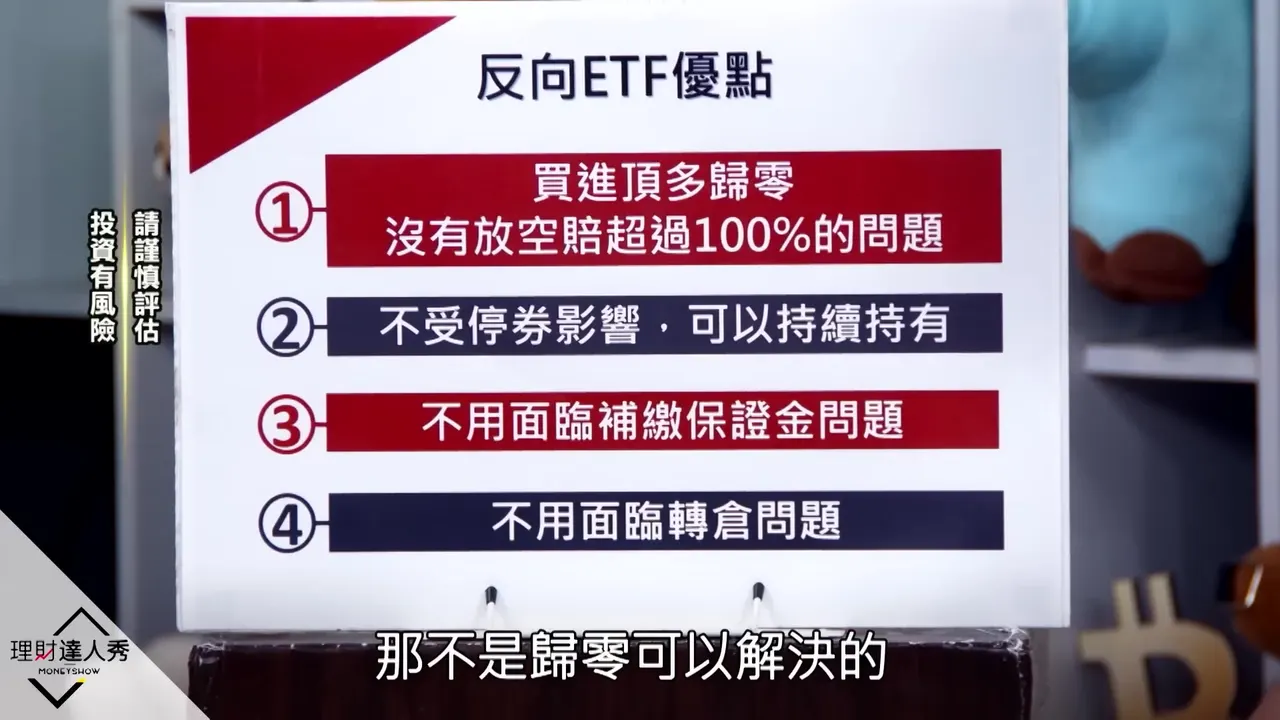
11:15Drawbacks and Limits of Inverse ETFs
Inverse ETFs have futures rollover costs built in, so their value keeps shrinking. 00632R has now rebounded to 6, but if the market rebounds it could fall below 5, then to 4 and 3, and if the market stays high it could even be delisted or split; so it suits only short-term hedging, not long-term swing holding.
▶ Watch from here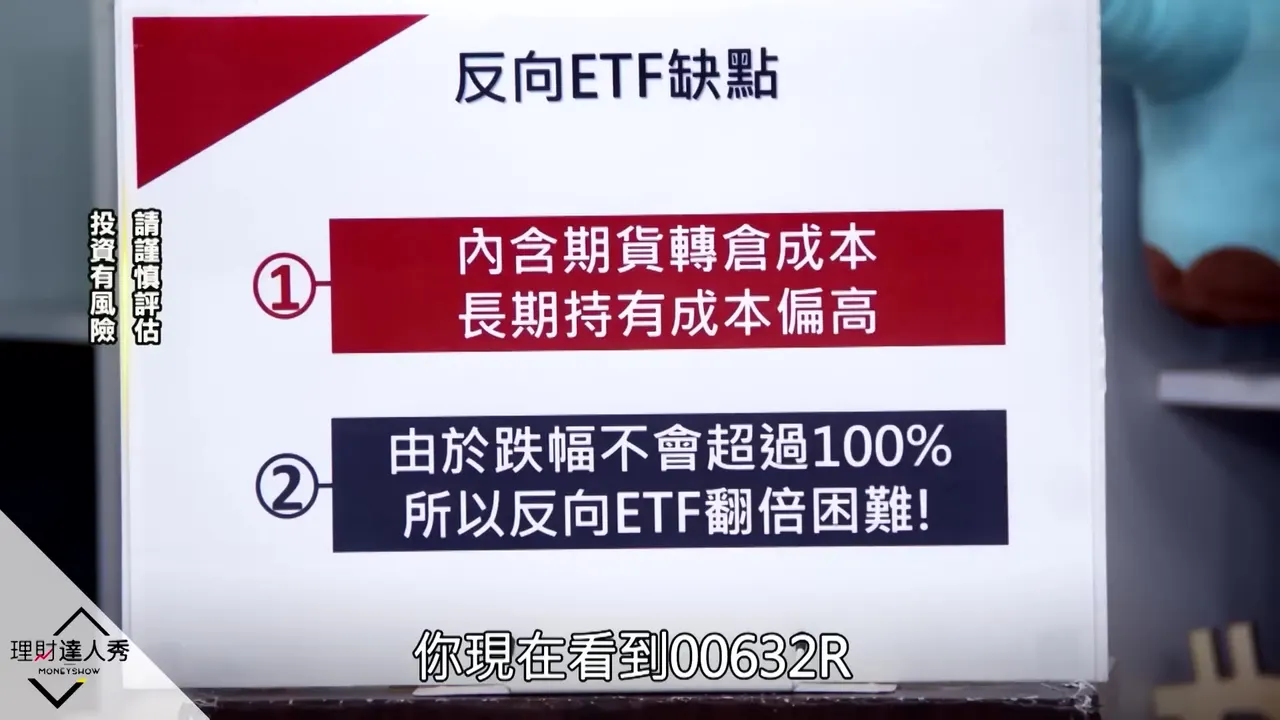
12:01Inverse ETFs vs. Stocks
In this move 00632R started rising from 5, and even reaching 10 is a struggle; its previous high was 23, and anyone stuck there can never recover. Doubling is hard for an inverse ETF, unlike a stock, which can recover however bad it gets. Next, the recently popular 00707R, which relies more heavily on futures hedging than 00632R, tracks Yuanta S&P Yen Inverse 1, as the yen has recently fallen sharply.
▶ Watch from here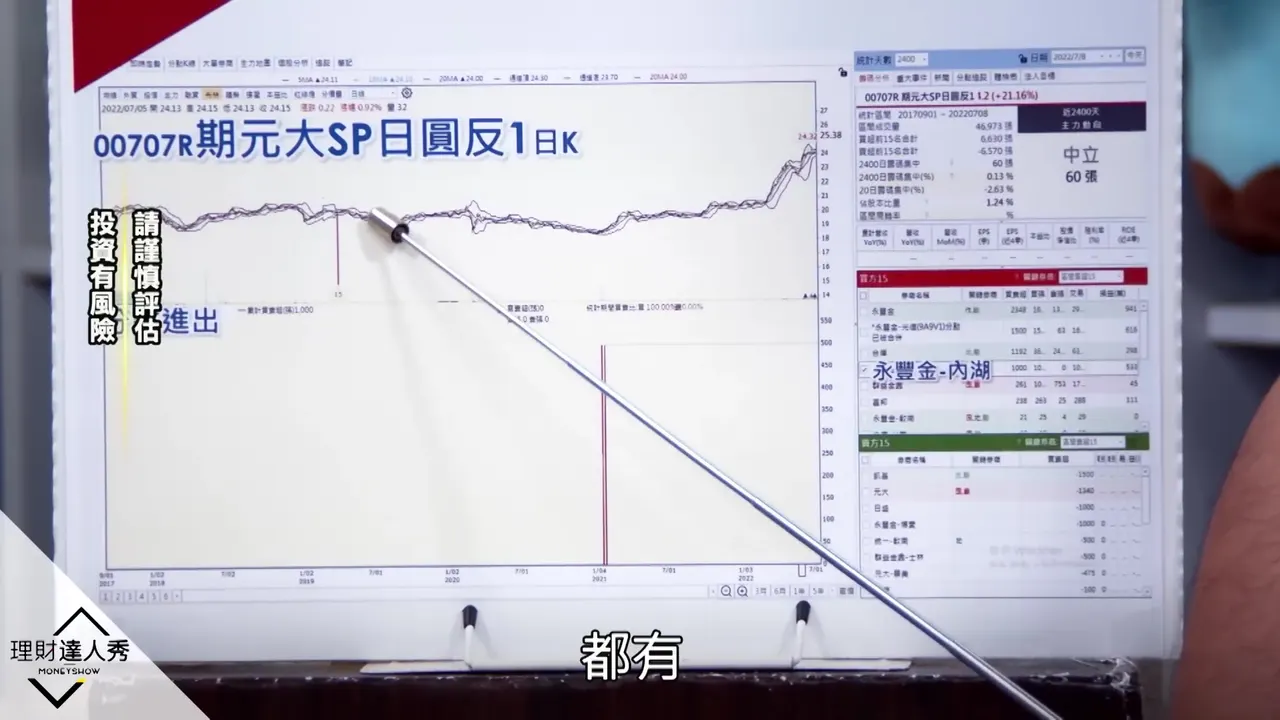
13:11Yen Inverse ETF and Broker-Branch Activity
Yuanta S&P Yen Inverse 1 (00707R) rose from 20 to nearly 24, climbing steadily during the yen's slump. The SinoPac Neihu branch bought 500 lots on each of 2 days, 1000 lots in total, buying at the start of the rise, after which the price jumped. The speaker thinks that when this branch sells its position, the yen will probably have bottomed, a good time to exchange into yen.
▶ Watch from here14:25The Analyst Investigation Controversy
Responding to a listener's question about the recent investigations of analysts: those investigated are all influencer-type amateurs who run groups and speak provocatively, not the properly run analysts who appear on shows. The speaker then begins explaining the first key point for avoiding investigation.
▶ Watch from here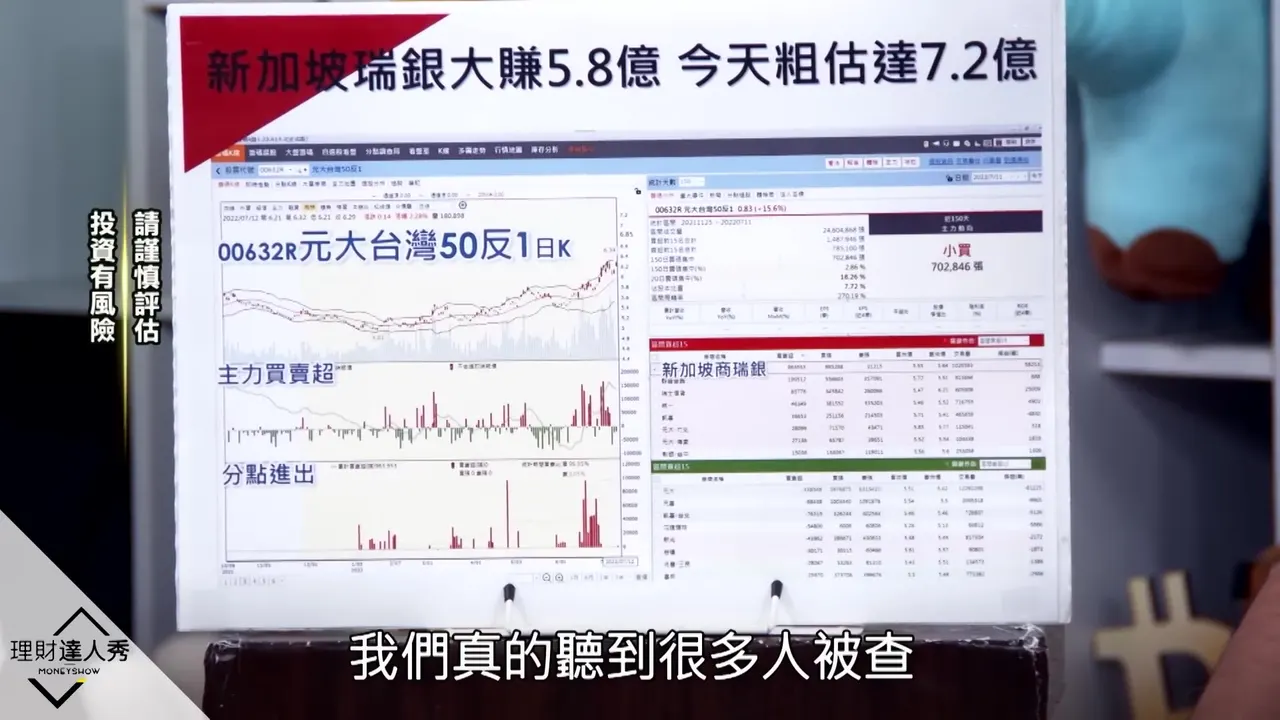
14:50Key Principles for Avoiding Investigation
The key to avoiding investigation is not to talk about stocks or index levels during market hours, to avoid any suspicion of inducing trades; speaking after the close and only about flow data, real information published by the exchange, is safe. Taking UBS Singapore as an example, it began buying 00632R heavily at the start of this year when the Taiwan market was around 18000-plus points, which can also be seen as reasonable foreign hedging.
▶ Watch from here17:15Foreign Investors Buying Inverse ETFs
UBS Singapore kept adding to 00632R from April when the market was still at 16000-plus points, and was still buying heavily at 14000, with cumulative purchases of 96 wan lots (wan = ten thousand); the ETF rose from 5 to 6.34, with paper gains of 5.8 yi as of the previous day and an intraday estimate of 7.2 yi. Inverse ETFs bleed value, and the longer they are held the worse it gets, so heavy foreign selling may signal they think the market can't fall further. The speaker also reminds that foreign net-buy amounts are often parked in the T50 inverse ETF, so check what foreign investors actually bought.
▶ Watch from here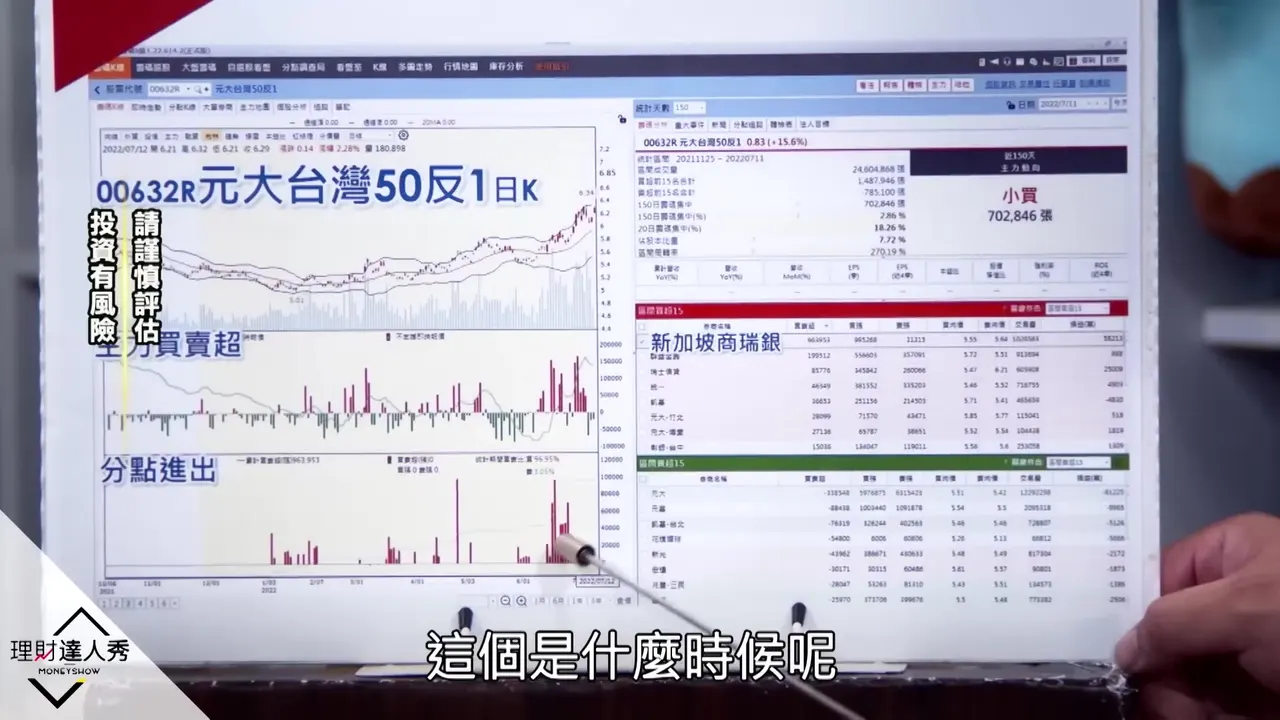
19:51Market Bottoming and Hedging Summary
Cathay Taiwan Weighted Inverse 1 (00664R) rose from 5.6 to 7.1, UBS Singapore bought 23 wan lots (wan = ten thousand), and the intraday estimated gain is about 2.4 yi. The speaker stresses the market can't fall 300 points every day; a rebound will come and may be big. But don't rush back to the bull side on a big rally: a rebound is a humane corridor for trimming long positions, and if you can't trim everything, you can hedge with inverse ETFs, short futures, buying put options or put warrants. In the short term the advantages outweigh the drawbacks, while in the long term the futures rollover mechanism keeps eroding value.
▶ Watch from here