Reading Bullish and Bearish Signals in Major Shareholder Share-Transfer Filings
TL;DR: Whether an insider share-transfer filing is bullish or bearish depends on its form and the price level: gifts, trusts or placements with a specific buyer at low levels lean bullish, while ordinary intraday trades at high levels lean bearish, and in a bull market the hit is only short-term, becoming much more damaging once the market weakens.
Key ideas
- Share sales by a chairman's wife or a major shareholder are often poison for the stock price. The motive may be family or household financial planning, or a belief that the price has run too far. After Feng Tay's chairman's wife sold 7000 lots, the stock fell nearly 7% the next day. Former Yageo chairman's wife placed 12000 lots with a specific buyer, selling at above 1000, and the stock later fell below 300, so she was seen as a big winner.
- First sort the filing into 4 forms. Gifts or trusts at low levels carry tax advantages and lean bullish. A placement with a specific buyer at a low level is also fine, but not necessarily at a high level. For after-hours fixed-price and block trades, look at who the buyer is. Ordinary intraday trades are the most serious, and when several insiders file at the same time at a high level, watch out for an overextension signal.
- Even with a specific buyer, if that buyer sells later it still weighs on the price, so check whether the buyer is a strategic partner. An ordinary trade can be sold 3 days after filing, which amounts to announcing a sale in advance, so the stock often drops as soon as the filing is announced. Stocks hyped by online communities more often fall on no volume after the boss files at a high.
- A filing does not necessarily mean an actual sale, and the holder can skip selling if the price is not good. But during the announcement period the price often falls before any sale happens, so when you see the news, sell first thing the next morning and do not wait 3 days.
- This year small caps have been surging wildly and market confidence is strong, so filings mostly cause only a short-term drop (10%–20%) before the price recovers. When the market weakens, the damage becomes clearly stronger, and the impact is larger in a bear market.
Section summaries
1:20Why Major Shareholders Sell
Explains the common motives for major shareholders selling: changes in family circumstances, family financial maneuvers, or in fact not being optimistic about the company's prospects and thinking the price has risen too far. This kind of selling is often seen as poison for the stock price, and it is the starting point for this lesson's look at share-transfer filings.
▶ Watch from here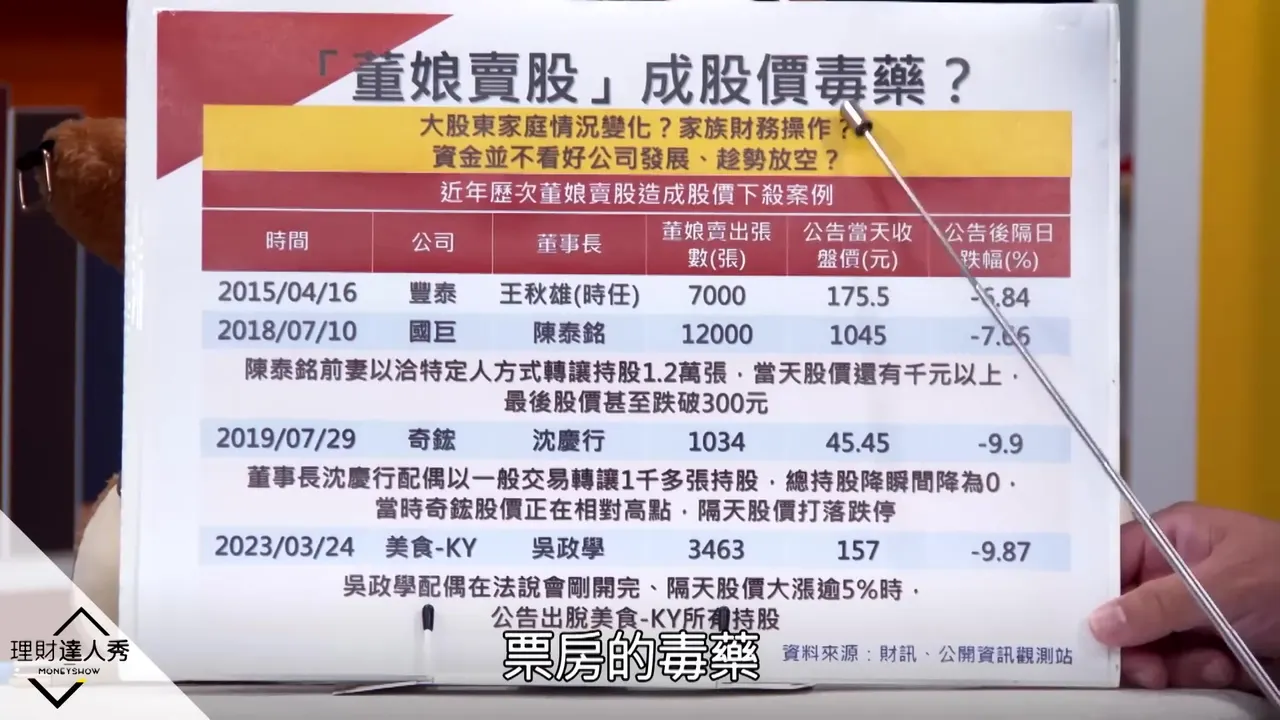
2:00Past Cases of Chairmen's Wives Selling
A review of cases where a chairman's wife selling shares drove the price down. In April 2015, Feng Tay's chairman's wife (chairman Wang Chiu-hsiung) sold 7000 lots; the close on the announcement day was 175.5, and the stock fell nearly 7% the next day. In July 2018, when passive components were surging, former Yageo chairman's wife placed 12000 lots with a specific buyer when the stock was above 1000 and it later fell below 300, so she was seen as a big winner. In July 2019, the chairman's wife of Auras filed to transfer 1030 lots, at an announced price of 45.45.
▶ Watch from here4:35The Four Forms of Share-Transfer Filings
On March 20, 2023, the chairman's wife of Foodmore-KY filed to transfer 3463 lots. Although a specific buyer was taking them, if that buyer sells later it will still weigh on the price, so check whether the buyer is a strategic partner. Filings fall into 4 forms by type: gifts or trusts at low levels carry tax advantages and lean bullish; a placement with a specific buyer at a low level leans bullish, but at a high level not necessarily; for after-hours fixed-price and block trades, look at who the buyer is; ordinary intraday trades are the most serious, since the shares can be sold 3 days after filing and the price often drops as soon as the filing is announced, and when several insiders file at once at a high level, watch even more for an overextension signal.
▶ Watch from here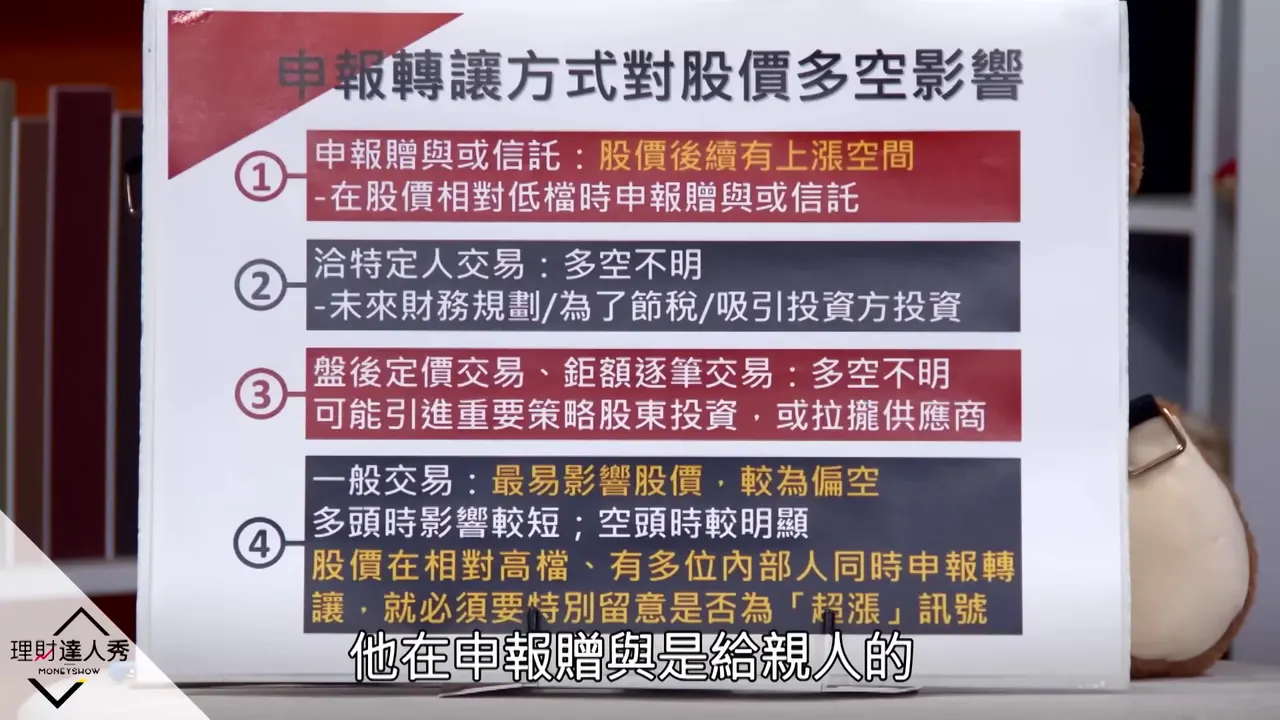
10:00The Risk of Filing at High Levels
For stocks recommended by online communities and chased by followers, the boss knows people are hyping the stock and files to transfer shares at a high level; once the news is out the price often falls on no volume. Since there is a 3-day wait after filing, the sale may not go well either, so people with no fundamentals and who only follow rumors should not chase blindly. Another example is a shipping stock whose boss, surnamed Kuo, filed to transfer a large amount at a high level and was left with only 50-odd lots, then later bought back 1000-odd lots, so selling 1 lot let him buy back 3 lots while keeping management control, a clever move.
▶ Watch from here12:06This Year's Market Conditions for Filings
This year small caps have been surging wildly and the market is still hoping for a dream rally, so the impact of share-transfer filings looks less severe: in one case the stock fell only about 10% after the announcement before rising back. The lesson then moves on to the case of a filing by the parent company of Leader Electronics (2462).
▶ Watch from here13:00Assessing a Parent Company's Filing
For Leader Electronics (2462), the filing was made by its parent company Leader Tech rather than by the chairman personally. Such parent-company filings are common, and Foxconn's investment companies also often file on their small "golden hen" subsidiaries. A filing is often the main cause of news-driven declines: as soon as news came out on Leader Electronics, the price dropped from the upper Bollinger Band to the lower band. But there is still a waiting period after filing, so the price often falls before any sale happens, and many people sell first on their own, when the company may not have wanted to sell at all.
▶ Watch from here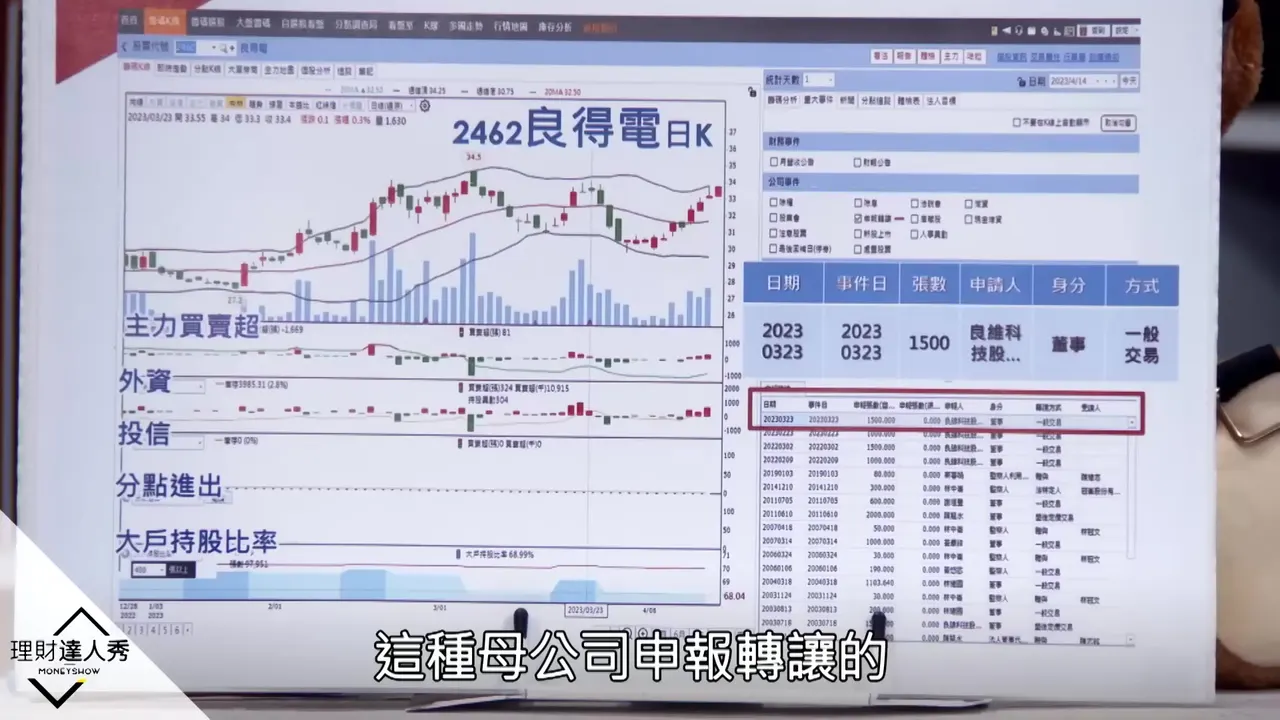
13:55A Filing Does Not Necessarily Mean a Sale
A filing does not necessarily mean an actual sale: if the price is not good the holder can skip selling, since the filing only makes the shares available for sale, and the same goes for releasing shares from central depository custody. So when you see the news, sell first thing the next morning and do not wait 3 days, because if you wait and the stock falls 3 days in a row there is no point selling. Another stock that filed this year had already risen a lot, fell at most about 20% from its high, and then slowly rose back.
▶ Watch from here15:03Bull and Bear Environments and Course Summary
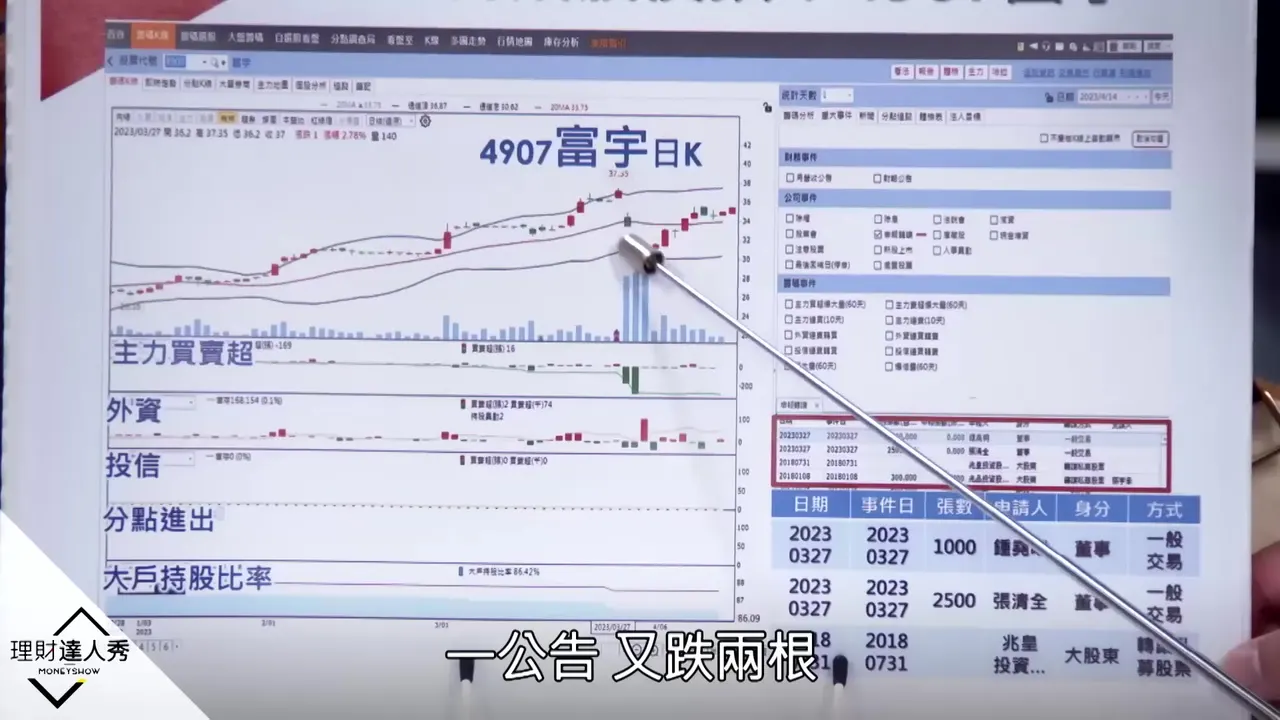
In a bull market a filing has only a short-term impact and the long term is fine, because market confidence is strong; its damage becomes stronger only when the market weakens. Few people research the fundamentals of such companies, and they often file after a big run-up, possibly with a major player pushing the price up behind the scenes. For example, Fuyu (4907) quietly climbed and then announced, and it promptly fell 2 candlesticks. In summary: shares transferred into a trust for children at a low level may keep rising afterwards, while a placement with a specific buyer at a high level or an ordinary intraday trade are both very damaging, and a bear market has a bigger impact than a bull market.
▶ Watch from here