High-Turnover Momentum Stocks: Using Position and Major-Player Buying and Selling to Spot a Breakout or Distribution
TL;DR: High turnover is neither good nor bad in itself; what matters is where it appears: a volume surge after a long low-level base with major-player net buying signals a swing move starting, while a spike at a high level with major-player net selling is a warning of distribution.
Key ideas
- Turnover rate is trading volume divided by shares outstanding, times 100%, much like a restaurant's table turnover; more than 20% in a single day or more than 100% in a week counts as high turnover, while TSMC's turnover is usually below 5%.
- The upside of high turnover is active trading and easy entry and exit; the downside is that at short-term highs major players may take advantage of the chaos to unload. High-turnover stocks often have volume and are often strong stocks, so there is no need to assume they are about to fail.
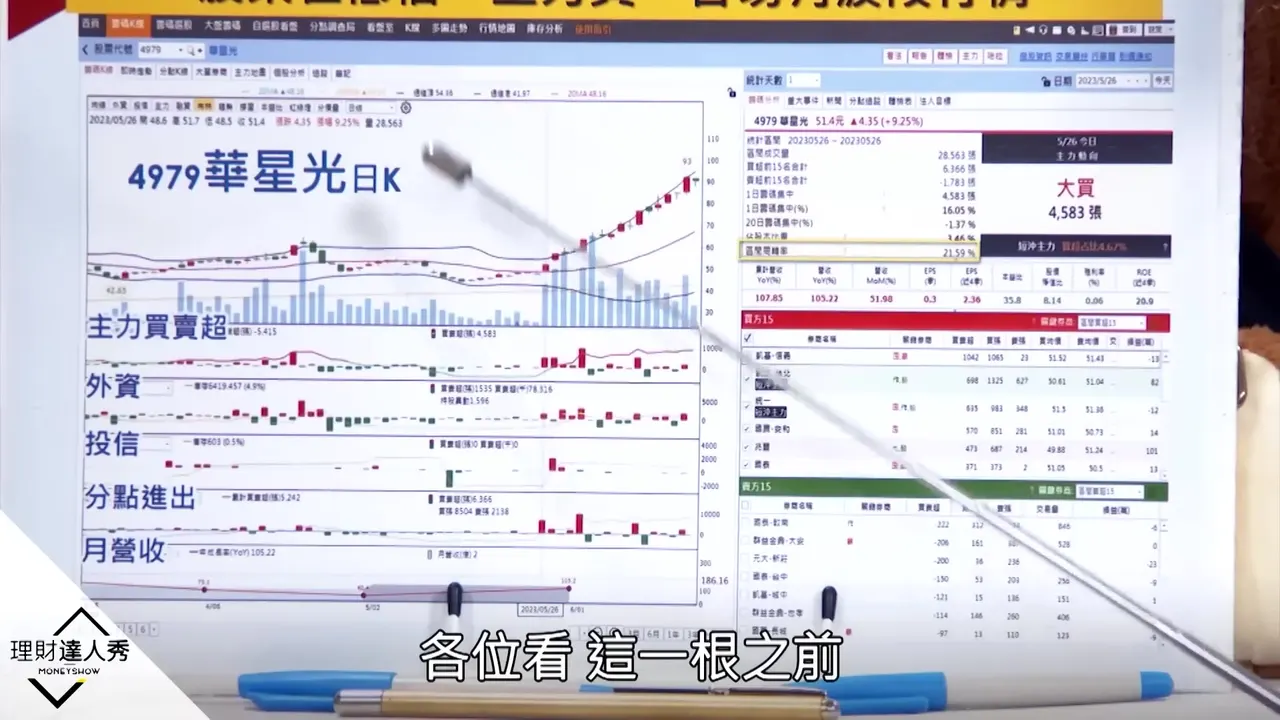
- At a low level, the signs are tangled moving averages, price near the monthly and quarterly moving averages, and narrowing Bollinger Bands; when turnover then breaks the 20% threshold with major-player net buying, a swing move tends to follow, as with Wavetek (華星光) and Hongbao (虹堡).
- At a high level with a large deviation from the moving averages, extreme turnover together with major-player net selling makes a sharp drop likely; Sunrise (昇銳) with 78% turnover is a case of being unloaded on, and when Kingbridge (金橋) bounced with major players selling continuously and turnover at 20%, it also easily made new lows.
- You cannot judge high versus low level from just the recent move; look at a longer chart, otherwise a stock like Kingbridge, which has a very high peak before it, can be mistaken for one about to take off.
Section summaries
2:15What Is Stock Turnover Rate
Turnover rate measures the share of shares outstanding that trades over a period, i.e. the churn rate, like table turnover at a restaurant; the formula is trading volume divided by shares outstanding, times 100%. If a day's volume exactly equals shares outstanding, every shareholder has effectively swapped hands once; the speaker once saw a stock with 500% turnover in a single day, meaning everyone played 5 rounds, and afterwards the price was cut in half and then in half again. He then previews a discussion of healthy and unhealthy turnover.
▶ Watch from here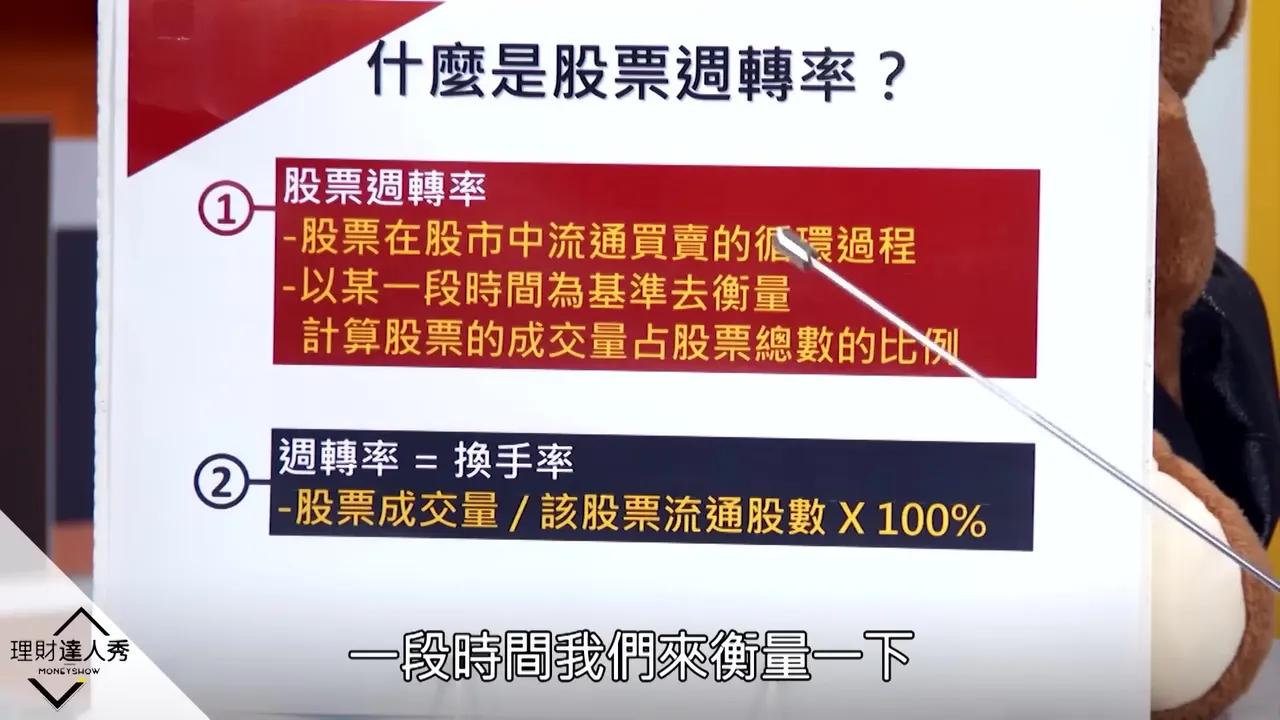
4:00Defining High Turnover, Pros and Cons
High turnover is defined as more than 20% in a single day or more than 100% in a week, contrasted with TSMC's turnover below 5%. Price needs volume, so high turnover can serve as a reference for entries and exits; the upside is active trading and easy entry and exit, and the downside is that at short-term highs you must beware of major players taking advantage of the chaos to dump shares.
▶ Watch from here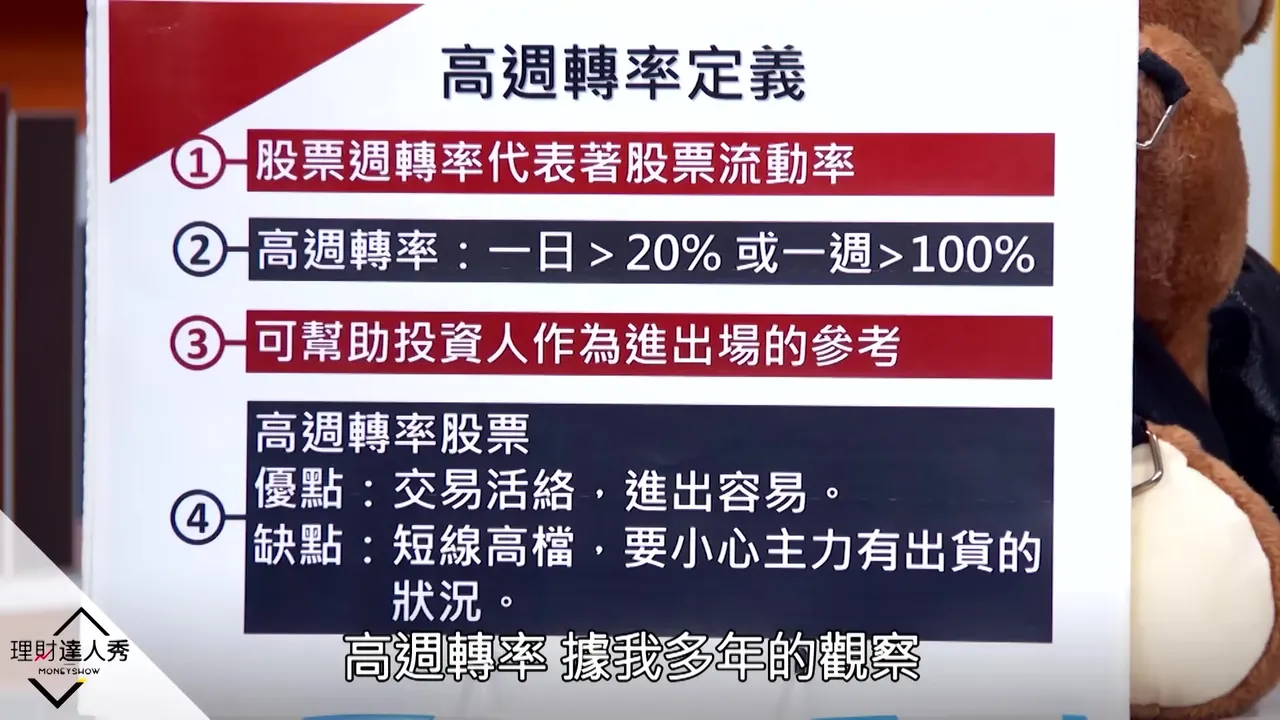
6:05How to Look Up High-Turnover Stocks
There are many data sources for high-turnover stocks: the ranking published by the Taipei Exchange covers only OTC-listed stocks, while third-party sites combine listed and OTC. Taking the listed-stock ranking of June 19 as an example, first place was Team Group (十銓), and Hwa Jing (華經) opened high that day, sank to the flat line, then rallied to limit-up, with turnover of nearly 50%. The speaker reminds viewers that high-turnover stocks often have volume and are often strong stocks, so don't assume at first sight that they are about to fail.
▶ Watch from here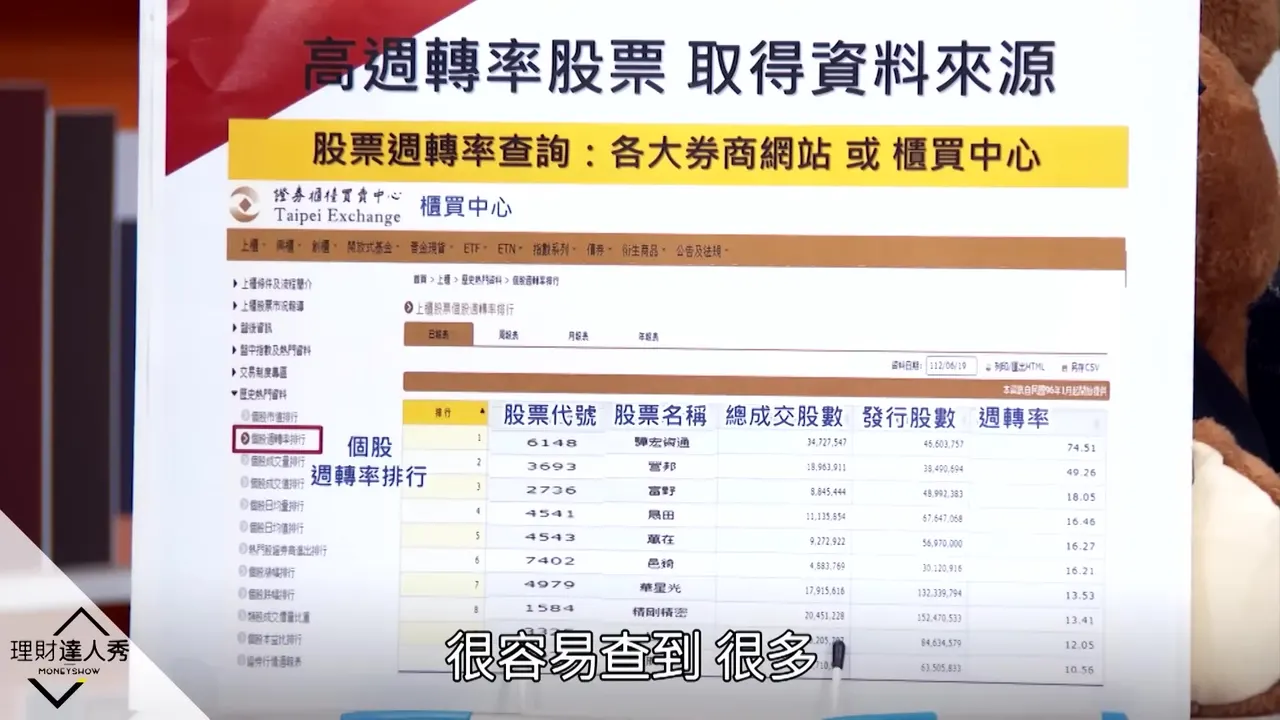
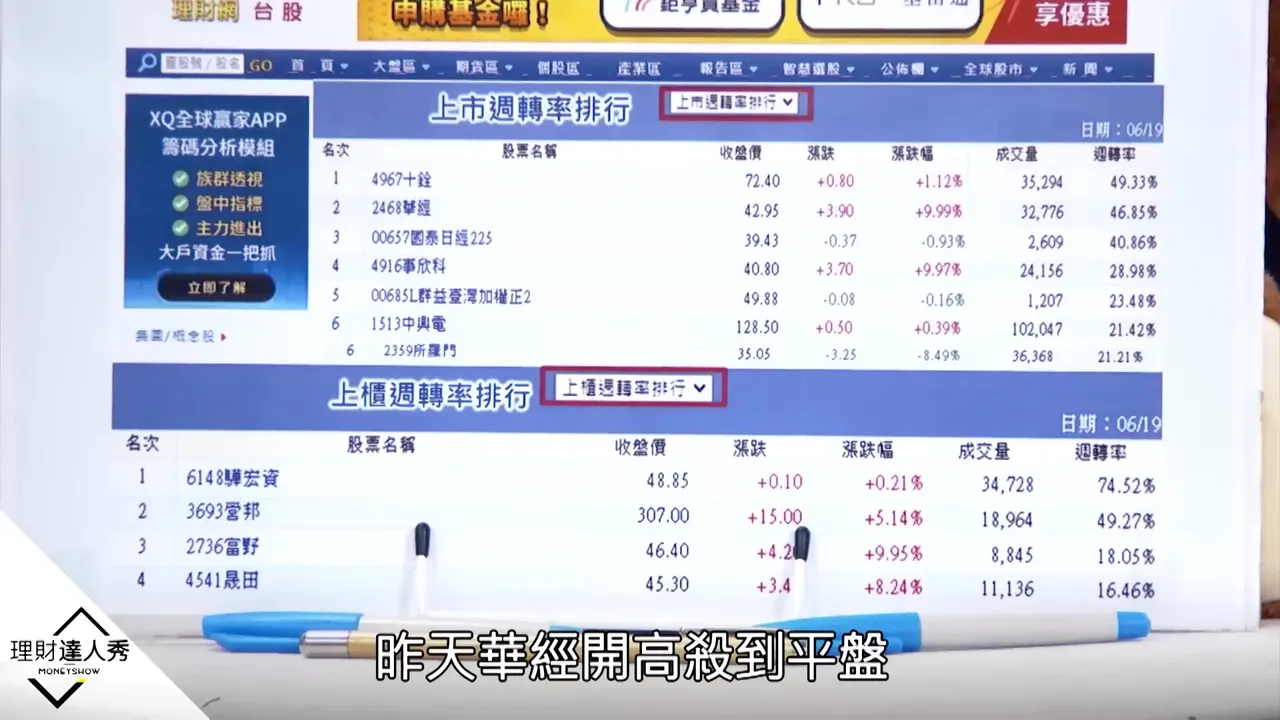
7:40Government Trading and the Opening of the Chip-Flow Approach
He points out that whenever the government trades, turnover becomes very high; Cathay Nikkei (國泰日經) had high turnover and hit limit-up that day, showing that high-turnover stocks all have some action. He then moves into his chip-flow trading mindset: high turnover is sometimes good and sometimes bad, starting with how a stock behaves when it is at a low level.
▶ Watch from here8:20A Volume Surge at a Low Level Signals a Swing Start
A low level means the price has been basing for a long time with the moving averages (5-, 10-, 20- and 60-day) tangled; if volume suddenly surges and turnover exceeds the 20% threshold, a swing move easily follows, and that high-volume candlestick is the launch signal. Wavetek (華星光) had 21% turnover that day, major players turned to net buying, broker branches kept buying, and the price rose all the way; Hongbao (虹堡) 5258 had 22% turnover on the day it opened the Bollinger Bands, and after its moving averages tangled it ran a small swing.
▶ Watch from here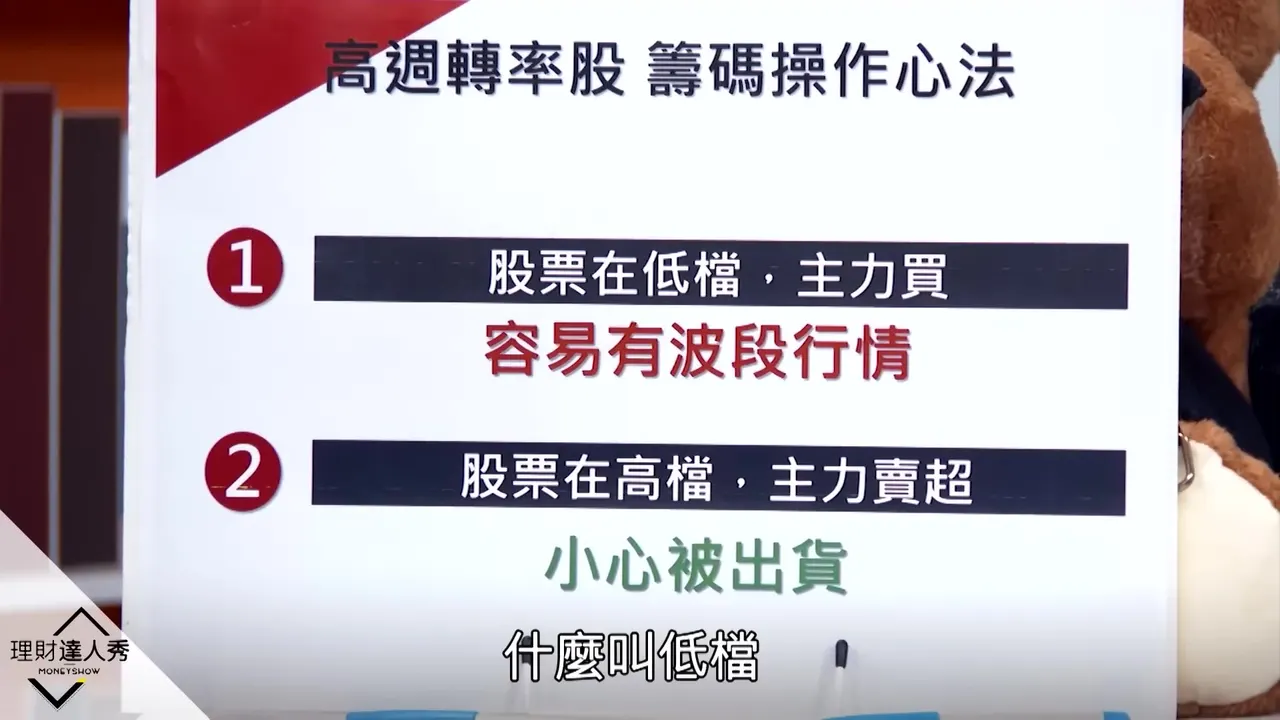
11:00How to Judge a Low Level, Contrasted with a High Level
He explains that a low level can be judged by tangled moving averages, price near the monthly and quarterly moving averages, and Bollinger Bands narrowing and compressing to the extreme; after a volume surge, a breakout move is likely. Sunrise (昇銳) 3128 had a large deviation at a high level with major-player net selling and turnover hit 78%, so watch out for the risk of distribution.
▶ Watch from here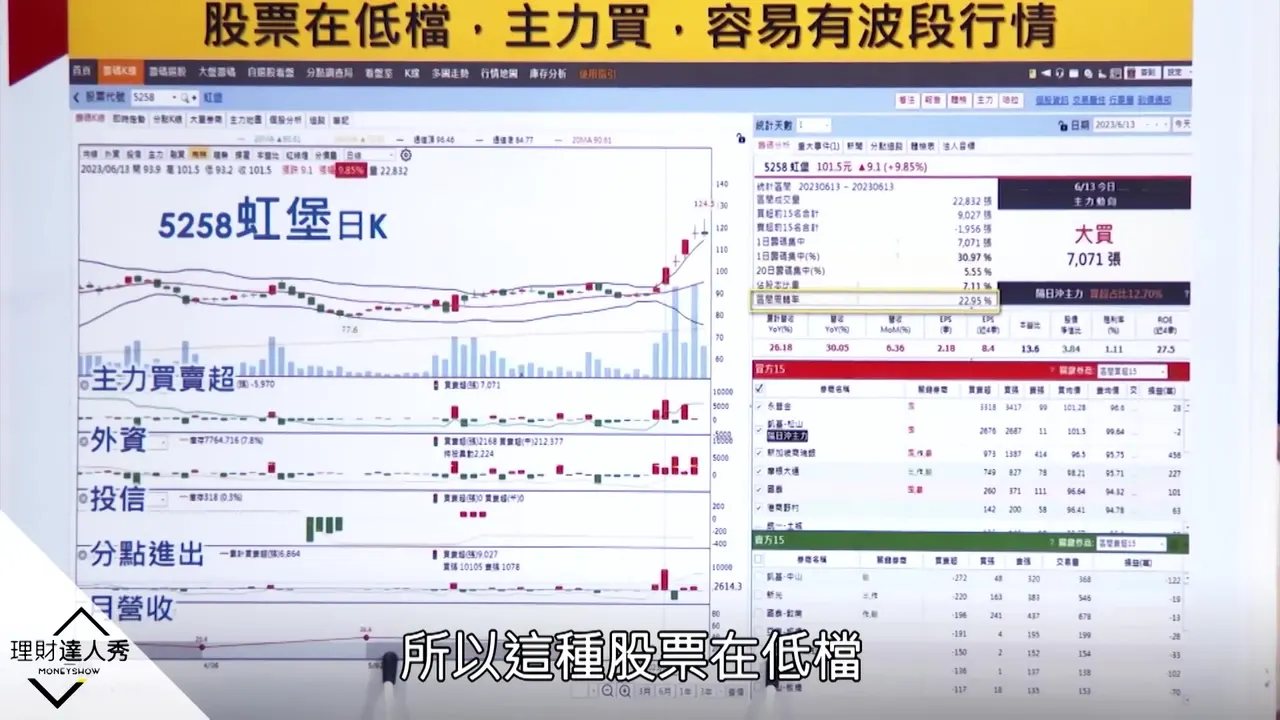
12:01A Volume Surge at a High Level Is a Distribution Warning
Turnover of 78% is extremely rare: if 1 wan (ten thousand) lots are in circulation, 7800 lots are trading; although day traders are mixed in, the speaker judges that the company insiders put out shares to sell, otherwise there would not be that much volume. High turnover at a high level with major-player net selling makes a sharp drop likely afterwards, and this is a case of being unloaded on.
▶ Watch from here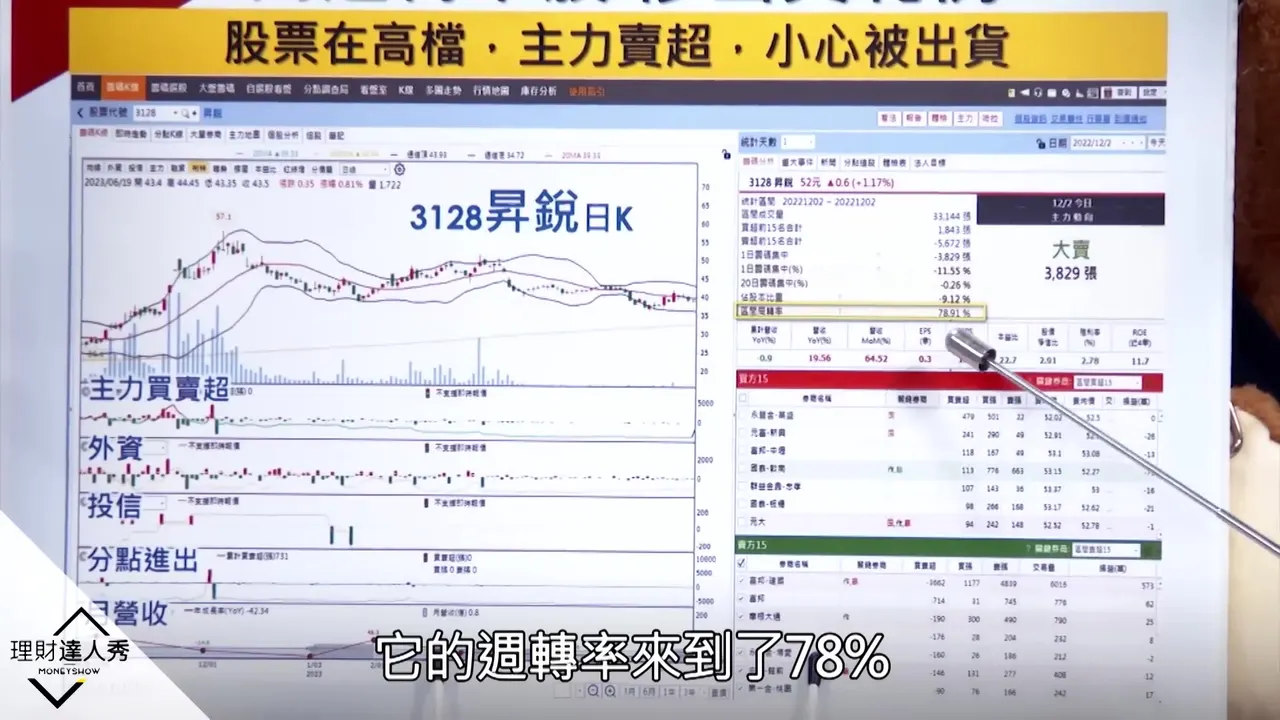
12:56Another High-Level Distribution Case
Another high-level distribution case is Kingbridge (金橋): the price bounced after falling from a higher peak, major players sold continuously through the swing with turnover at 20%, and it easily makes new lows. Even if the broad market rises to 17000, that has nothing to do with Kingbridge, because it already rallied last year and has a very high peak ahead of it; looking at this chart alone you might wrongly think it is about to take off, so look at a longer chart.
▶ Watch from here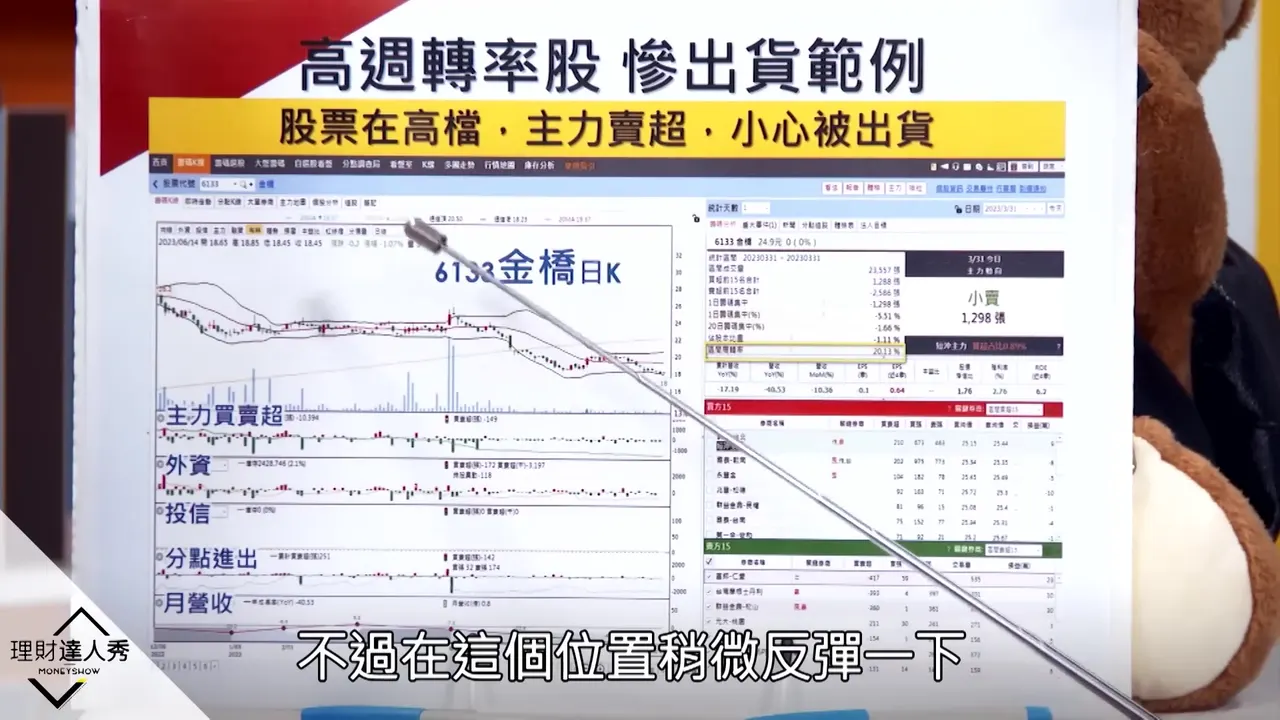
13:21Turnover Depends on Where It Appears
In summary, turnover depends on where it appears: if it shows up in the first stage of a rally, it means a stock that has lain dormant for a long time is starting to attract attention and is more likely to rise; if turnover surges after a big run-up, it may be company insiders and major players unloading, and retail investors should be on guard. He again reminds viewers to look at a longer chart.
▶ Watch from here