Dragon Boat Festival Turning Point Check and Index Futures Hedging: Biotech & Medical and Taiwan Sustainability
TL;DR: The Dragon Boat Festival turning-point statistics mean little; what to watch is how TSMC performs after the holiday and divergences in flows in strong stocks, and shareholders can hedge with the Biotech & Medical and Taiwan Sustainability index futures launching on June 8, turning big swings into small gains or losses.
Key ideas
- The 12-year statistics show only a 50% chance of a turning point and the moves are small, so they have no reference value; TSMC rose to 268 and 346 after the 2018 and 2019 festivals, and the real point is buying the right target and concept, namely the ESG sustainability leader.
- The chip warning sign is a divergence: major players sell, retail buys, then big holders sell again; cleaning-product pandemic-concept stocks rose more than 2x on 30% revenue growth, and Taiwan Dahjiang rose to over 500 before last year's festival and fell to over 100 after it, so stocks that have risen a lot need caution both before and after the holiday.
- To hedge stock holdings, shorting the big index futures has too low a correlation, buying puts costs time value, and fully shorting the stock's own futures defeats the purpose, so use index futures similar to your holdings instead.
- Futures leverage is high: a contract worth about 23 萬 needs only about 21000 in margin, roughly 11x leverage; losses mostly come from picking the wrong direction and holding losers without stop-losses, so set a stop-loss, keep extra margin, and trade few contracts.
- In a calculation with 2 lots of stock worth about 48 萬 and 2 short biotech futures, gains or losses shrink to just 2000 either way; the top 10 Taiwan Sustainability Index components make up 57% and TSMC alone 30%, so it can hedge TSMC or substitute for TSMC if you can't afford it, and hedging makes it harder to be shaken out.
Section summaries
0:20Opening on Futures Hedging
The opening teases the Dragon Boat Festival rumor that the "demons show their true form", which worries people about a turning point, and notes that futures have a hedging function that lets investors make small gains or losses without spending much, setting up the hedging theme of the session.
▶ Watch from here0:45Checking the Dragon Boat Turning-Point Statistics
Looking back at the past 12 years around the Dragon Boat Festival, the chance of a turning point is only 50%, which is effectively no turning point, and the moves are small, so it has little real meaning; the point is to buy the right target and concept. Last year (2019) the market fell before the festival and rose after, then rallied strongly, a good upward turning-point entry; in 2018 it rose before and fell after, only a small range-bound swing, completely different from last year.
▶ Watch from here5:00TSMC Around the 2018 Festival
Taking 2018 as an example, TSMC began rising on the first trading day after the festival and climbed all the way to 268, showing that even though the broader market looked range-bound, TSMC was still a good buy, and a brief wrap-up leads into the discussion of whether the same applies this year.
▶ Watch from here5:25TSMC's 2019 Wave Confirms the Pattern
Taking TSMC in 2019, an even better entry appeared after the festival, launching a big wave that climbed all the way to 346, further reinforcing the argument that TSMC performs after the festival; the speaker concluded with a hint that smart investors should already have grasped the logic of this entry.
▶ Watch from here5:45TSMC After the Festival and Chip Warning Signs
The conclusion is that whether the festival brings a turning point doesn't matter, but TSMC usually performs after the festival and lifts the broader market, mainly because of its ESG and sustainability-leader concept. The speaker also warns about chip flows: for example, 6582 shows the odd pattern of major players selling, retail buying, and big holders selling again, so strong stocks should be watched for a return to their old levels after the festival.
▶ Watch from here7:45Chip Divergence and Retail Buying Risk
If recently strong stocks show a divergence, with major players leaving and the retail holding ratio rising, a turning point may come after the festival and needs special attention. Even the broader market has largely been pushed up by retail buying now, but heavy retail buying in individual stocks still calls for caution; for example, Maobao also shows major players selling and retail buying, with the retail holding ratio rising steadily, big holders' share falling, and the price at a high level.
▶ Watch from here8:15Pandemic-Concept Stocks and the Taiwan Dahjiang Case
Pandemic-concept stocks in cleaning products have seen revenue grow 30% while their prices rose more than 2x, gains beyond fundamentals with chips already loosening, so those that have risen a lot need caution. Taiwan Dahjiang rose to over 500 before last year's festival, then turned and fell all the way to over 100 afterward; this year may not repeat it, but special care is still needed before the festival. However, Dahjiang's cash dividend this year is 8.88 and its fundamentals are supportive, and some want to keep holding for the dividend, which raises the question of how to keep holding while hedging.
▶ Watch from here9:45Introducing the Biotech & Medical Index Futures
There are 3 ways to hedge stock holdings: short the big index futures, but its link to individual stocks is too low; buy puts, which lose time value; or short the stock's own futures, which defeats the purpose if fully shorted. So the speaker introduces the Taiwan Biotech & Medical Index futures listing on June 8: code BTF, 50 per point, daily limit of 10% up or down, cash-settled, index around 4600 points, margin about 21000 per contract, with components including Dahjiang and Grape King, and features of high volatility, high leverage, low trading costs and low correlation with the broader market.
▶ Watch from here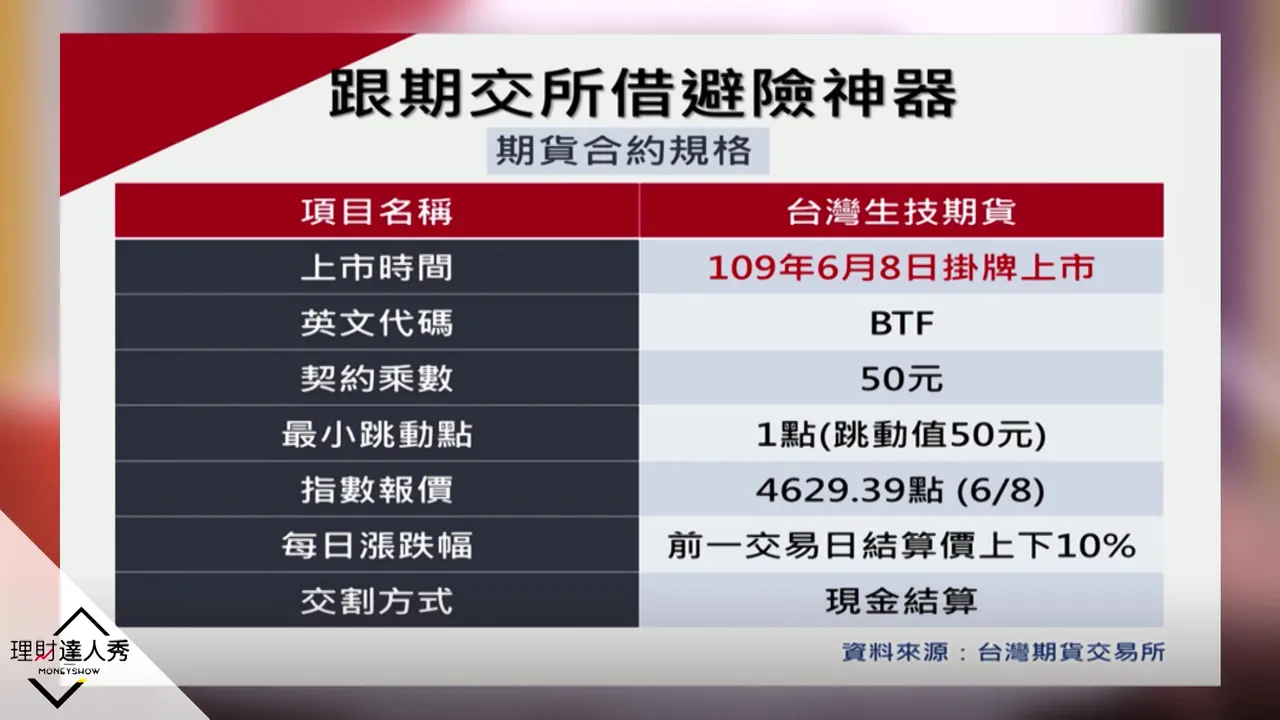
14:35Biotech Futures and the Broader Market
Biotech stocks are mostly volatile high flyers, the biotech index has outperformed the broader market this year, and it has low correlation with the TAIEX; for example, on June 2 the biotech index fell 1.6% while the TAIEX rose 1.26%, and on May 27 the biotech index fell 1.8% while the TAIEX rose 1.1%, moving out of step. You can study chip changes in components such as Dahjiang to judge the long or short direction of biotech futures.
▶ Watch from here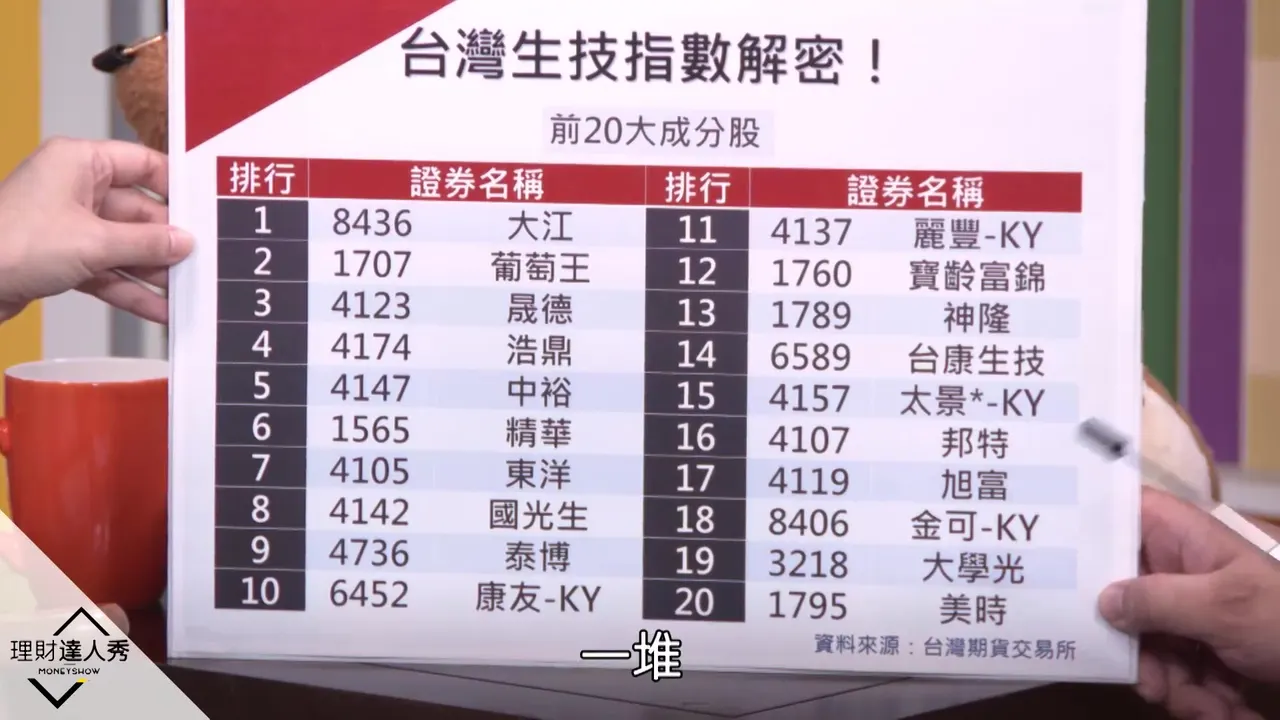
17:05Biotech Futures: Calculations and Placing Orders
Suppose the index rises from around 4600 points that day: a 100-point gain times 50 is 5000 per contract, and shorting a fall of the same size also earns 5000; a contract of about 23 萬 needs only about 21000 in margin, roughly 11x leverage. Picking the wrong direction and holding losers without a stop-loss are the main causes of loss, so the advice is to set a stop-loss when entering (for example 4570), keep extra margin (for example 10 萬), and not trade too many contracts at first. The speaker bought one contract at 4635, the index rose about 50 points, and the contract gained 2500; another speaker thinks biotech stocks still have room this year and takes a bullish view.
▶ Watch from here22:05Semi-Hidden Hedge with Small Futures
Holding one lot of Dahjiang worth about 28.5 萬, shorting one biotech futures contract roughly offsets a similar range of movement. With 1 lot each of Dahjiang at 285 and Grape King at 195, worth about 48 萬 in total, shorting 2 futures contracts is equivalent to about 46 萬. In the calculation, the stocks together gain 10 for a profit of 1 萬, while an 80-point index rise costs the futures 8000, leaving a profit of only 2000, a semi-hidden hedge that lowers volatility.
▶ Watch from here24:35Hedging Mindset and the Sustainability Index
In the opposite scenario, the stocks fall 10 for a loss of 1 萬 while the futures earn 8000, so the loss is only 2000, letting you make small gains or losses, feel fine at work, and keep collecting dividends. The speaker then introduces the Taiwan Sustainability Index (ESG concept): its components are mostly blue chips that balance social responsibility and corporate governance, and its long-term performance beats the broader market; its largest component is TSMC.
▶ Watch from here29:05Sustainability Index Components and Futures Specs
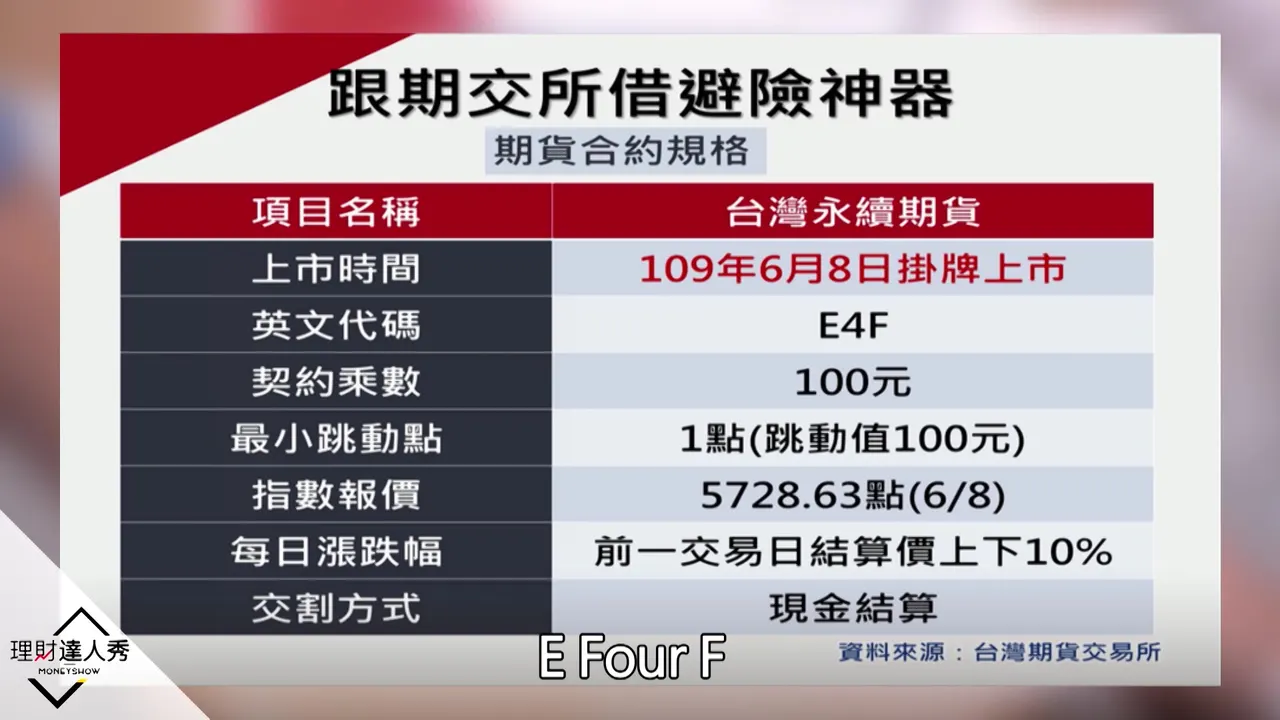
The top 10 components of the Taiwan Sustainability Index are TSMC, Foxconn, Chunghwa Telecom, Cathay Financial, Nan Ya, Fubon Financial, MediaTek, CTBC Financial, Uni-President and China Steel; these 10 stocks account for as much as 57% of the index weight, and TSMC alone accounts for 30%, so the index is closely tied to TSMC. The futures code is E4F, at 100 per point (higher than the 50 of the biotech futures), listing on June 8. This year's volatility is 30.86, nearly double the average of 15.96 from June 2015 to April this year, and its correlation coefficient with the broader market is 0.995, with almost identical curve shapes.
▶ Watch from here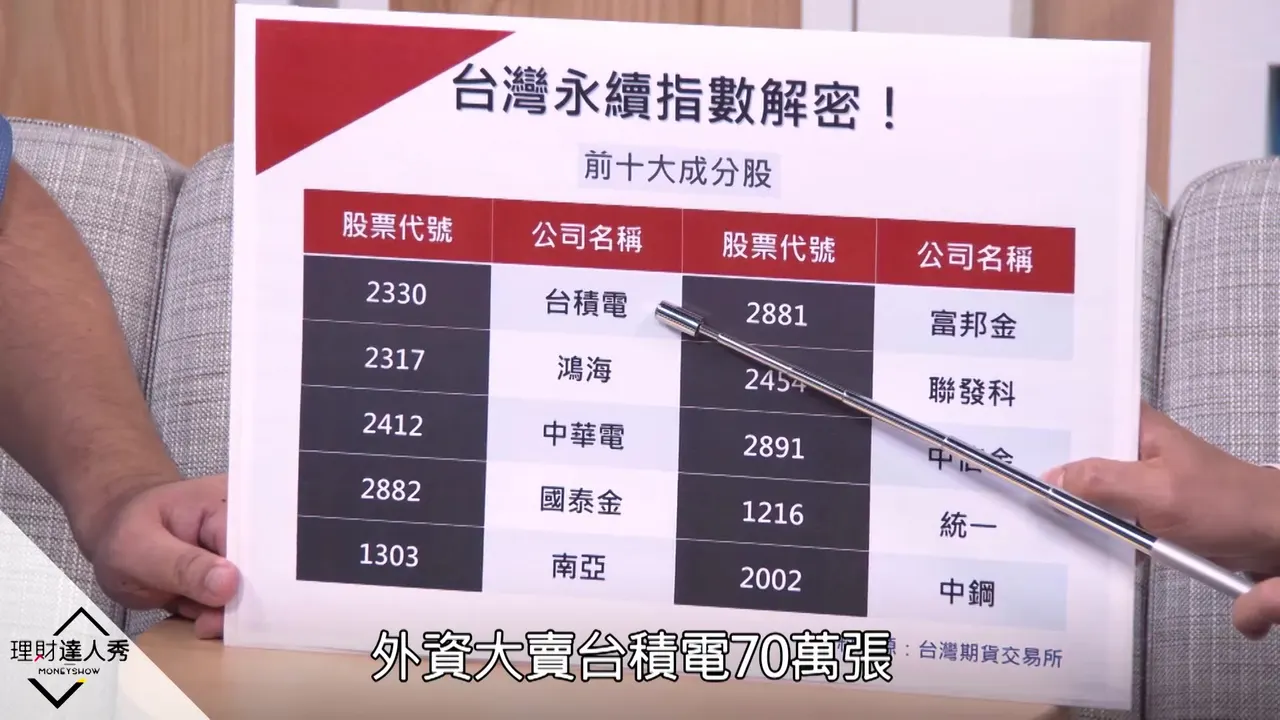
33:17Wrap-Up on the New Futures and Hedging
To sum up the two new futures listing on June 8: the Taiwan Sustainability Index futures can be paired with TSMC shares to hedge, for example holding 1000 lots of TSMC and shorting 100 contracts when worried about a US stock crash, and can also serve as a substitute when you can't afford TSMC; the Biotech & Medical Index futures contain more than 20 components, and you can watch the bellwether Dahjiang. Finally, the speaker reminds viewers that hedging is something big holders and institutions do, and retail investors who learn to hedge are moving toward the path of big holders.
▶ Watch from here