Betting on Volatility with Small Money in Warrants: Earnings-Call Timing and a Five-Phrase Checklist for Picking Warrants
TL;DR: Small-money warrant traders should target stocks likely to swing hard around earnings calls and pick warrants with a five-phrase checklist: big-swinging underlying, small and stable implied volatility, tight bid-ask spread, ample bid size, high leverage. Gains and losses are asymmetric in the buyer's favor, but warrants with too little leverage or too-high implied volatility only lose money.
Key ideas
- For earnings calls, what matters is the next day, not the day itself: the histories of Faraday (3035), AUO and Macronix show dramatic moves the next day. Buy calls if bullish, puts if bearish, or buy both to bet on limit-up or limit-down if unsure, but if the stock ends flat the next day, both sides lose.
- Warrant gains and losses are asymmetric, which favors the buyer: with 10x leverage, a limit-up in the underlying earns 0.7 while a limit-down loses only about 0.34, unlike stocks where a 10% limit-up and limit-down exactly offset. This requires picking the right warrant, and when buying both calls and puts the amounts invested must be equal.
- There are 3 good times to enter: around earnings calls when the underlying starts to move, bottomed-out stocks in a bear year after a high-volume selloff (rebound trades must be quick in and out), and ex-dividend season in a bull year. In bear years, stocks often trade at a discount to the dividend and fall after ex-dividend, so ex-dividend plays are unsuitable.
- The five-phrase checklist: the underlying should swing big, the warrant's implied volatility should be small and stable, the bid-ask spread small, bid size sufficient, and leverage as high as possible. The lower the spread-to-leverage ratio (spread ratio divided by leverage) the better, and 0.3% or below is decent; for example, a 1% spread ratio with 5x leverage gives 0.2%.
- Avoid bad warrants: calls with effective leverage below 2, and puts with tiny absolute leverage (nano-level warrants). They usually have excessive implied volatility and wide quotes, so the warrant barely moves when the underlying does. Warrants carry time value, so use them to win big with small money, never bet your net worth, and never leave them unattended.
Section summaries
1:35Warrants suit small investors and earnings-call trades
Warrants suit small investors, and volatility is greatest in the earnings-call seasons of January, April, July and October. Earnings calls often coincide with quarterly reports and discuss the next quarter's outlook; if the outlook is poor, foreign investors sell hard the next day, so the day after an earnings call often sees dramatic moves. You can buy calls if bullish, puts if bearish, or buy both to bet on limit-up or limit-down, but if the stock is flat the next day, both sides lose.
▶ Watch from here5:30Faraday's earnings-call history
Take Faraday (3035) as an example: the chance of a rise the day after an earnings call is only 34%, showing that its calls often release more bad news. Looking back: in July it fell 8% the next day, in April good remarks lifted it 4.1%, and last October it hit limit-up two days in a row. This underlines that the asymmetric payoff of betting on limit-up or limit-down with warrants is better suited than buying the stock.
▶ Watch from here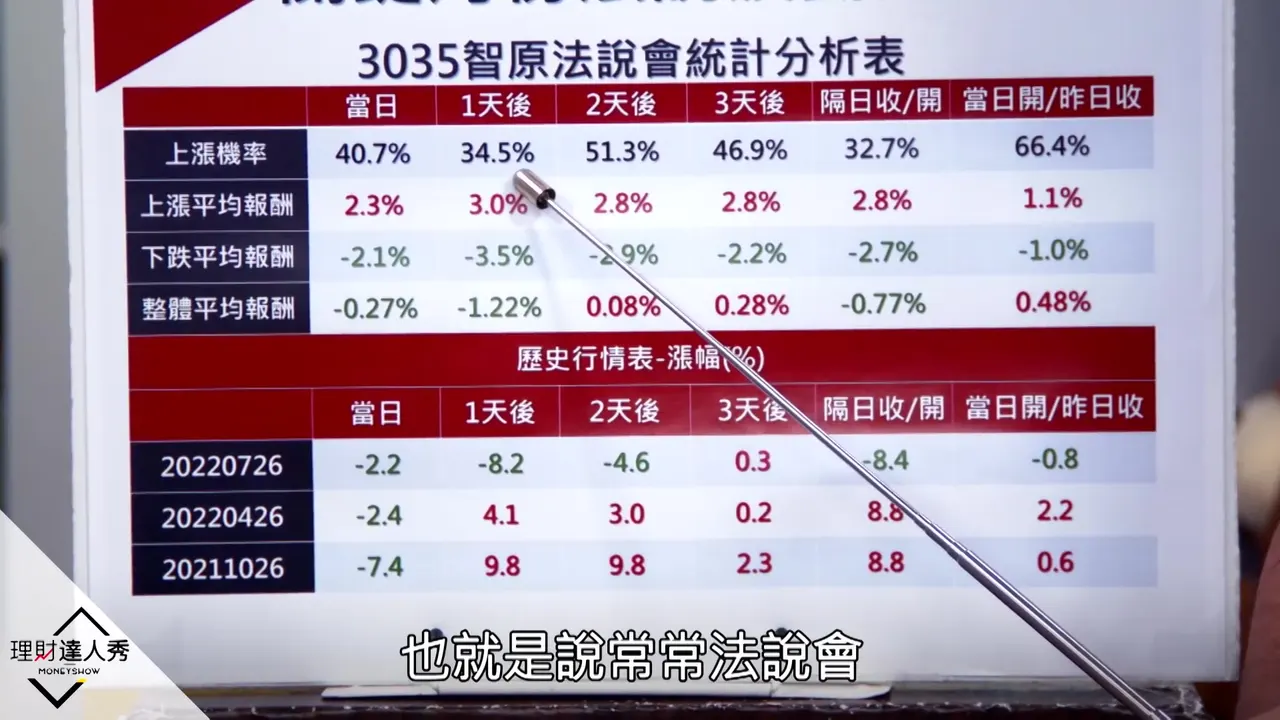
7:20AUO's earnings-call volatility
The chance that AUO rises the day after an earnings call is slightly higher than Faraday's, with an average gain of 2.1% on up days and an average drop of 2.8% on down days, so volatility is somewhat larger. Last April it hit limit-down the day after the call and fell another 8.2% the day after that, right at a panel-industry peak, for a combined drop of more than 10% over 2 days; taking part with put warrants could have earned big.
▶ Watch from here8:30Macronix's earnings calls and disappointment selling
Macronix (2337) mostly sounds optimistic at its earnings calls; the chance of a rise the next day is 40%, with an average gain of 2.4% and an average drop of 3.3%, so volatility is large. This July it rose 4% the next day and in January 6%. The speaker reminds us that the memory cycle is weak, and if a company that has always been optimistic says something bad, disappointment selling will be even scarier.
▶ Watch from here9:40Three times to enter warrants
Three good times to enter warrants: first, when the underlying starts to move, especially around earnings calls, when volatility is large and information is more public; second, bottomed-out stocks in a bear year, where after a high-volume selloff a rebound trade must be quick in and out; third, ex-dividend season, but only in bull years, because in bear years stocks often trade at a discount to the dividend and fall after ex-dividend.
▶ Watch from here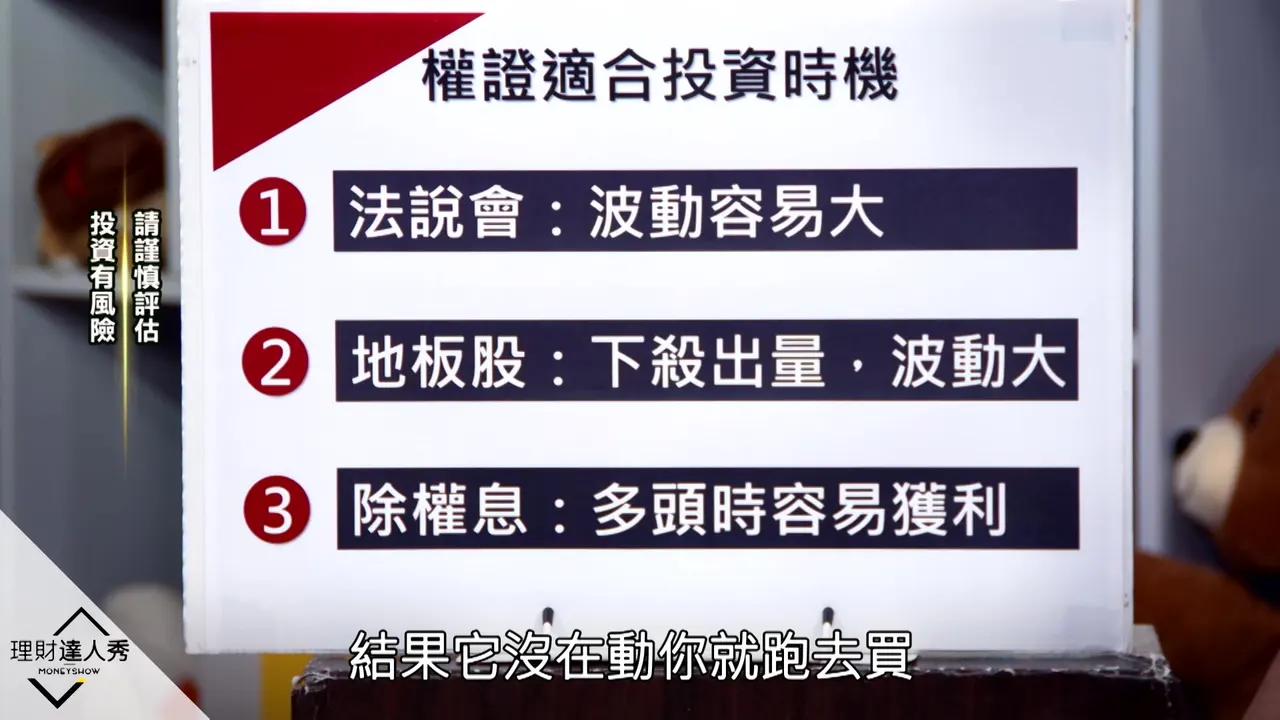
10:50Preview of the five-phrase checklist
The speaker previews that picking warrants takes five phrases. Unlike convertible bonds, which can be condensed into a single word, warrants cannot be condensed and need five words to remember, setting up the selection principles that follow.
▶ Watch from here10:55The five phrases: volatility, spread, size and leverage
The checklist explained: the underlying must swing big, and low-volatility stocks such as Chunghwa Telecom and China Steel are unsuitable; the warrant's implied volatility should be small and stable; the bid-ask spread should be small, and when too many are bought, the market maker widens the spread; bid size should be ample, and a small ask size is in fact a sign of a good warrant; leverage should be high, because warrants are about winning big with small money.
▶ Watch from here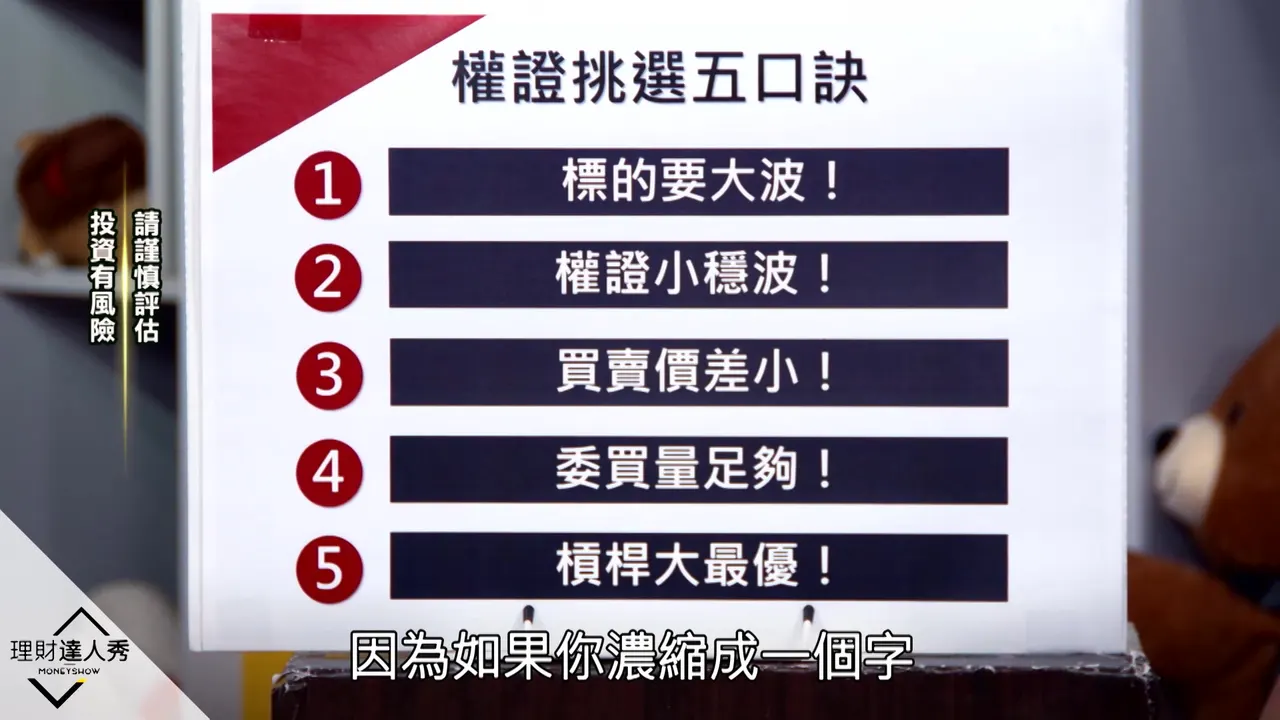
14:45Spread ratio and spread-to-leverage ratio
The spread ratio concept: the buy price is low and the sell price high, so every round trip incurs a spread loss; diamonds, for example, can have a spread ratio of 50%-70%, which makes them hard to cash out. A 1% spread ratio is acceptable, and with 5x leverage the spread-to-leverage ratio is 0.2%; the smaller this ratio the better, and 0.3% or below is a decent warrant, meaning the warrant starts to profit once the stock rises just 0.2%.
▶ Watch from here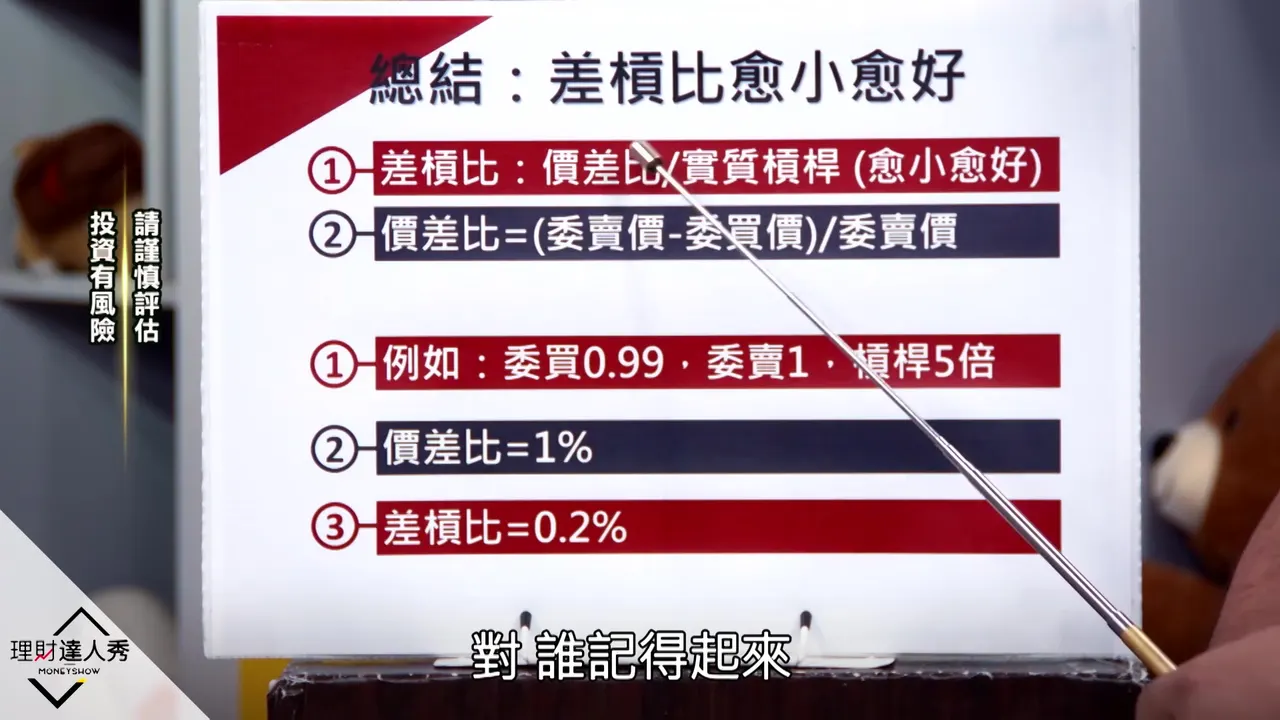
17:15Good-natured warrants versus predatory warrants
When volatility is high, predatory warrants multiply; any warrant with a wide spread is a rip-off. A good-natured warrant has low, stable implied volatility (small and stable swings), high leverage and a small spread ratio, while a predatory warrant has high, unstable implied volatility (high and erratic swings), low leverage and a large spread ratio. The speaker then picks a Macronix warrant as an example.
▶ Watch from here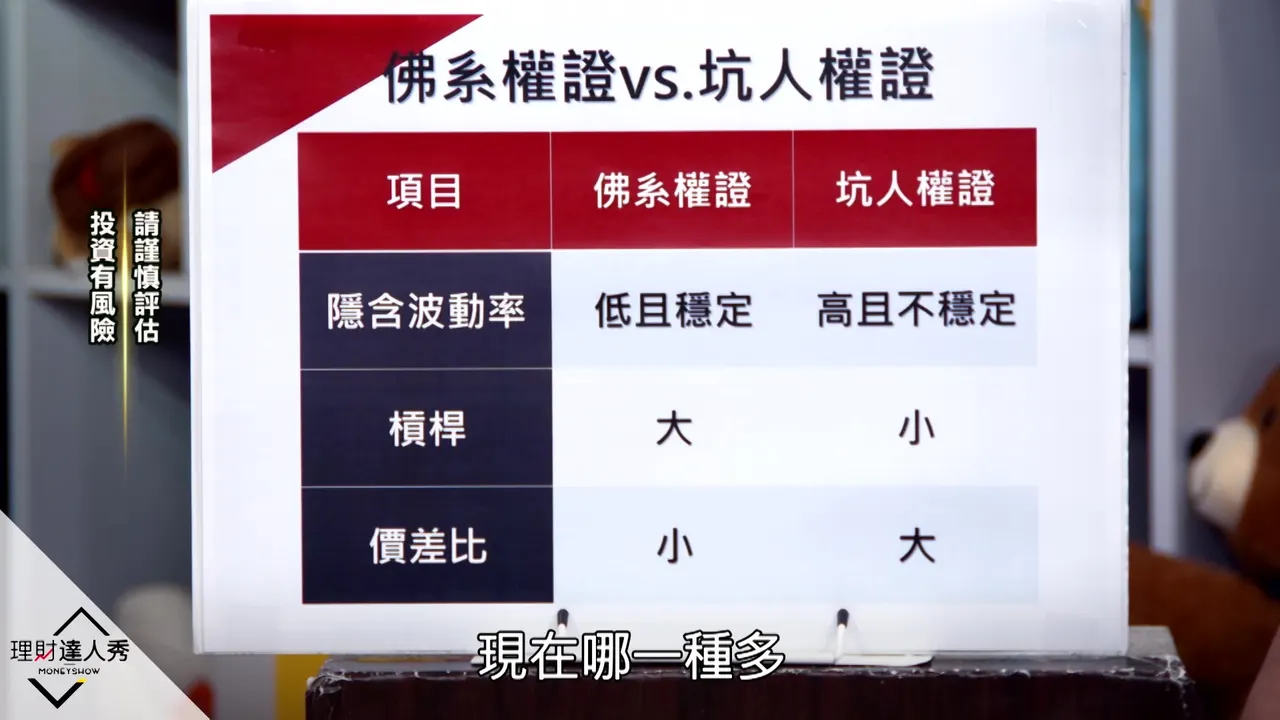
18:15A quality warrant example and selection indicators
Using a Macronix warrant issued by Yuanta as the example, the speaker thinks its market-making bid implied volatility is relatively stable, and it dares to display implied volatility openly; with its large issuance size and high revenue, its products are issued relatively rigorously. The indicators: effective leverage of 10x is very good; the bid-ask spread is only 0.01 to 0.1, so quotes are very tight. For a popular warrant with only 10 lots on the ask, you can wait a few seconds or minutes for the issuer to replenish and then keep buying, accumulating slowly in batches.
▶ Watch from here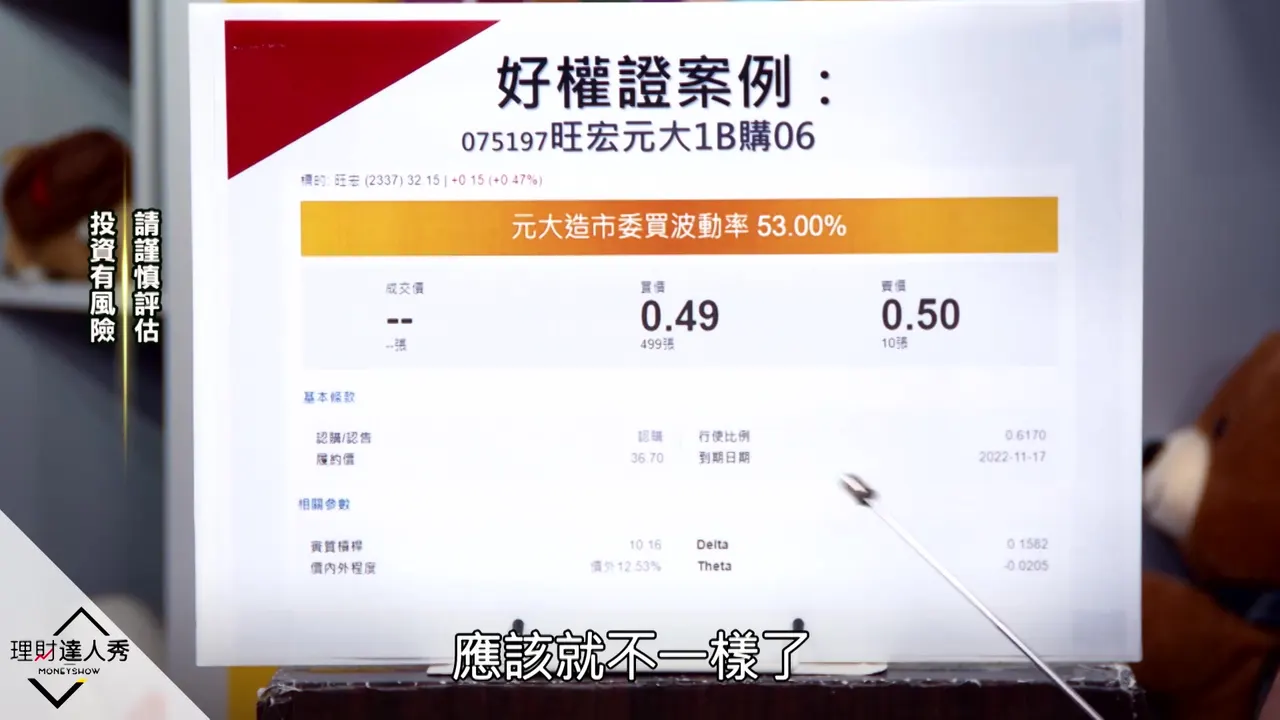
20:55The asymmetric edge of betting on earnings calls
Take a warrant with effective leverage of 10x and implied volatility of 53%: when implied volatility falls, the warrant price falls too, so it needs to be stable. When the underlying hits limit-up, the warrant goes from 0.49 to 1.19, a gain of 0.7; at limit-down it is still worth 0.15, a loss of about 0.34, so the asymmetry favors the buyer. To bet on an earnings-call move you can buy both calls and puts with equal amounts invested, but pick 10x leverage, not warrants with too little leverage that don't move.
▶ Watch from here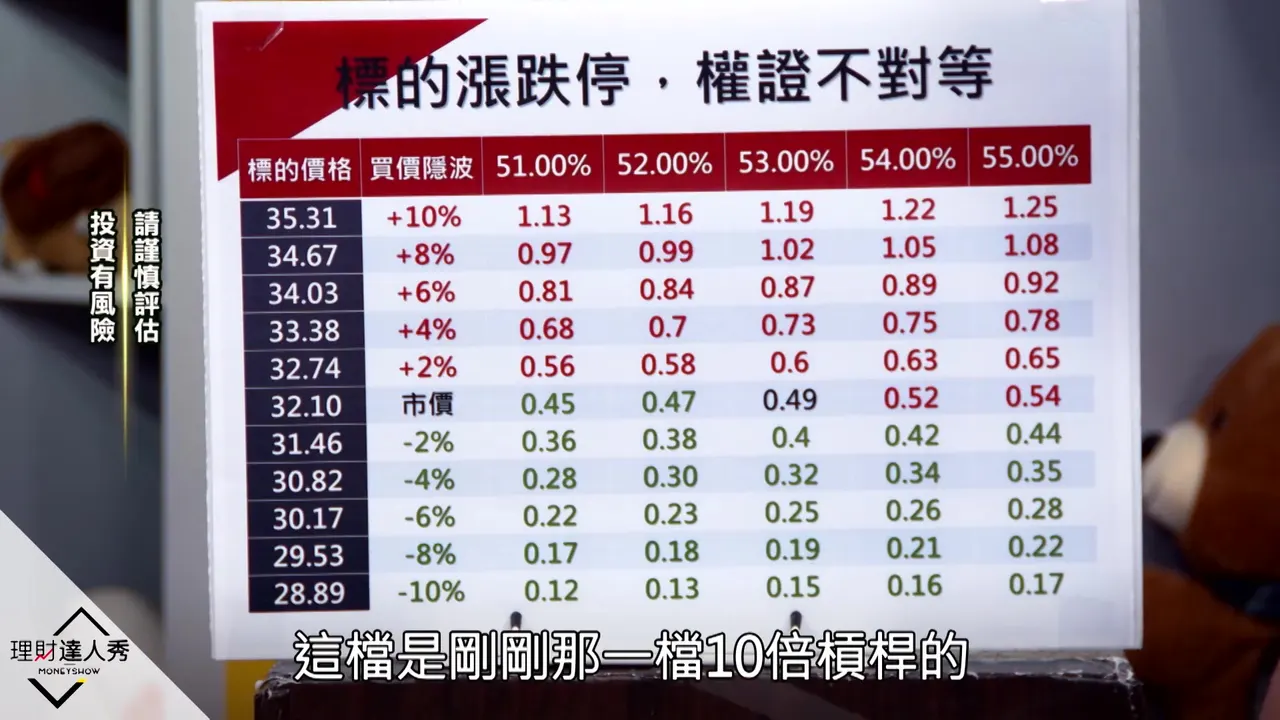
23:45Avoiding bad calls with too little leverage
A warning to avoid bad warrants: calls with leverage below 2 are worse than the stock itself, with small moves, fast time-value decay and high interest costs; do not touch these few with effective leverage below 2.
▶ Watch from here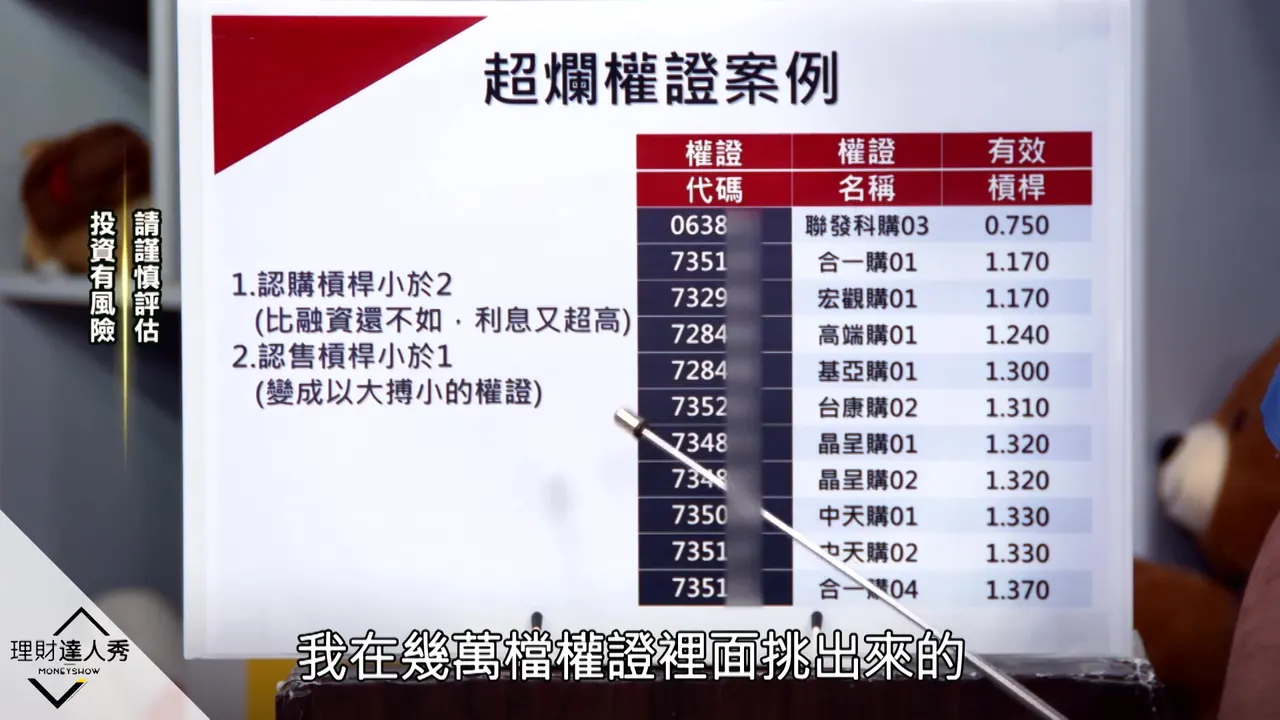
25:00Put leverage and the nano-warrant trap
For puts, the larger the absolute value of leverage the better; leverage of negative 0.2 means that for every 1 wan (ten thousand) spent, the issuer only takes 2 thousand worth of hedging while still charging time value, so you might as well short the stock yourself; such nano-level warrants also have wide bid-ask spreads, a fatal flaw.
▶ Watch from here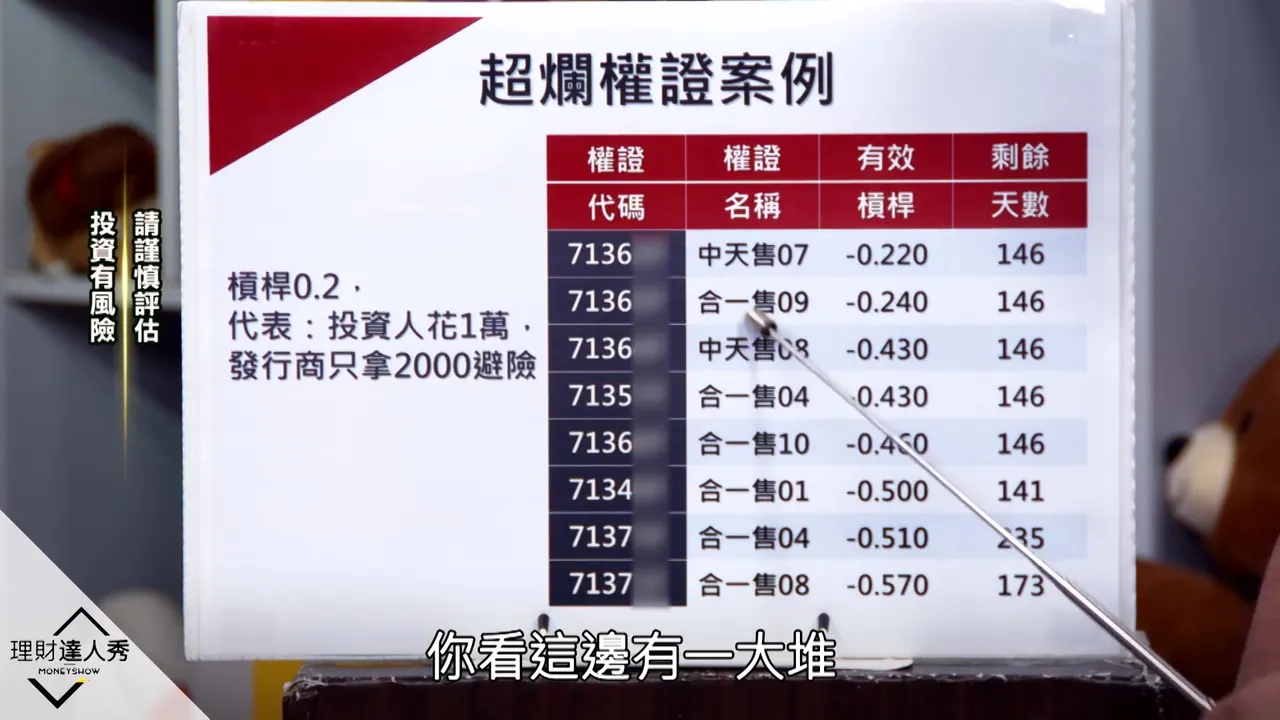
26:44Personal experience: asking issuers to adjust quotes
The speaker shares a personal experience: he once phoned an issuer and asked it to loosen the quotes on warrants with too little leverage, so investors would not buy them by mistake. The issuer agreed to widen the quotes; the main cause of too little leverage is excessive implied volatility, so after buying, investors see the warrant not move even when the underlying drops 2% to 4%, and they simply cannot make money.
▶ Watch from here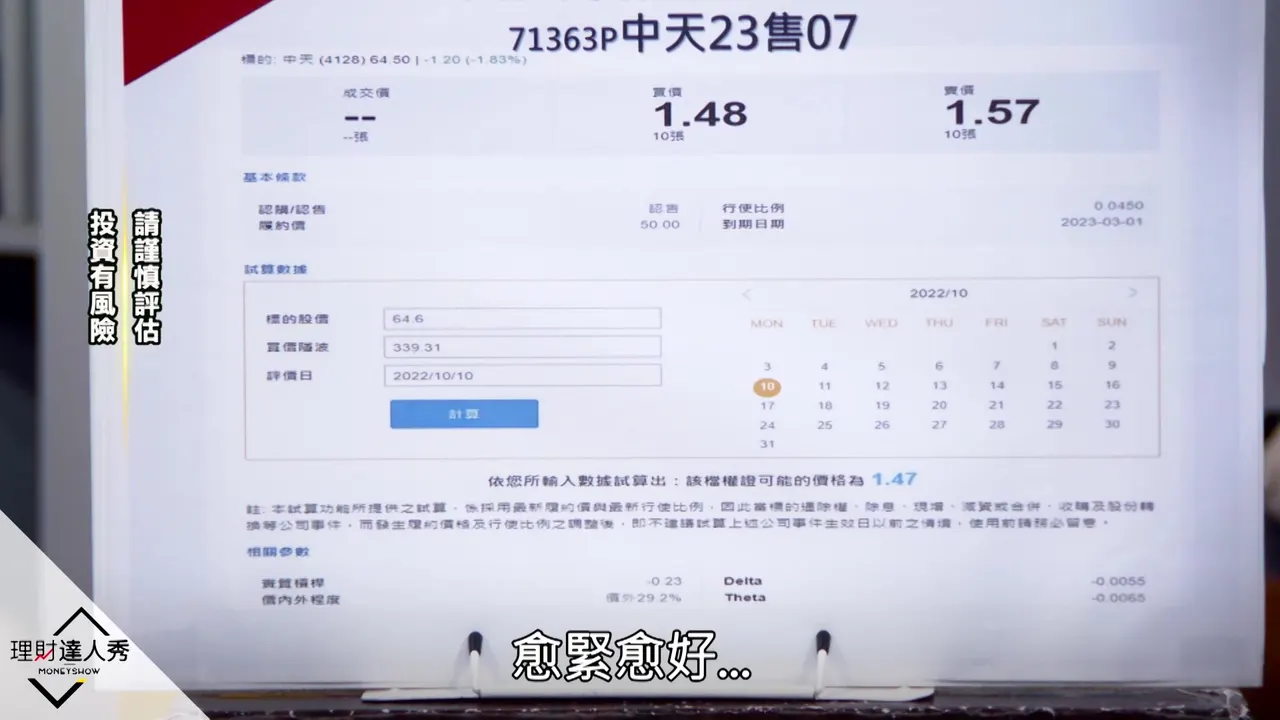
27:55Checklist recap and risk reminder
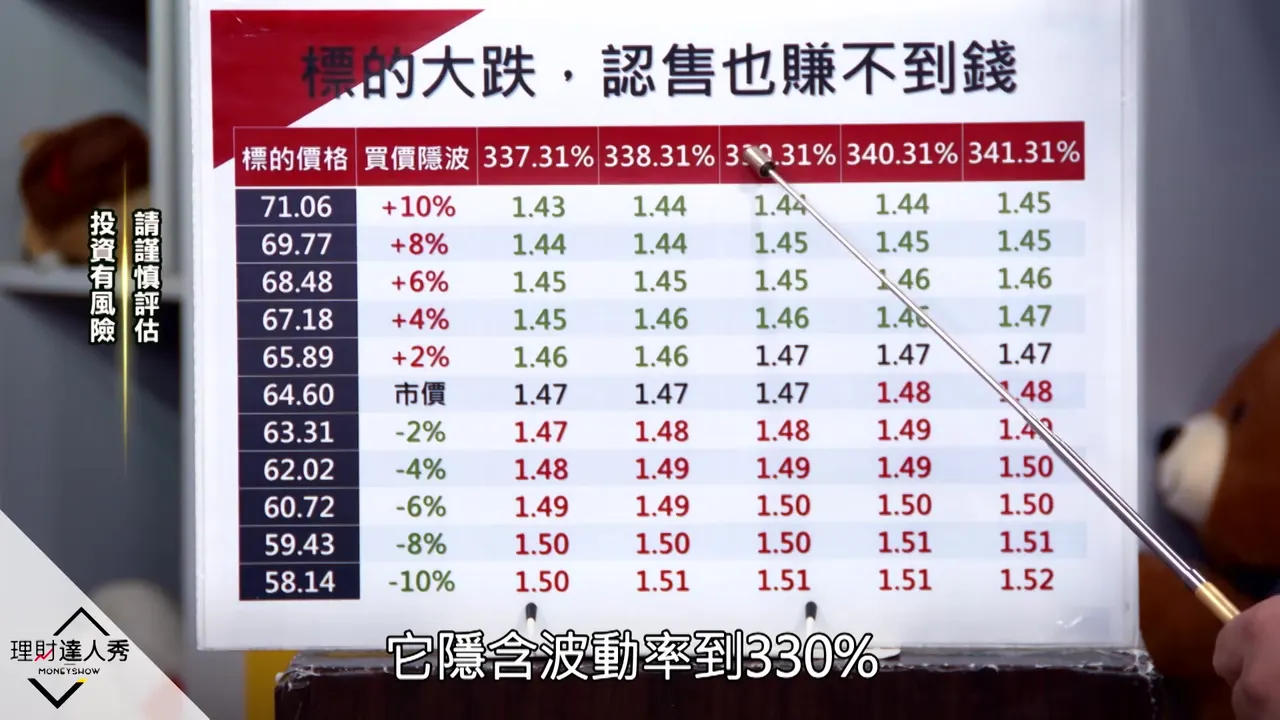
Recap of the checklist: the underlying should swing big, implied volatility should be small and stable, and leverage should exceed 5x, ideally 10x. The counterexample is a put warrant with implied volatility as high as 330, bought at 1.47, which only reached 1.51 at the underlying's limit-down, a gain of less than 3%; a typical 5x-leverage put earns at least 50% at limit-down, so this kind of warrant is worse than shorting the stock directly. Warrants are about winning big with small money, so do not bet your net worth, and since they carry time value, leaving them unattended can lose everything down to zero.
▶ Watch from here