Stock Rotation After Taiwan's Market High: AUO Volume Surge, ABF Names and Profit-Taking Rules
TL;DR: The broad market has not truly broken its prior high and the OTC market has not returned to its previous peak, so the speaker argues for locking in gains once a stock is up 20-something % and switching into fundamentally strong, low-base stocks, rather than holding out for a single stock to gain 50%.
Key ideas
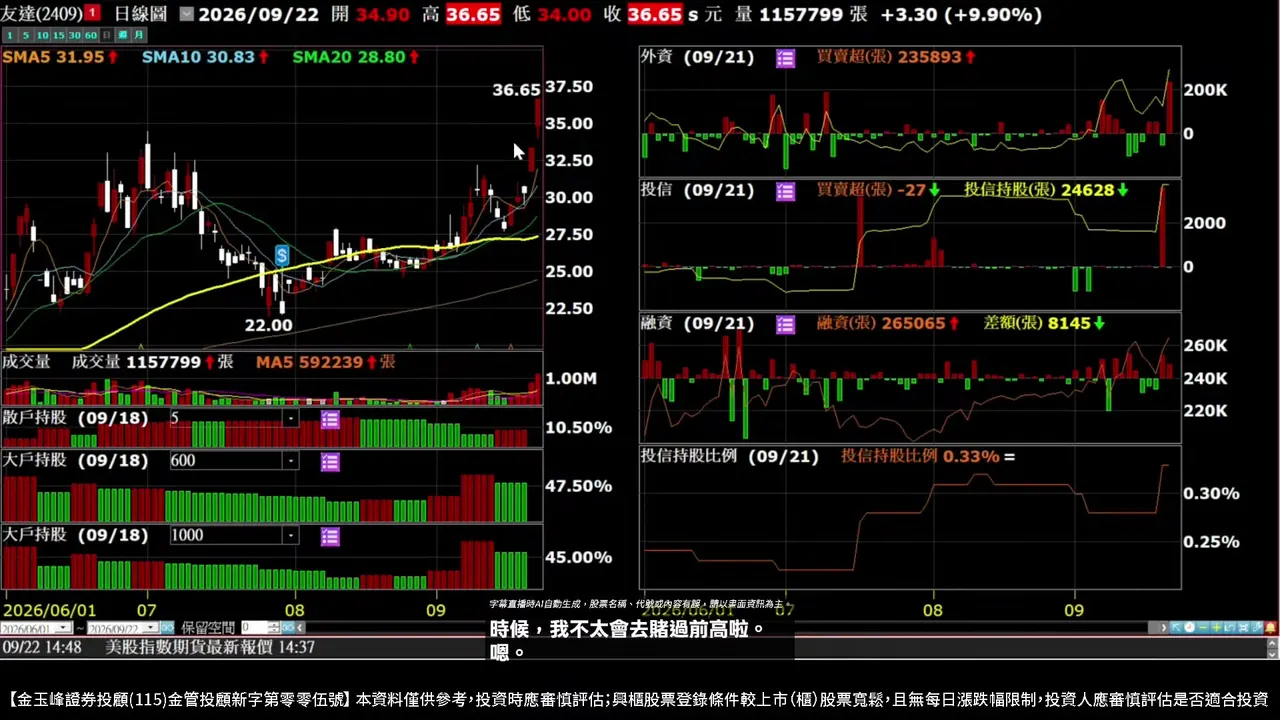
- AUO's trading volume broke 100 wan (a million) lots for the first time, locking it up would take NT$400 yi (a yi is a hundred million), and foreign investors are buying again; the speaker puts his profit-taking defense at the bottom of the red candlestick, around 34, and if volume is not big enough he won't bet on a break of the prior high and will sell as soon as bullish news appears.
- With the whole ABF group surging, the speaker thinks Unimicron is not seriously affected by the Japanese-supplier-related event, and that Zhen Ding being sold by investment trusts is just chip consolidation while big players keep buying back; he says that as long as Taiwan market volume stays elevated after expanding, Zhen Ding will definitely rise.
- Profit-taking and switching stocks require discipline: exit a single stock once it is up 20-something %, and it is fine if it keeps rising afterward, because low-base stocks you switch into often earn it back quickly (the speaker earned it back the next day); eMemory was sold only after it passed 3000, again following what he said beforehand.
- Stocks with grinding price action need a time stop: if a stock climbs along the 5-day and 10-day moving averages but never produces a long red candlestick, leave if it hasn't pulled back within 2 days; be alert when the deviation widens and the price keeps refusing to return to the moving average, because when prices rise a lot some people want to sell and when they fall a lot some want to buy, so they eventually revert to the average.
- The New Taiwan dollar returning to an appreciation trend means foreign buying is back; foreign investors find it easier to buy heavyweight stocks, so the weighted index will break its high first, but retail investors only make money once the OTC market gets back near its prior high; so waiting to buy Innolux is fine, while chasing MediaTek or UMC is conservative because their target prices have mostly been reached.
Ask AI about this episode
Copy the prompt, paste it into an AI service, and add the question. The AI reads the notes on this site and links to the page and the video timestamps.
Or open directly:ChatGPTClaudeGrokPerplexity
Section summaries
0:55AUO's Volume Surge and Profit-Taking Strategy
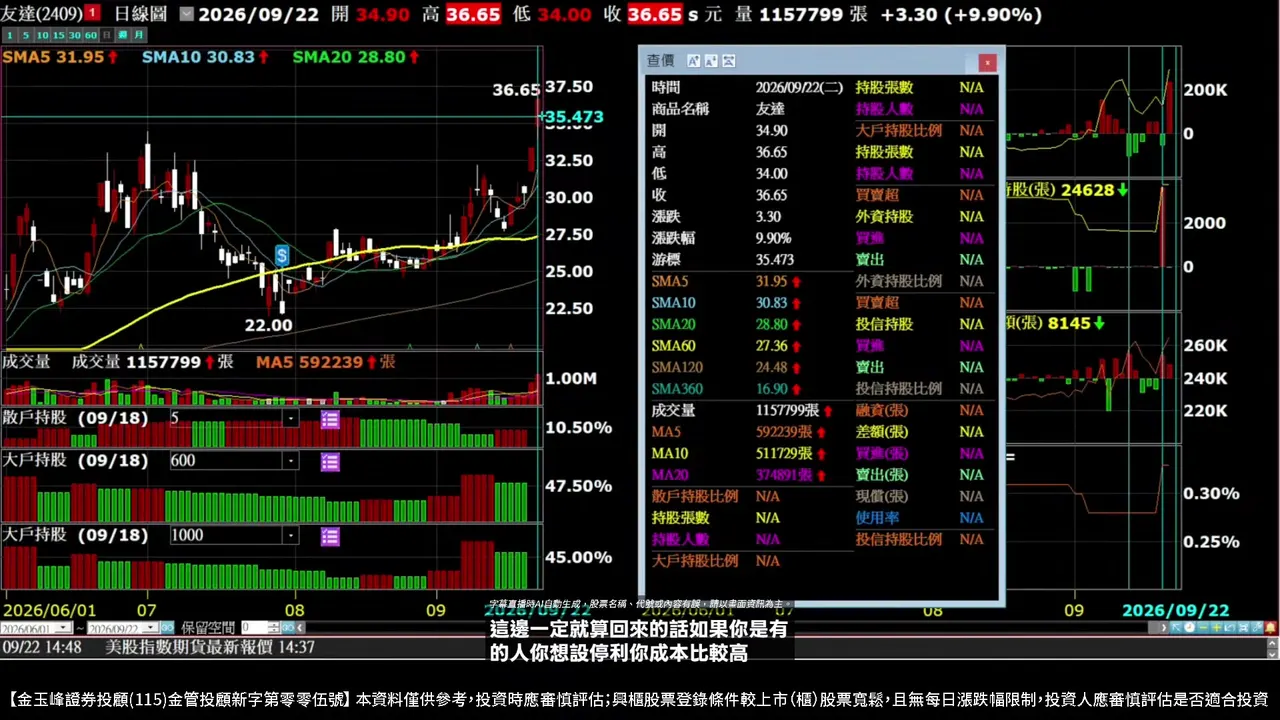
AUO's trading volume broke 100 wan (a million) lots for the first time today. The speaker judges that with volume piling on volume there are still higher highs ahead, and estimates that locking up AUO would take NT$400 yi (a yi is a hundred million). Strategically, when volume is not very large he won't bet on a break of the prior high and will run as soon as bullish news appears, then see about further opportunities later. For those already holding at a higher cost, the profit-taking defense can be set at the bottom of the red candlestick, around 34, and it should not be broken; entering makes sense only if it holds at 34 and turns back up.
▶ Watch from here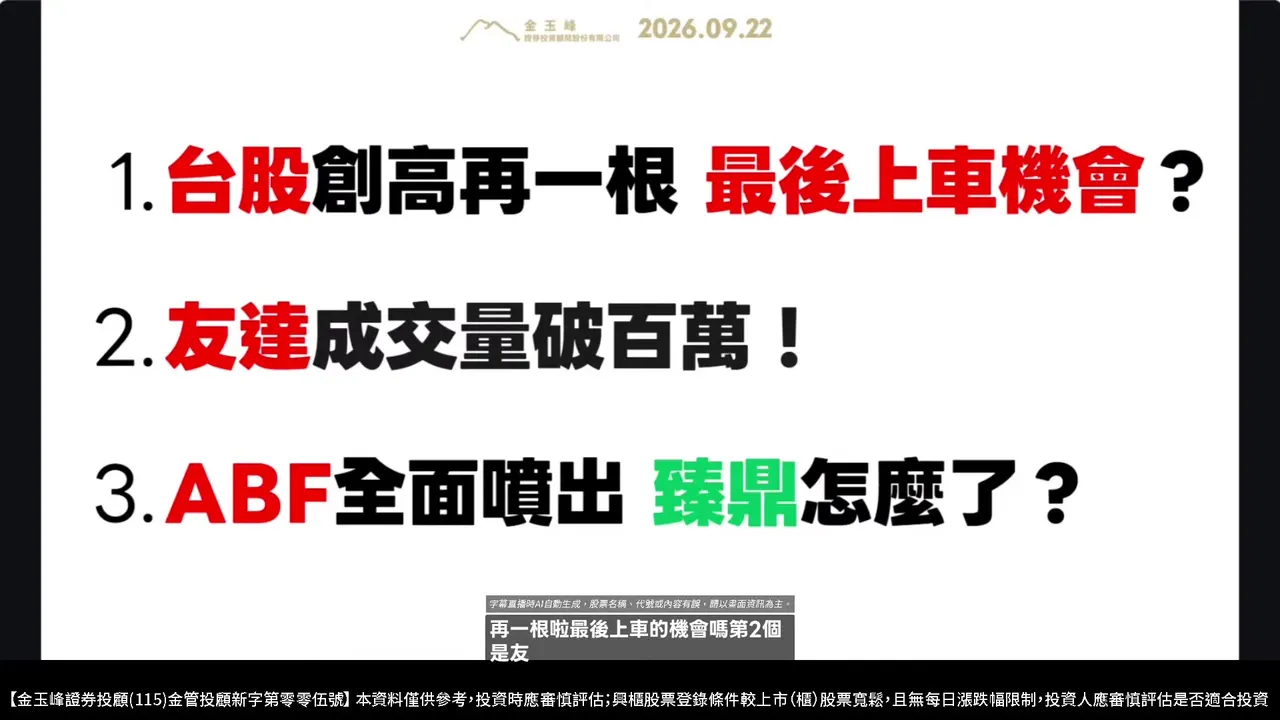
4:20The Three ABF Players: Unimicron and Zhen Ding
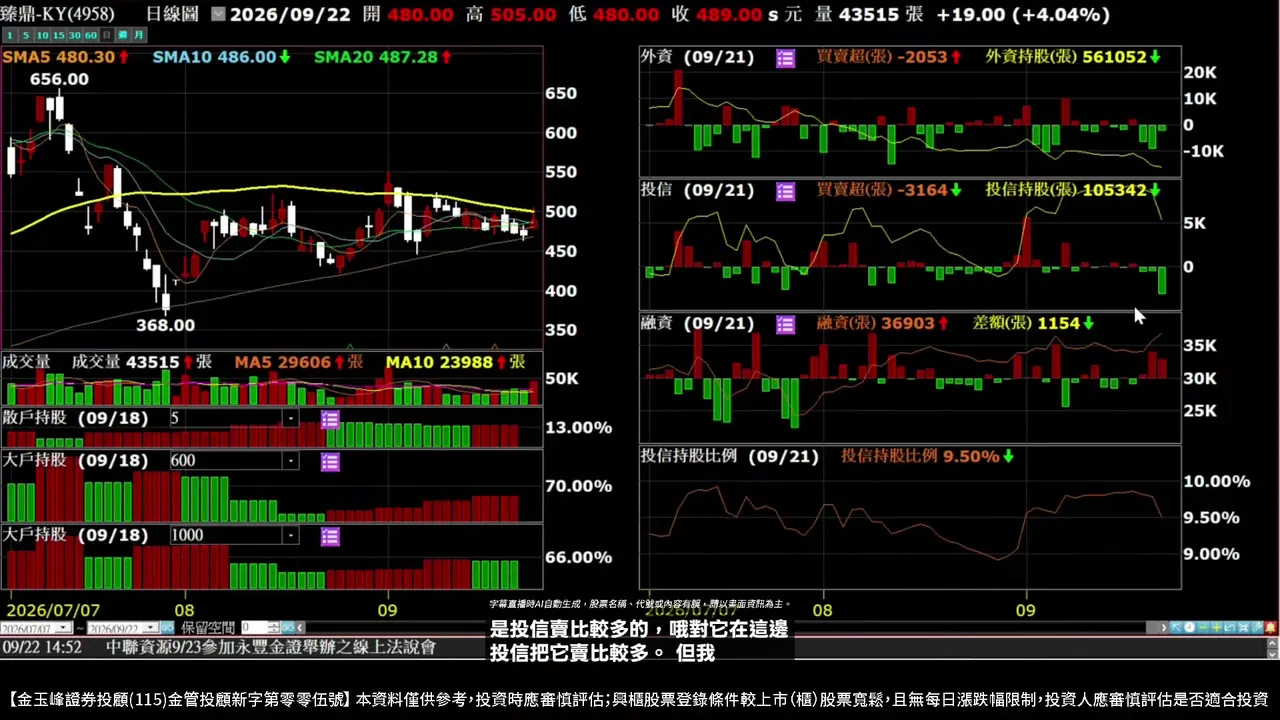
Responding to the whole ABF group surging: Unimicron was affected by the Japanese-supplier-related event, but investment trusts did not sell much, and from what is known so far the level involved goes no higher than below vice president; the speaker thinks fundamentals matter too much for this to be serious. At Zhen Ding, investment trusts actually sold more over the past 2 days, but the speaker says even if it is the weakest performer in the ABF group, its quality still beats most stocks; it is just chip consolidation now, with big players continuing to buy it back. As long as Taiwan market volume stays elevated after expanding, Zhen Ding will definitely rise.
▶ Watch from here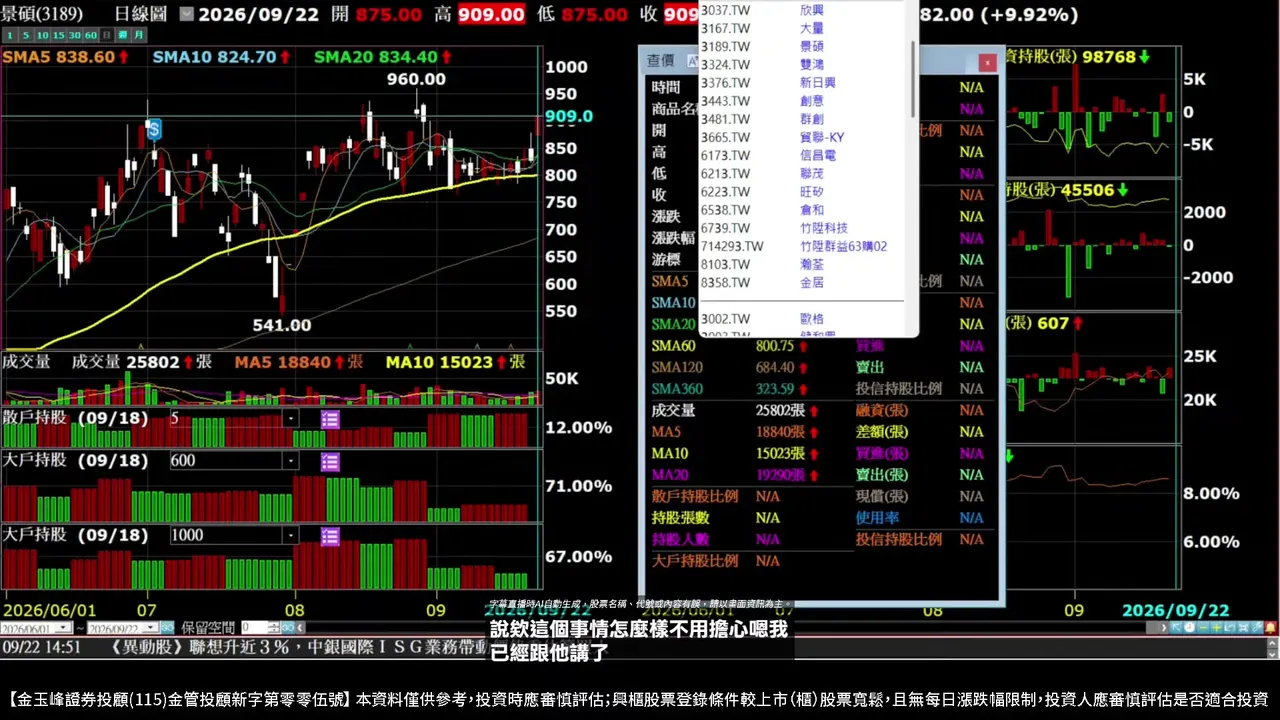
8:45Intraday Volume and International Markets
The speaker's pre-market condition was this: if the broad market opens high, estimated intraday volume must be at least 1.2 trillion, and then he watches Japan and Korea, the NT dollar and the Nasdaq. During the session, volume in Korea and Taiwan began to shrink, so he did not dare set sell orders too high at the open, since a challenge to the prior high might fail. His recent strategy is to exit a single stock once its gain is 20-something %; today he sold one at about 30%. For Hong Zhi, members who entered should already have about 28%.
▶ Watch from here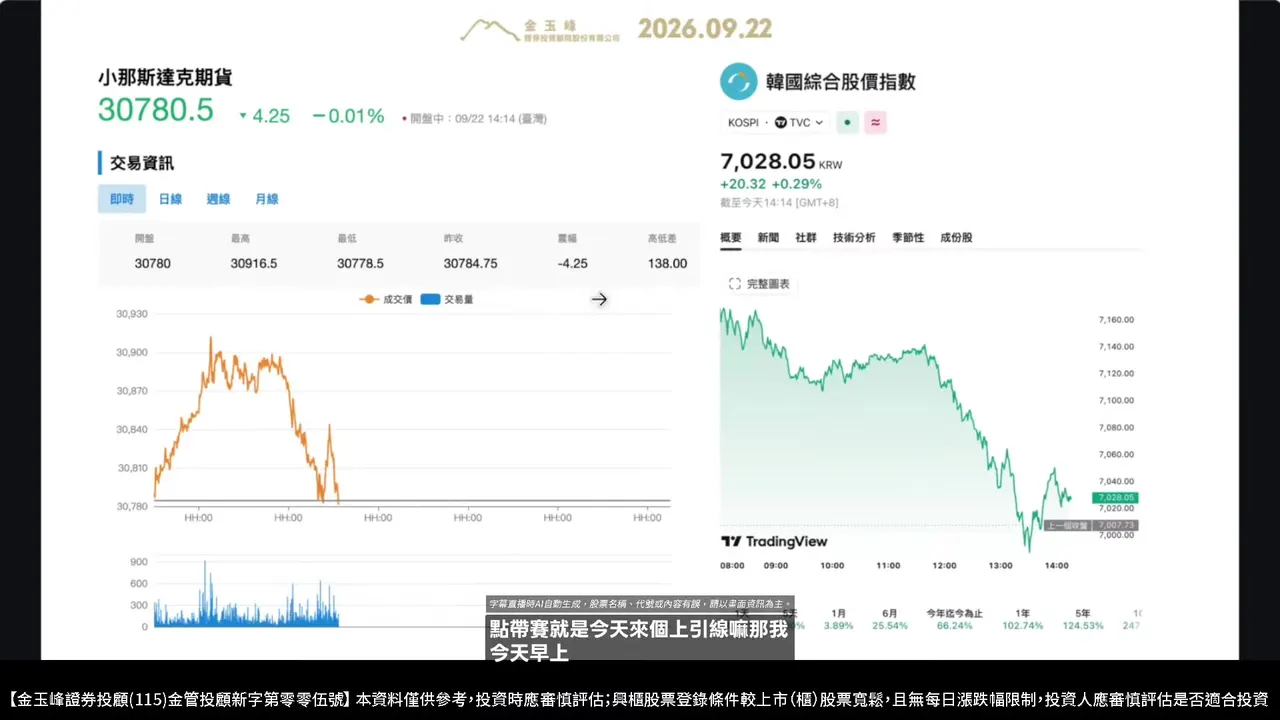
9:55Driver IC Theme and Kinsus Outlook
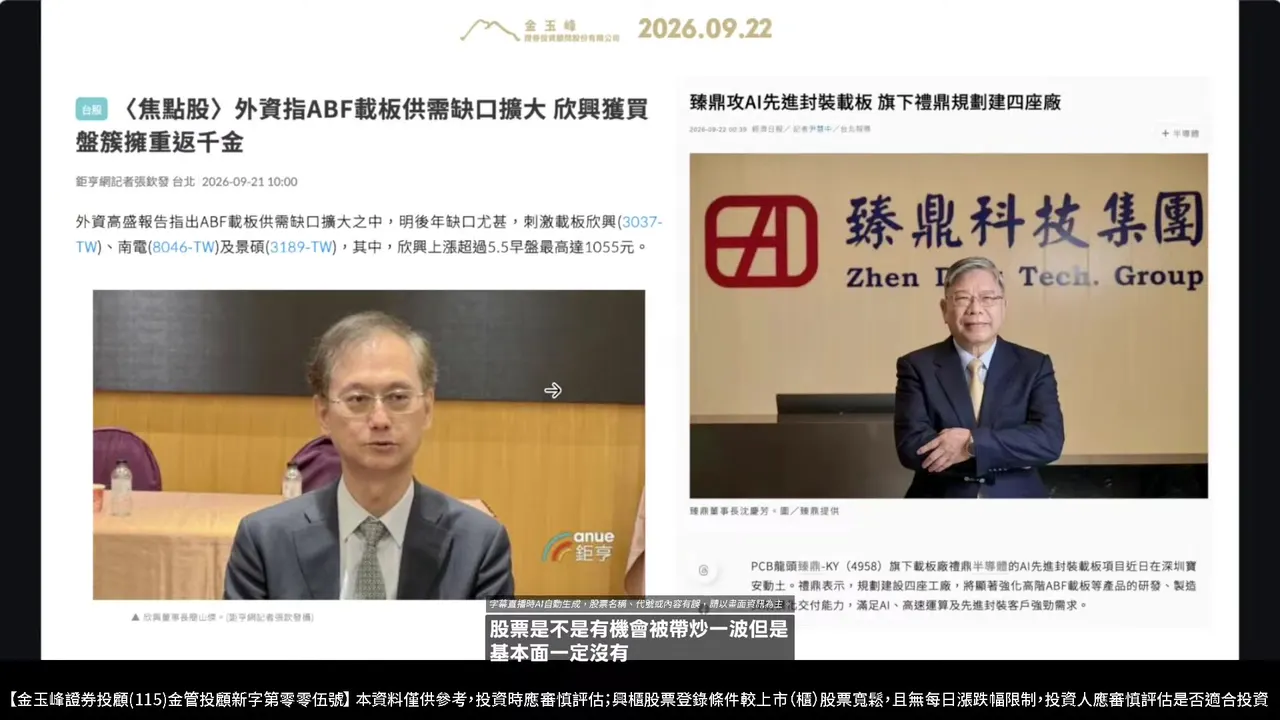
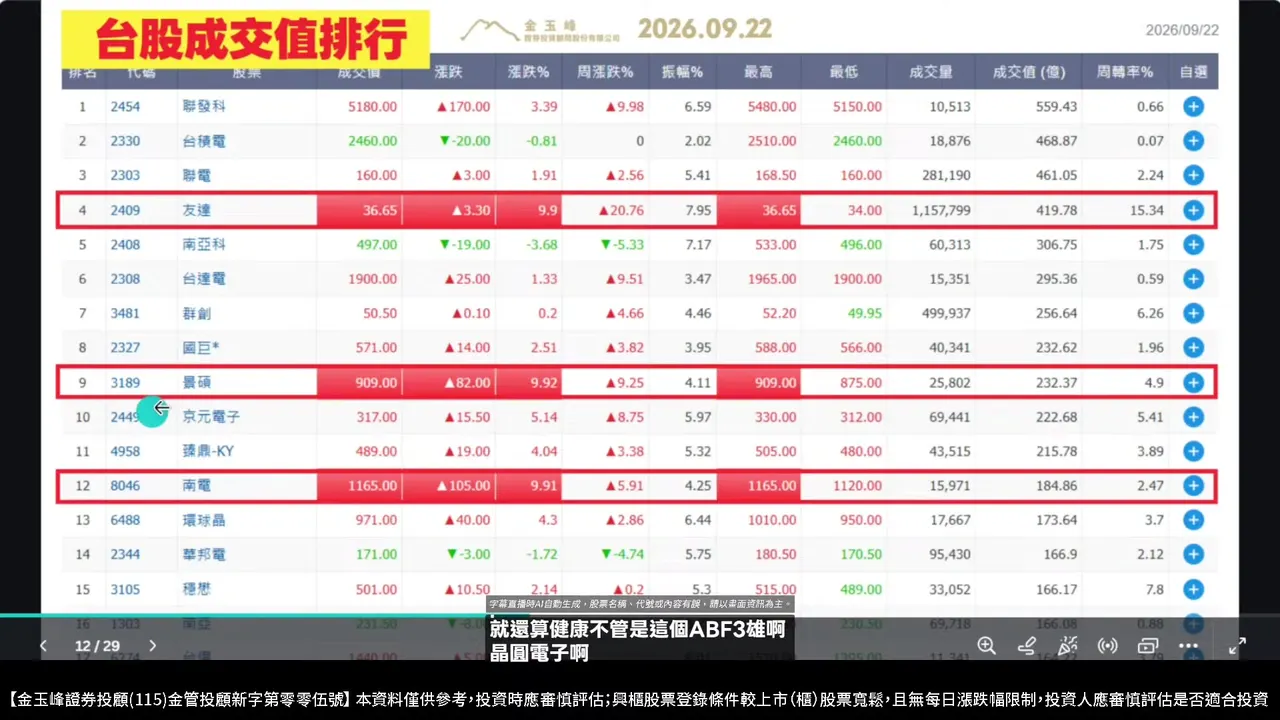
With AUO's volume piling on volume, foreign investors back, and the price level retail investors like, the speaker thinks there is still room to play, and those who want to buy can wait for a black candlestick. Panel price hikes are good news for driver ICs, so watch Dian Xu and Novatek, though fundamentals are certainly worse than 2 years ago. On ABF, Unimicron has returned to a high price level, and Kinsus closed at 909 in a bullish alignment, so it can be bet on; those who don't want to bet can trim at highs first, and the speaker thinks Kinsus will sooner or later reach such high prices too.
▶ Watch from here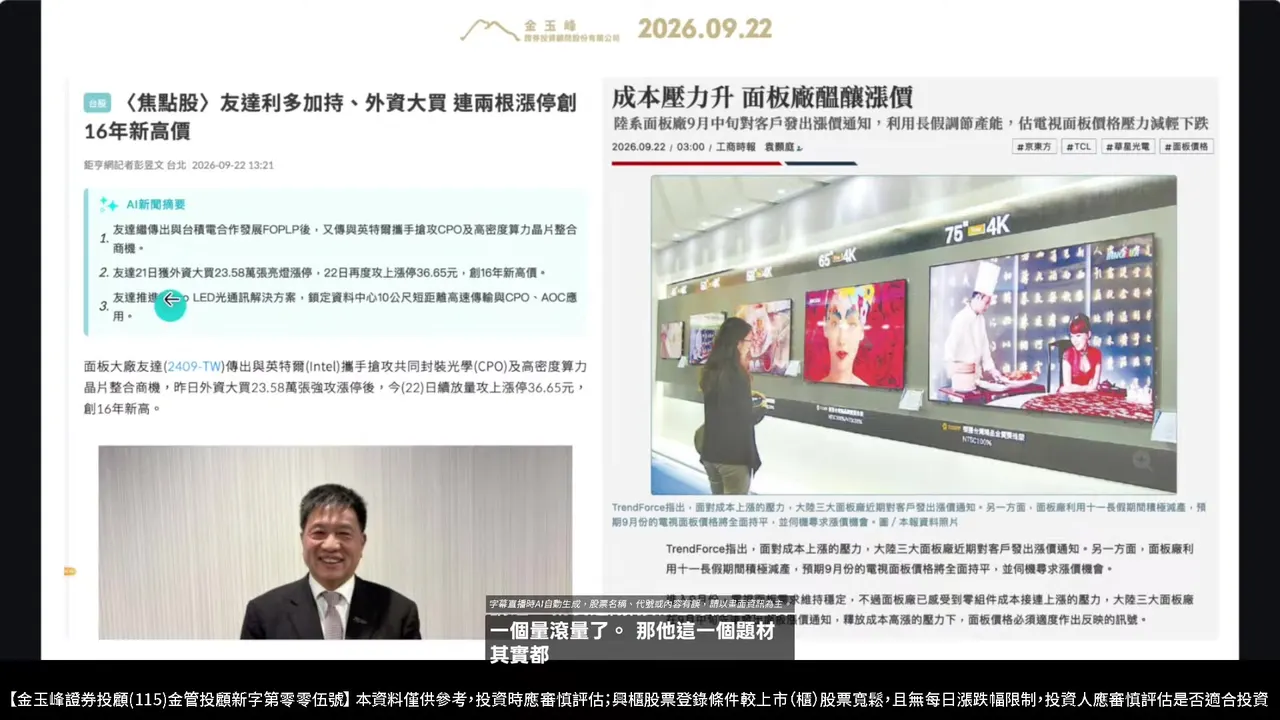
11:30Stock Switch Records and Theme Stock Scan
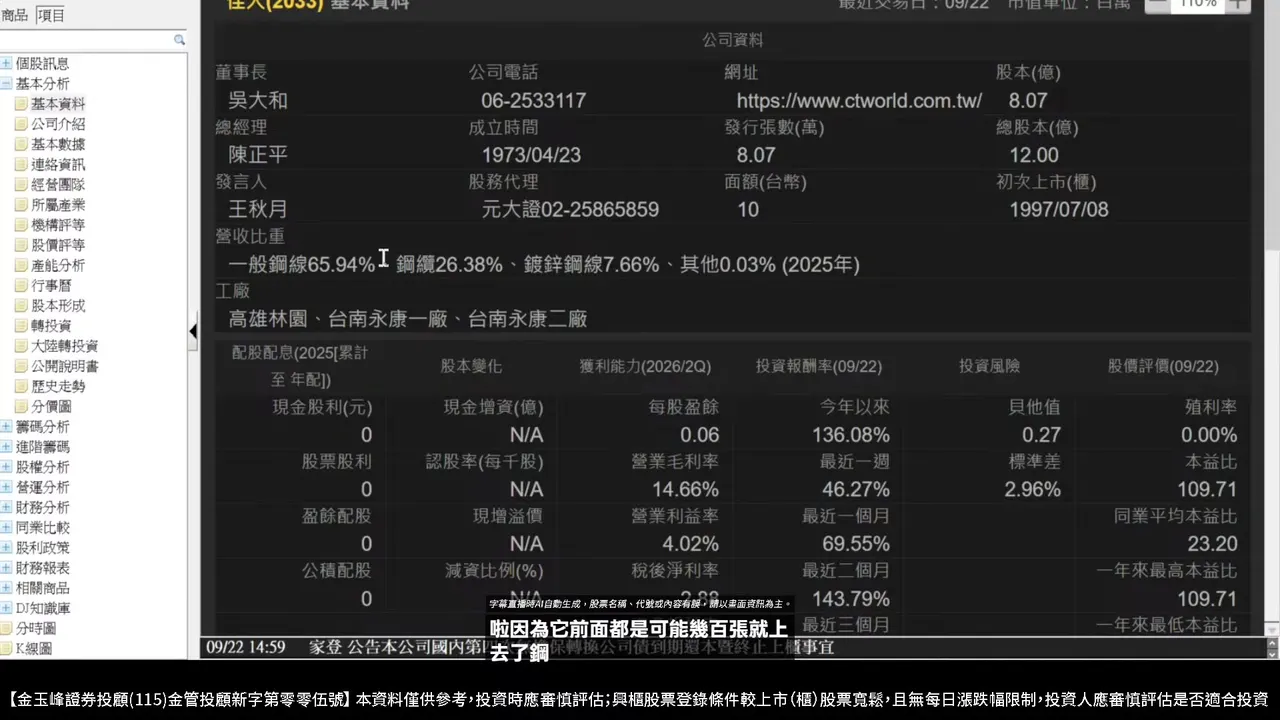
Sharing trading records: eMemory was sold for a gain of 20-something %; Gaoli was sold a bit early, earning about 10%, then the speaker switched into Hong Zhi (3605), which is also under the B1 regime; yesterday he switched AUO into Xintec (3374), which also hit limit-up today and closed at 487, and the add-on AUO order also earned nearly 20%. He then quickly scanned the limit-up and limit-down lists, mentioning theme stocks such as solar stocks, Taiwan Surface Mounting Technology, Lotes and Episil, and warned not to touch one of them: it started falling on the very day it hit limit-up, so it is not a controllable stock. He also said Chipbond is worth watching because of its strong packaging and testing business.
▶ Watch from here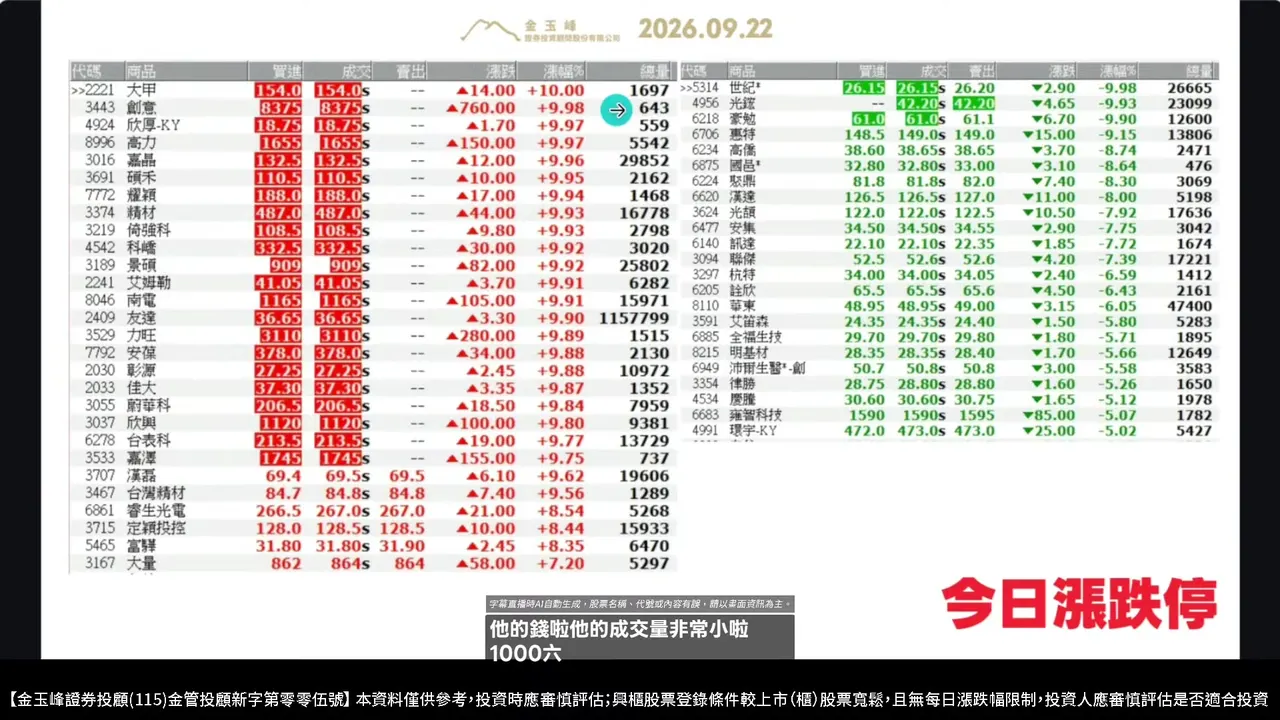
16:25Chipbond Trading and Staged Profit-Taking
Chipbond did not keep up today with the gains of UMC and Unimicron, which are in the same sector. The speaker pulled up the chart to explain that people who entered at different times should each set their own profit-taking points: early entrants are already up more than 100%, round-trip trading is close to 200%, and last time he sold at 300 and then bought back on a dip. He hopes the price does not fall below key support, and if it does, profit-taking is triggered. He did not sell today because neither investment trusts nor foreign investors have left yet; if either of them sells, he may leave tomorrow even if it opens high.
▶ Watch from here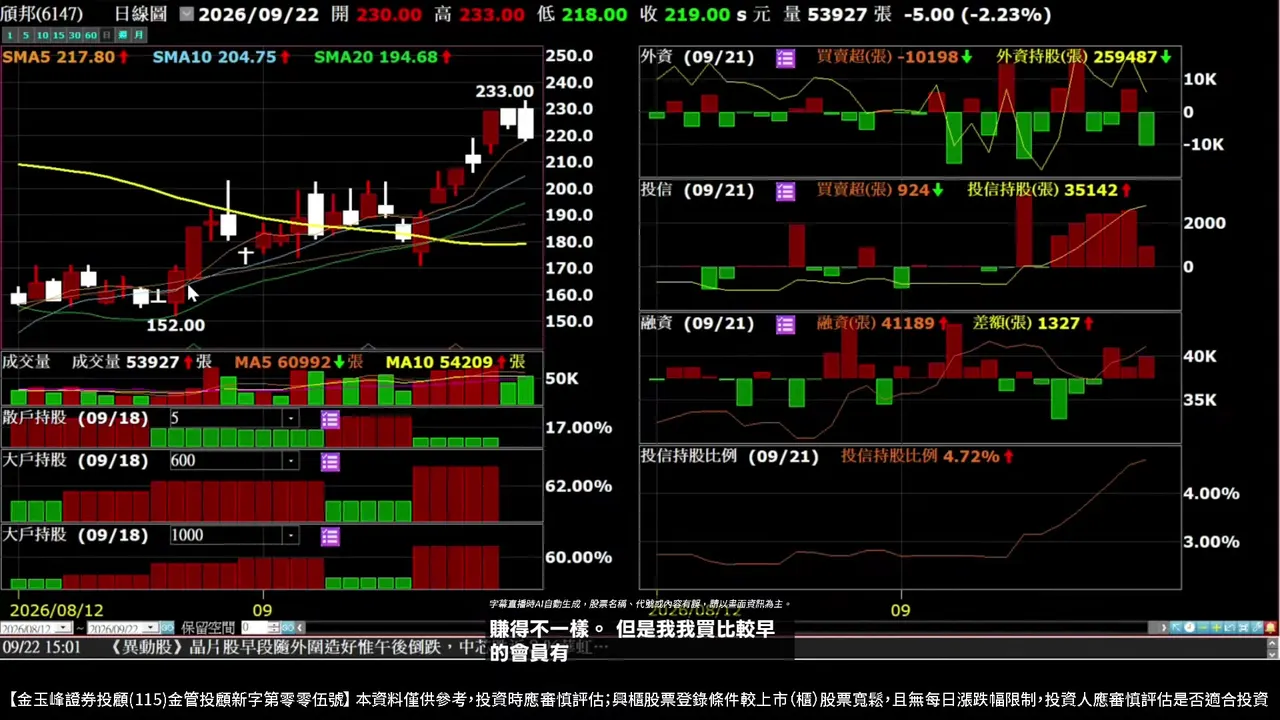
17:25Delta Electronics Window Dressing and Add-On Point
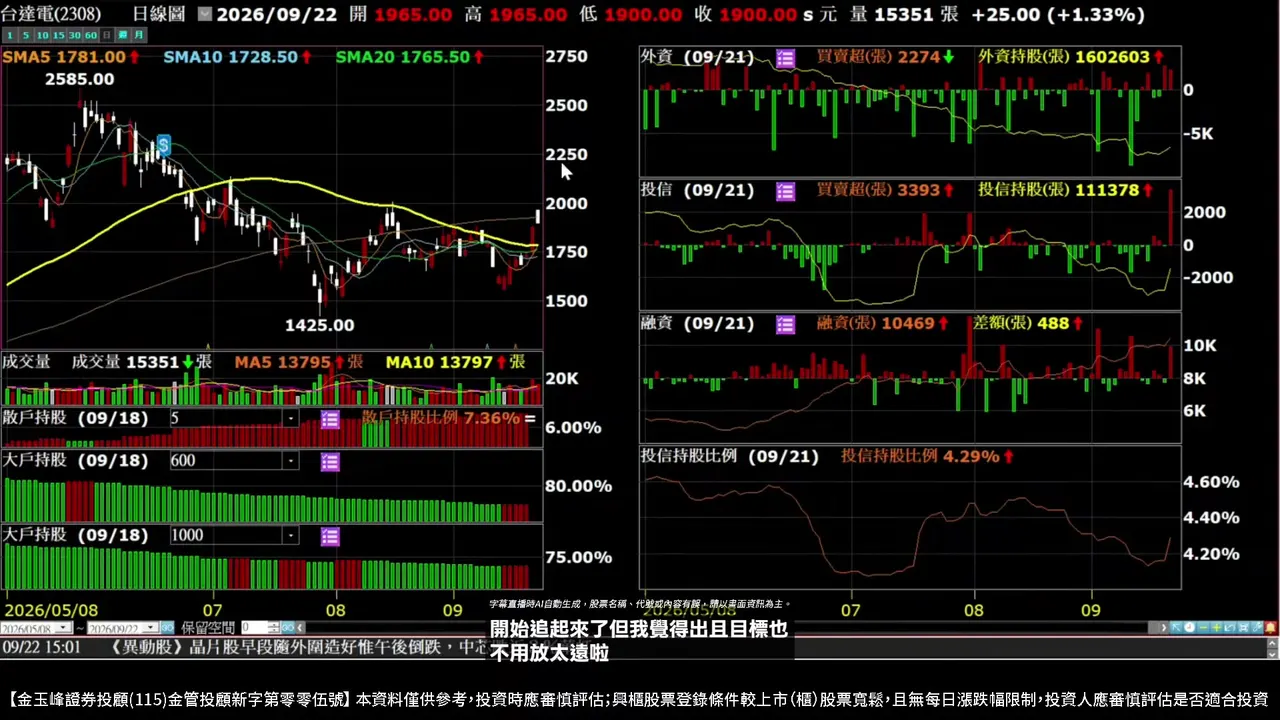
Delta Electronics may be a stock investment trusts will window-dress in Q4. Aggressive investors can buy today, while the safer approach is to wait for a pullback to the upper edge of the long red candlestick at 1800–1875 and buy then, because the speaker believes such large investment trust buying won't last just 1 day. The profit-taking target need not be far, around 2250, where a pile of retail investors are stuck with costs of about 2100–2200, so selling pressure from people breaking even may return when the price gets back there. He also notes that MediaTek hit a record high, and he will take profits on 1/3 to 1/2 at a suitable time.
▶ Watch from here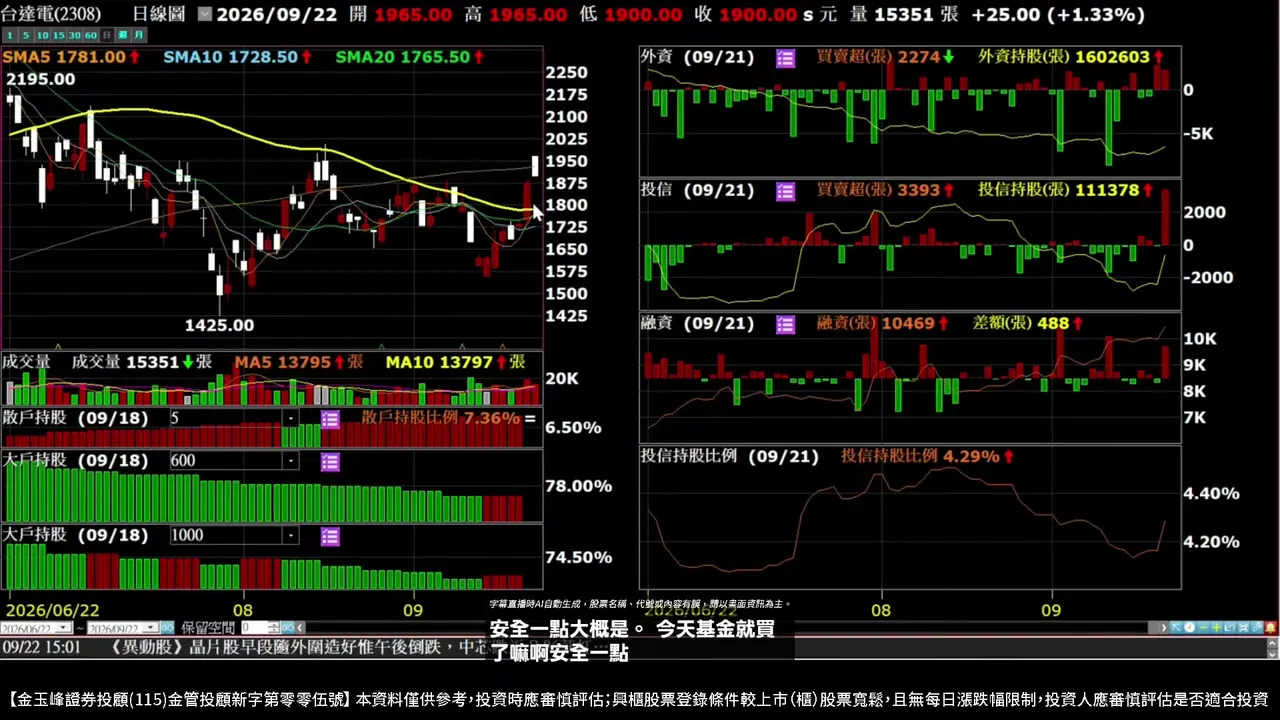
19:25Market Chop and Stock Rotation Strategy
The broad market challenged its prior high today but failed to hold, having been lifted by heavyweights such as Largan and Global Unichip, and after pulling back it turned choppy in the short term. The speaker is not greedy with most stocks: if the index is stuck above 46000–48000 and consolidates back in the 47000s, he sells holdings with gains of 10-something % or 20% and switches into fundamentally good, low-base stocks such as Zhen Ding; a 20–30% gain on a single stock feels like plenty. His view is still a target of 5 wan (ten-thousand) points, but what matters more is the OTC market returning near its prior high, so that retail investors can make money. On individual stocks, waiting to buy Innolux is fine; he is conservative on MediaTek and UMC because their target prices have mostly been reached, and he would only be interested in UMC again when it returns to the 140s; for ChipMOS, buying near 100 and selling around 120 is safer.
▶ Watch from here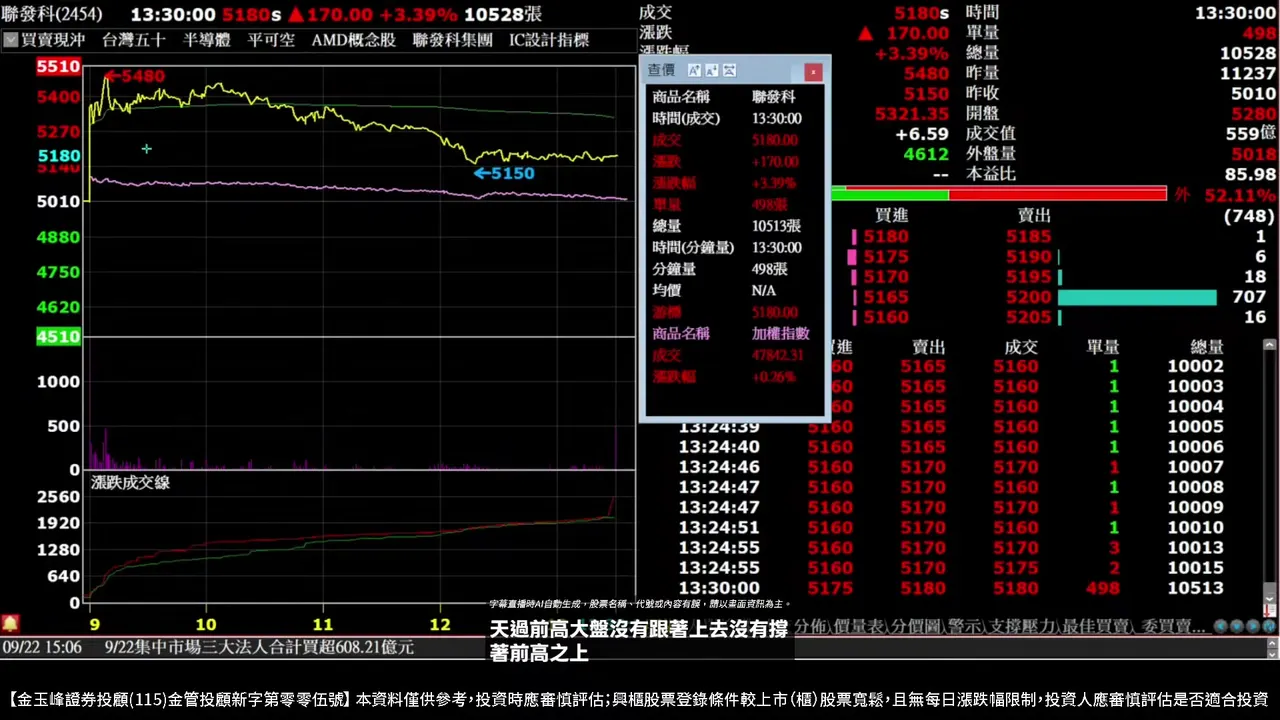
26:10Grinding Price Action and Market Health
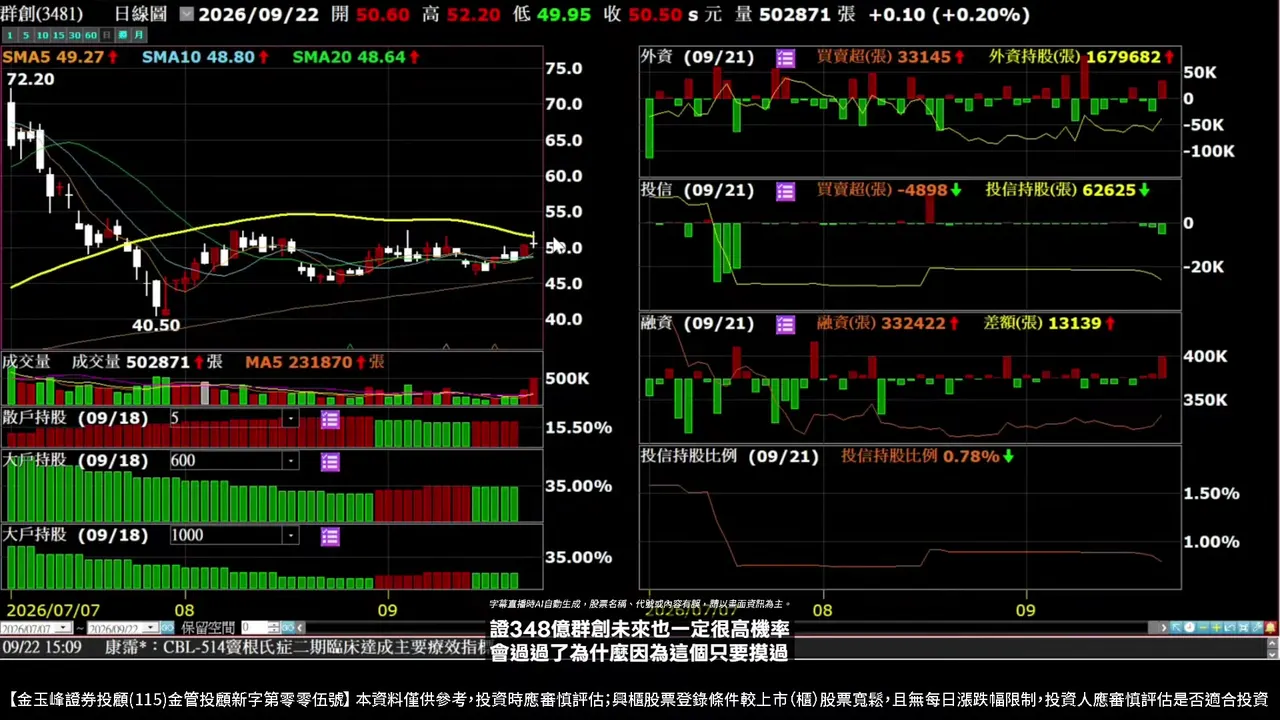
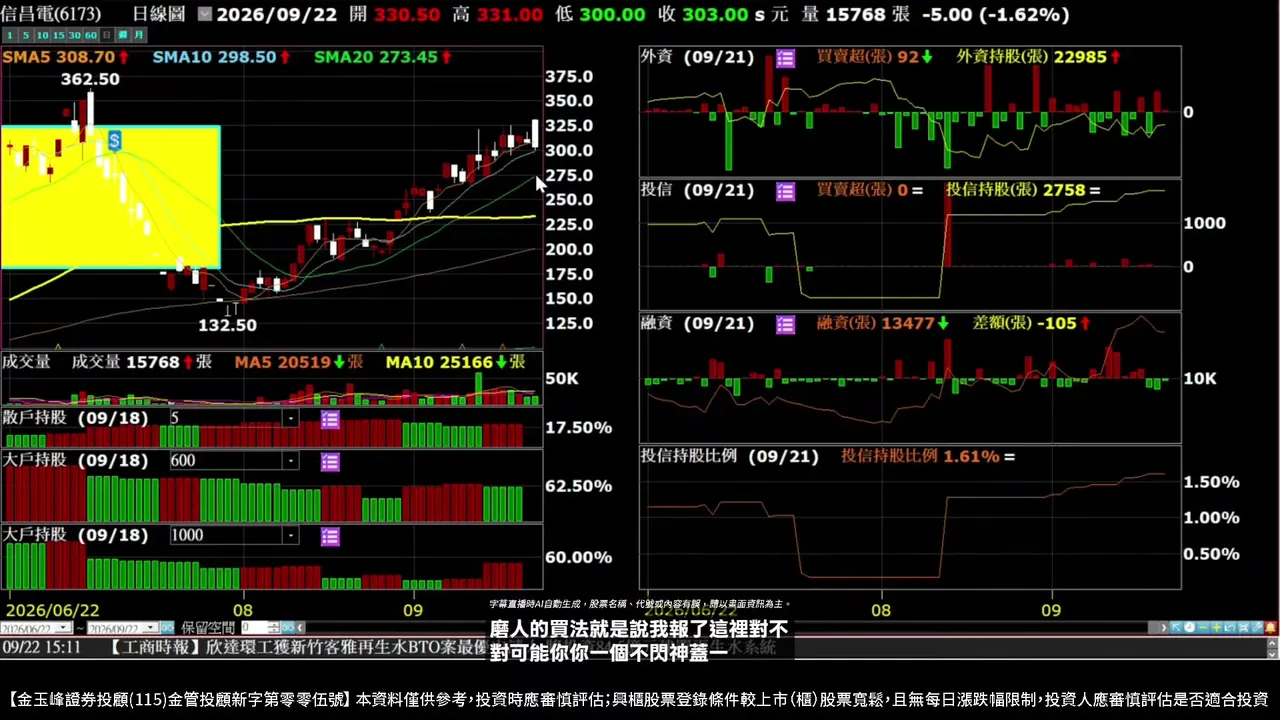
Stocks such as Sino-American Silicon Products, Prosperity Dielectrics (6173) and Holy Stone (3026) are climbing along the 5-day and 10-day moving averages but cannot produce a long red candlestick, which is grinding price action; the speaker suggests exiting near the prior high, or setting your own rule to leave if there is no pullback within 2 days. With a market this good, opening high without pushing higher looks bad. He reviews the market and still finds it healthy: the ABF group and King Yuan Electronics have steadied, Winbond is not dead yet, and Nan Ya and Taiwan Union have popped up and are worth starting to watch.
▶ Watch from here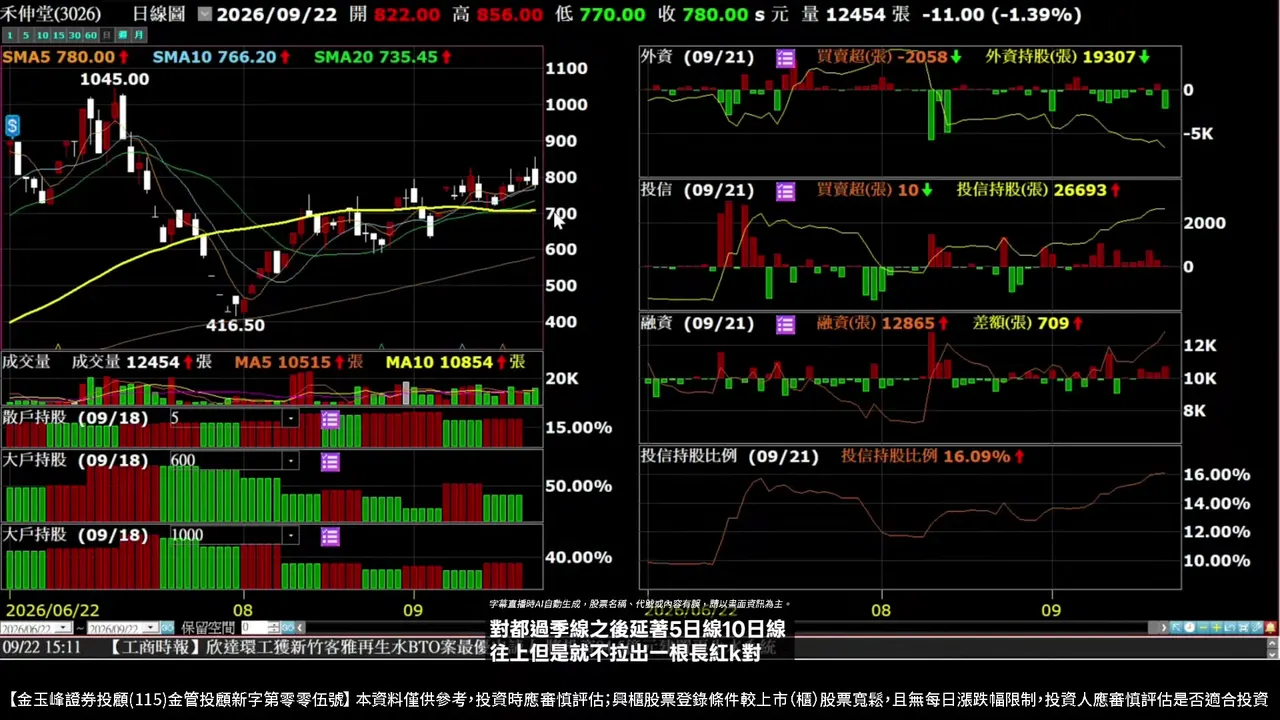
27:45Dongli Ge and Tianmu Jie Holdings Review
What Dongli Ge added yesterday is all in the right sectors, including power, IP, thermal and packaging/testing; he also left memory packaging/testing stock Powertech and AI connector stock Lotes, and trimmed TSMC. Tianmu Jie bought Taiwan Union, and the speaker, using next year's EPS of 70, says anything around 1300 is cheap; she also sold MPI, Wiwynn, Nan Ya PCB and Chenbro. The closing point: the NT dollar has returned to an appreciation trend, meaning foreign buying is back, and since foreign investors find it easier to buy heavyweight stocks, the weighted index will break its high first, so those wanting to buy OTC should wait a bit.
▶ Watch from here31:55Disposition Stock Warnings: Gaoli and Huajing
Gaoli comes out of disposition today and needs special attention; Huajing and Century fell into disposition, and if they fall further they may turn into no-volume declines like the last stock that hit the probe, so holders are advised to cut if they can. Very few stocks come out of disposition tomorrow, because in a peaceful, prosperous market nobody gets locked up.
▶ Watch from here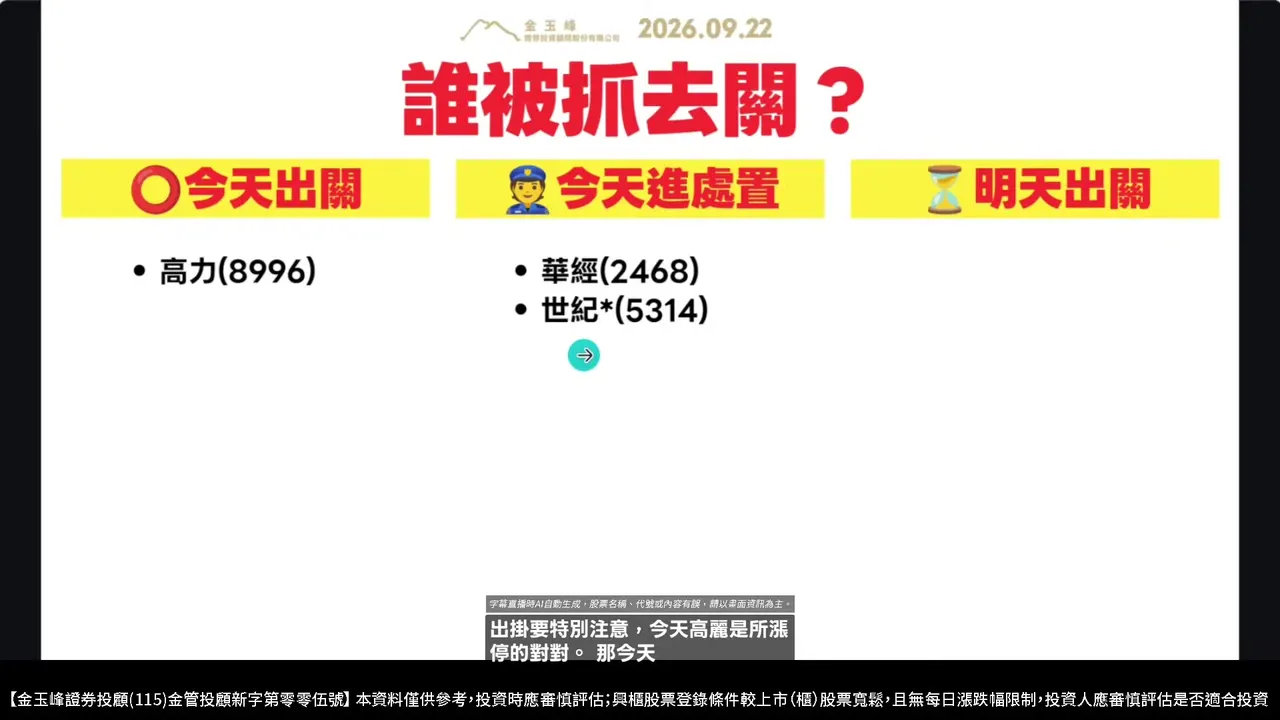
35:15Understanding Deviation: The Principle of Returning to the Moving Average
The speaker uses a well-behaved child running away from home as a metaphor for widening deviation: a normally well-behaved stock suddenly stays far from its moving average and keeps not coming back, which is usually not a good thing, just like a runaway who stays away too long and often returns only after something goes wrong and the money is gone. Deviation means the price has risen or fallen too much in the short term and is too far from the moving average, but it will eventually revert to the average, because when prices have risen a lot some people find them expensive and want to sell, and when they have fallen a lot some find them cheap and want to buy.
▶ Watch from here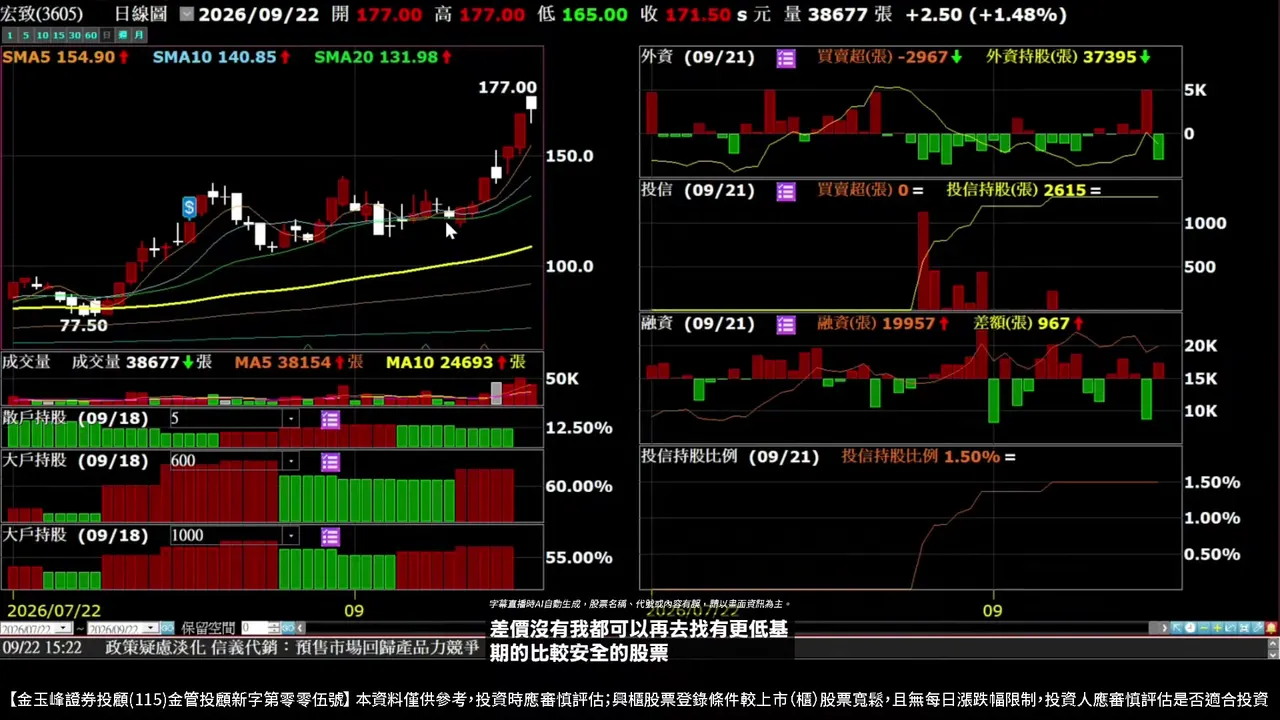
37:05Profit-Taking and Redeploying Capital
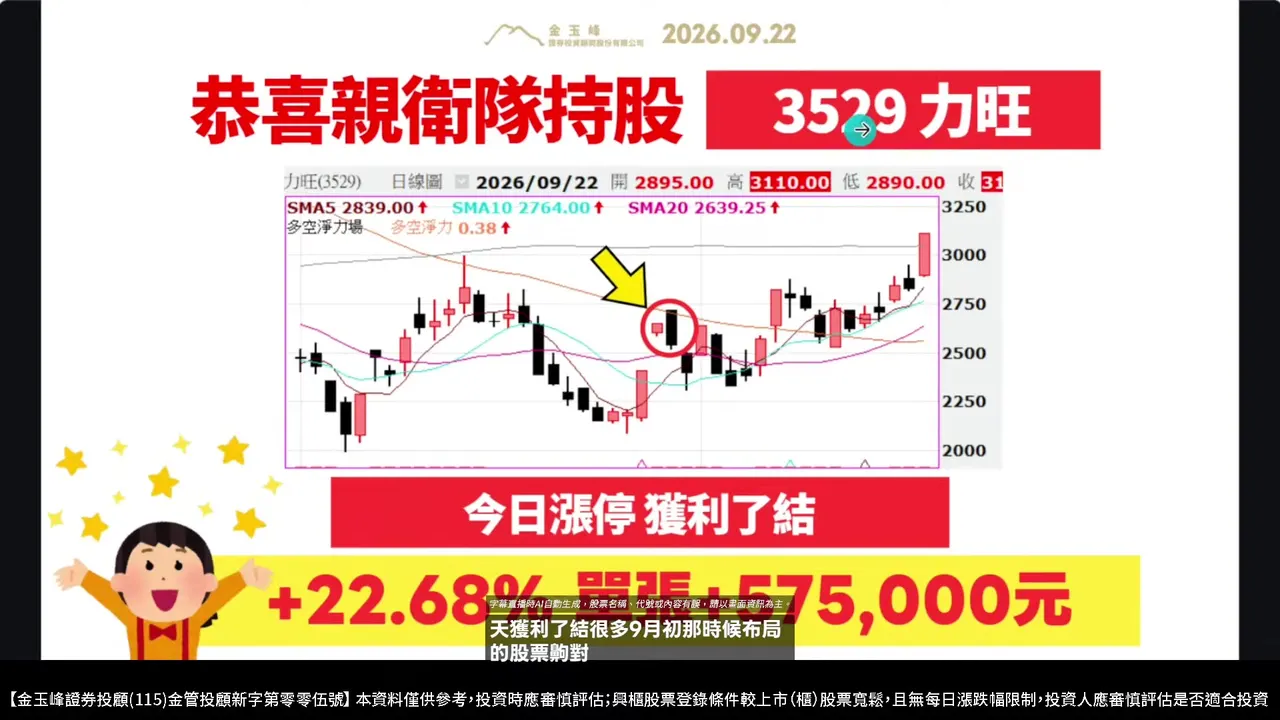
Today he sold multiple stocks he positioned in early September, including eMemory: near limit-up it hit the neckline, and unsure whether it would lock limit-up during the session, he took profits first; he had said from the start that he would sell only after it passed 3000, and today he sold above 3000, so he did what he said. Considering that many people are reluctant to switch stocks, he took the chance to cash out and free up capital for the next stock. He also sold APMemory, which had gone nowhere for 10-something days, at cost.
▶ Watch from here