Memory Stocks After Earnings: Buy the Range, Not the Bottom, with Cash-Level Control in a Low-Volume Market
TL;DR: SK Hynix posted strong earnings and Korean memory stocks bounced, but the broader market is rising on thin volume with a near-vacuum in chip flows, so buy the range rather than the bottom and adjust your cash level in steps based on pre-written objective criteria instead of intraday emotion.
Key ideas
- Don't try to catch the exact bottom; buy only the relative range low after a pullback: wait for the price to close above yesterday's high and return to the prior plateau, so the range low becomes a defensible level, and leave if it breaks again. Bottom-pickers never know how to defend.
- Subjective emotion swings during the session, so write objective criteria for members in advance: the Taiwan dollar holds steady, Japan and Korea return to their prior ranges, oil prices stabilize, and the index closes above yesterday's high. Meeting 1–2 of them means adding a small short-term position; only when 3–4 are met do you raise the position level to 60%.
- The index rose 25% from the 4 wan (ten-thousand) point level in 3 months, and a pullback of about 10% is healthy, but the rise is on low volume, foreign investors have net sold over 2 trillion, and ETFs buy and never sell, leaving chip flows near a vacuum; with the 10-day and monthly moving averages overhead as resistance, there is no rush to add exposure.
- Pullbacks in individual stocks need not be feared; what matters is the range and institutional cost: Ardentec can be tried at the range low if it returns to the prior plateau around 200–220, and Taiwan Glass need not be feared if it consolidates to around 63, but if investment trusts are dumping, wait until they finish; and watch for upper shadows when volume appears at highs.
- Korea depends on memory, so if Korean stocks don't rebound, don't bother with the rest; with SK Hynix's earnings and larger shareholder returns, plus this week's FOMC and AI giants' earnings, the market is watching how fast AI capital spending pays back, and bad news seems no longer to be piled on.
Ask AI about this episode
Copy the prompt, paste it into an AI service, and add the question. The AI reads the notes on this site and links to the page and the video timestamps.
Or open directly:ChatGPTClaudeGrokPerplexity
Section summaries
0:05Opening: The Memory Rally and Cash Is King
SK Hynix's Q3 operating profit soared 6-fold, but the market already knew the earnings would be good, so buyers only show up once the price falls cheap enough; Korea has bounced over the past two days, and memory can only follow Korea. At the open, ABF stocks gapped higher and then sold back to flat, which was worrying, so he favors cash is king and buying the range rather than the bottom, waiting for a close above yesterday's high and a return to the prior plateau range. SK Hynix says memory will be in shortage until 2030, and its shareholder returns were raised by 100 trillion won, which is seen as important fundamental support.
▶ Watch from here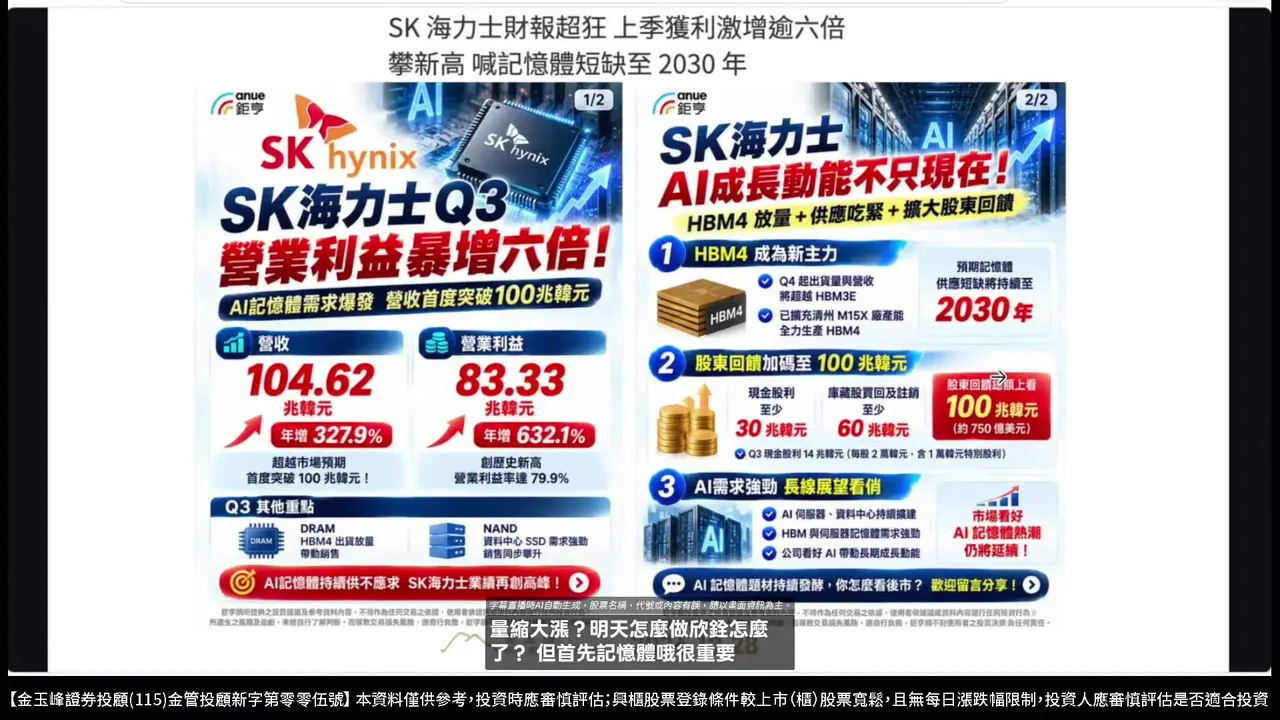
6:00Cash-Level Control and Signal Criteria
One member cut their position to a 30% level and thanked him; because subjective emotion swings during the session, he wrote the objective criteria for members in advance. The signal criteria are: the Taiwan dollar holds steady, Japan and Korea return to their prior range plateaus, oil prices stabilize, and the index closes above yesterday's high; meeting 1–2 allows adding a small short-term position, and meeting all 3–4 means adding back the mid-sized position and raising the level to 60%.
▶ Watch from here10:05Intraday Pullback and Reading Margin Flows
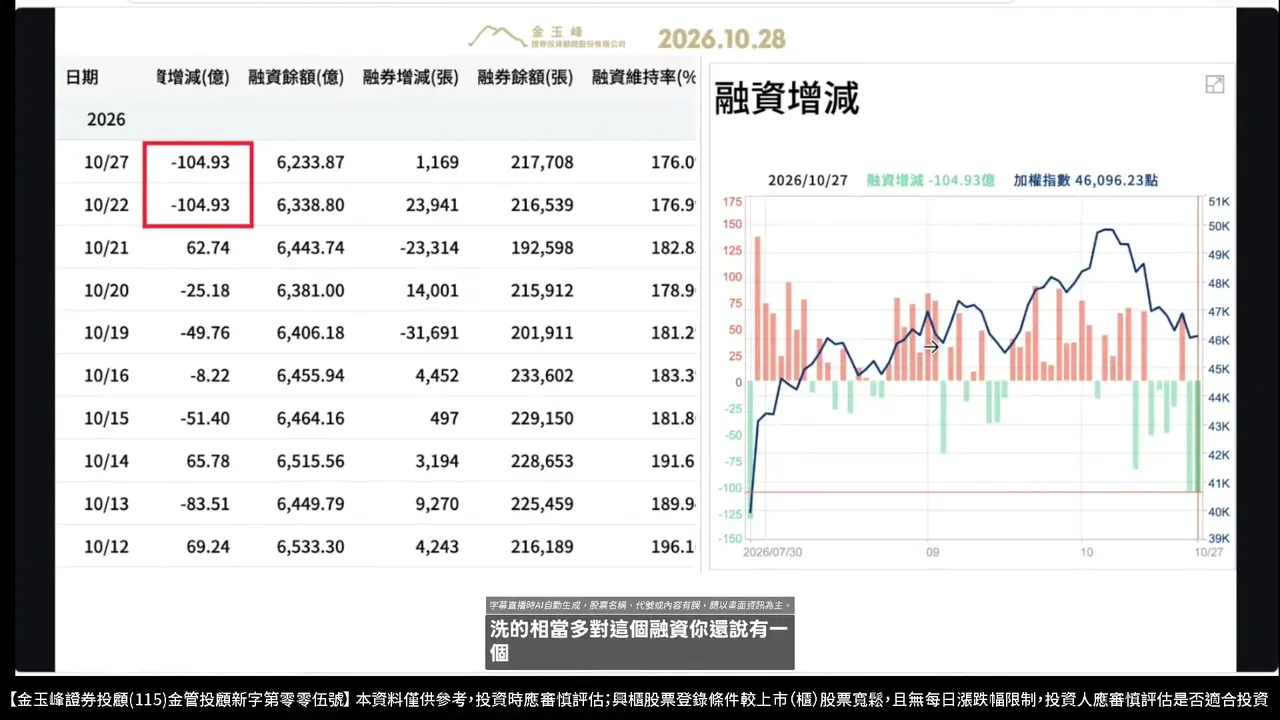
After selling off to 10:30 the market pulled back and the 5-minute candles did not break, meaning money is still there, so he chose to believe the index, back at its quarterly moving average, would shake out margin traders through sideways consolidation. About 100 yi (hundred-million) was flushed out on Friday and again yesterday, and margin balances fell 104.93 yi on both days, suggesting the same group of people exited; disposition stocks fell intraday and then recovered, not looking like they will keep collapsing. Today he only raised the cash level slightly, because only 1–2 of the main criteria were met.
▶ Watch from here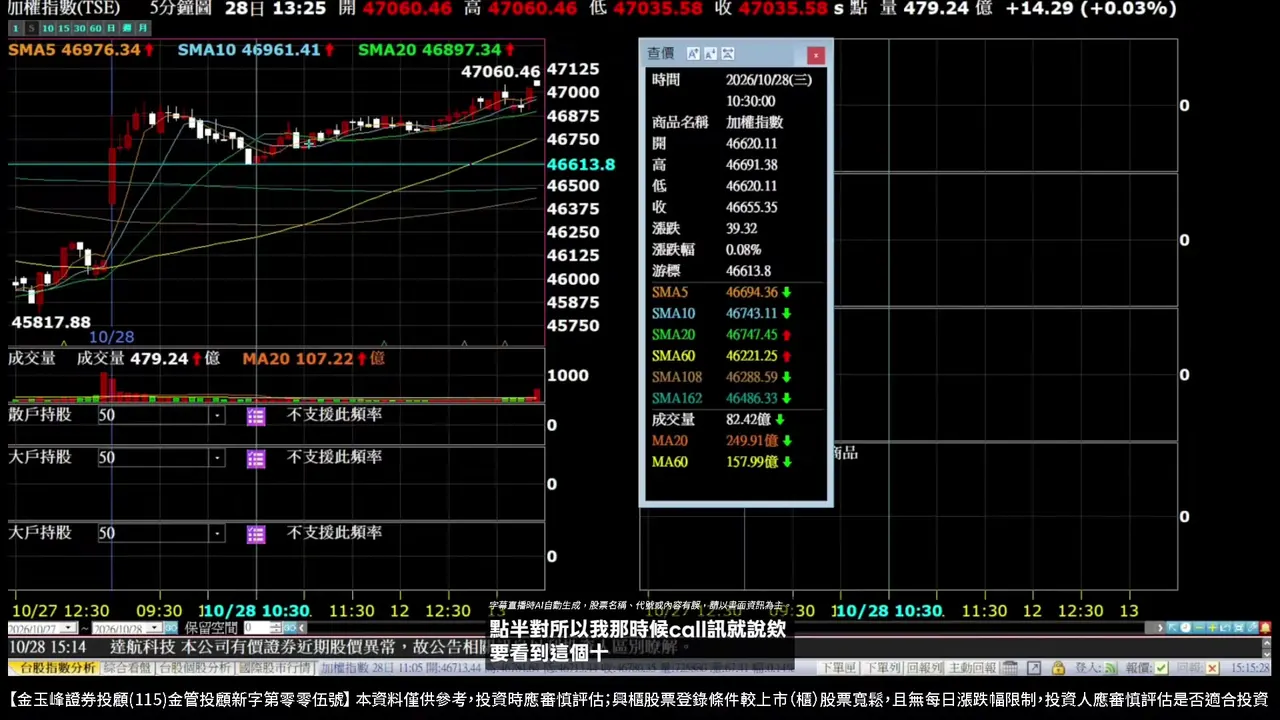
14:35Buy the Range, Not the Bottom, and Viewer Questions
The index has swallowed the black candle of October 22 and is back in its range, and Japan, Korea and the industry leaders he wants to buy are also back in range, so he is willing to believe this is a relative bottom; if it rebounds to the prior high near the 5 wan (ten-thousand) point level (about 3000 points of room), that's a win, and if the range breaks again, he leaves. The index recovered within 3 days after breaking the quarterly moving average; asked whether it could crash twice in a year, the boss said absolutely not, because last time was a super crash.
▶ Watch from here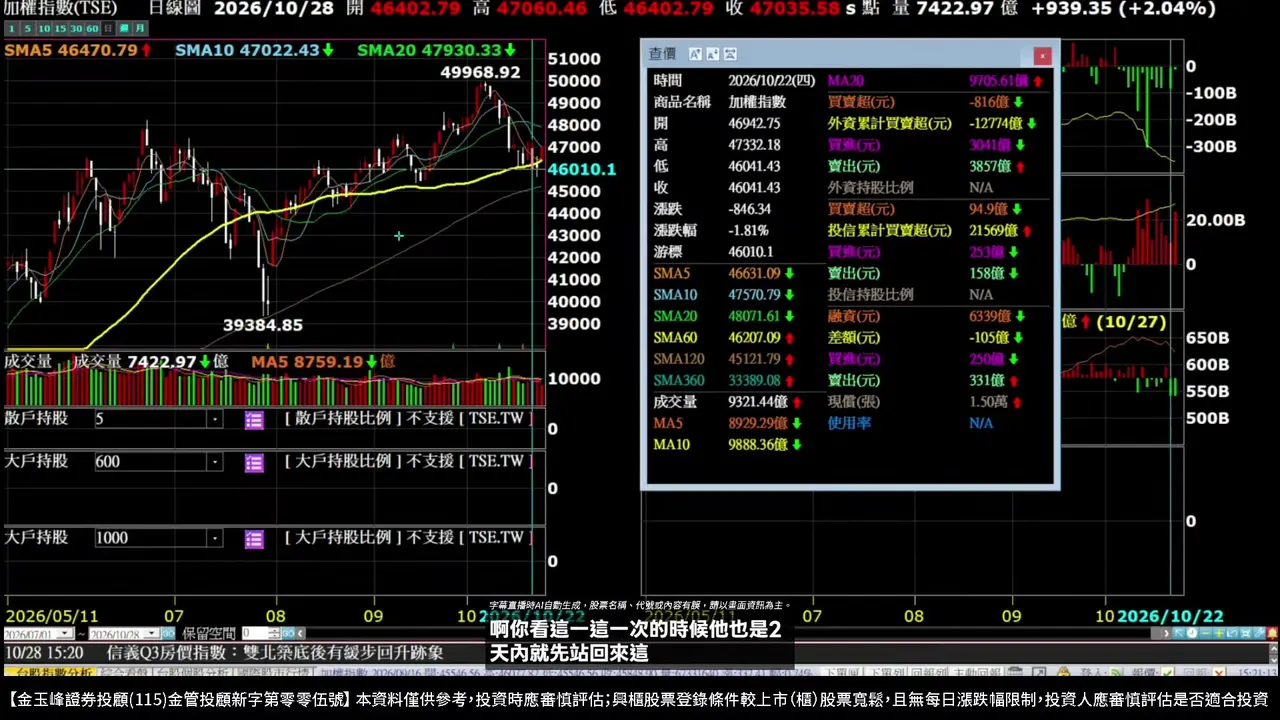
16:05Low-Volume Rise and Vacuum-Like Chip Flows
The index rose 25% from the 4 wan (ten-thousand) point level in 3 months, with very low volume on the way to 5 wan, only 1.2 trillion even on good days, so today's rise is a low-volume rise; a pullback of about 10% is healthy. Foreign investors have net sold over 2 trillion and ETFs buy and never sell, so chip flows are near a vacuum. The TAIEX also faces resistance from the 10-day and monthly moving averages; he thinks this wave will at best reach 4 wan 8 before a small black candle appears, and after roughly 1000 more points a black candle becomes likely, so those not fully invested can wait for the small black candle to press back and then add, and everyone runs if the quarterly line breaks; hence his cash level is still just over 50%.
▶ Watch from here22:25Taiyao, Xingquan and Investment Trust Cost
Ardentec earned about 3 per share in Q3 and 7.49 in the first 3 quarters, and may earn over 10 this year at a P/E of 20-something, so fundamentals aren't bad; but the earnings call mentioned Q4 revenue declining by a single-digit percentage quarter on quarter, which the market read as unsatisfying, and with the whole packaging and testing sector up today, Ardentec looks relatively weak. He argues short-term selling pressure doesn't affect the long term, and once the price returns to the prior plateau around 200–220, you can start trying to buy the range low; investment trusts bought above 250, so unless they dump, there is no need to worry much. Also, Taiyao, which was rumored two days ago to have orders cut, is fine today, and quite a few stocks with industry concerns rose 7% or even hit limit-up, outperforming Taiyao.
▶ Watch from here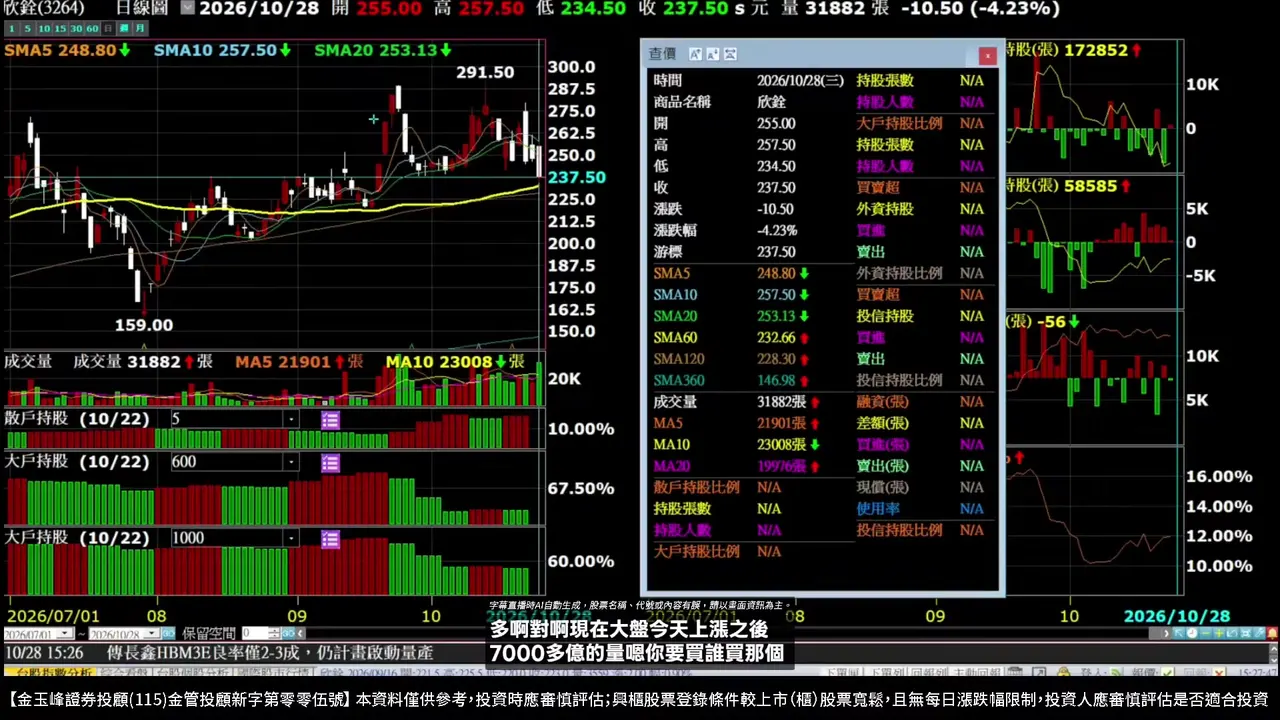
27:45Limit-Up Stocks and Fiberglass Cloth
Most of today's limit-up stocks were names you can readily name: Chunghwa Precision Test Tech, Jinju, Gold Circuit Electronics, Genius Electronic Optical and Fuqiao, with high-priced and low-priced theme stocks rising together; fiberglass cloth, with PCBs still growing and no bad news, is called a pure land on earth.
▶ Watch from here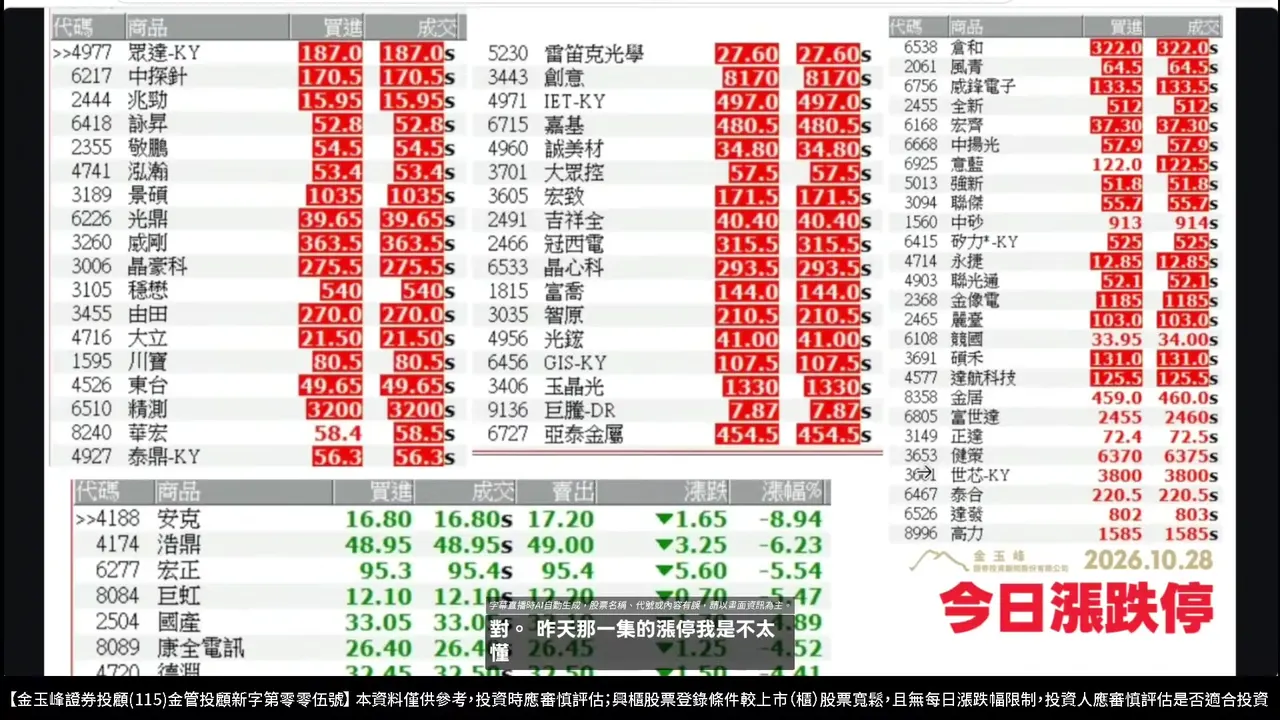
32:05Yangcheng, King Kuo and Eastern Technical Analysis
Yangcheng (3498) has risen all the way on volume of only 5000–6000 lots, with no volume spike, and the gap up is a good one, with the 5-day and 10-day lines as defense. King Kuo's prior high is 100; after breaking 100, the area near 120 tends to pull back for a retest, especially when the index is weak; if it consolidates and absorbs short-term selling it still has a chance to run again. Eastern may first make a small retest near its prior high of 45, and a retest is not bad but healthy, and after it succeeds the next advance will go farther; if volume appears at the high and the intraday upper shadow grows, pay a bit of attention.
▶ Watch from here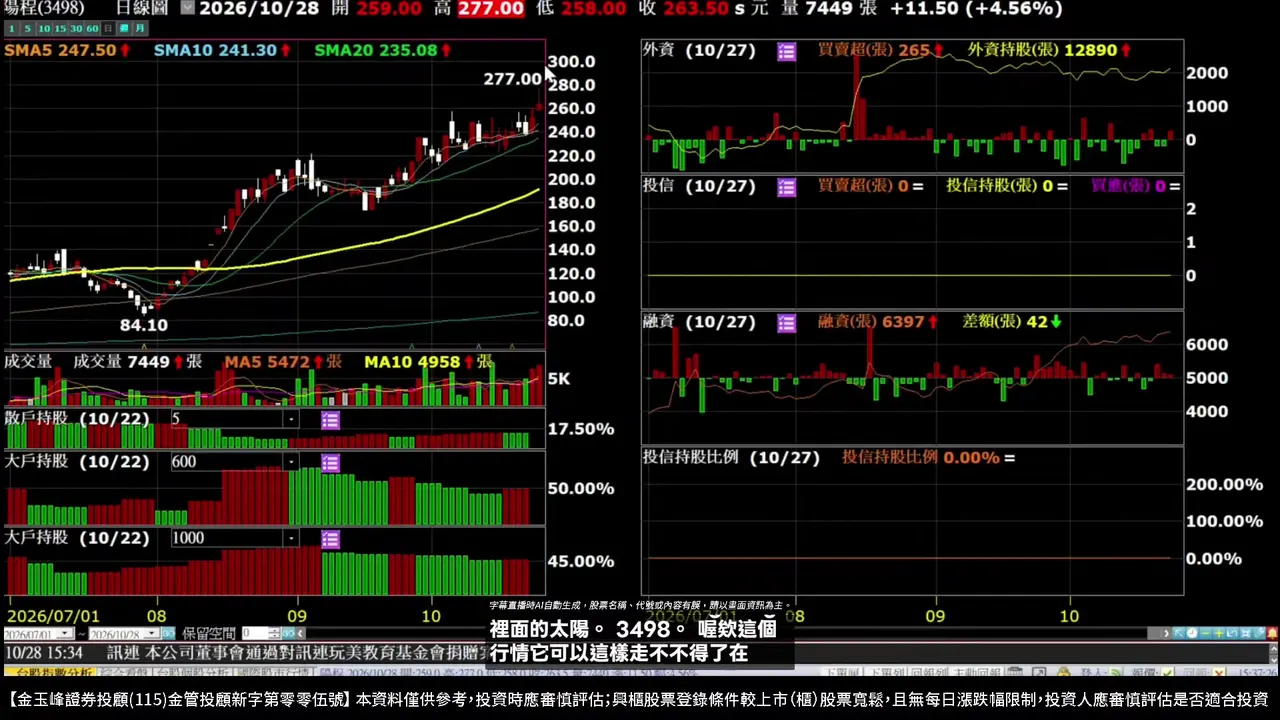
34:45Baseball Analogy and Taiwan Glass Pullback
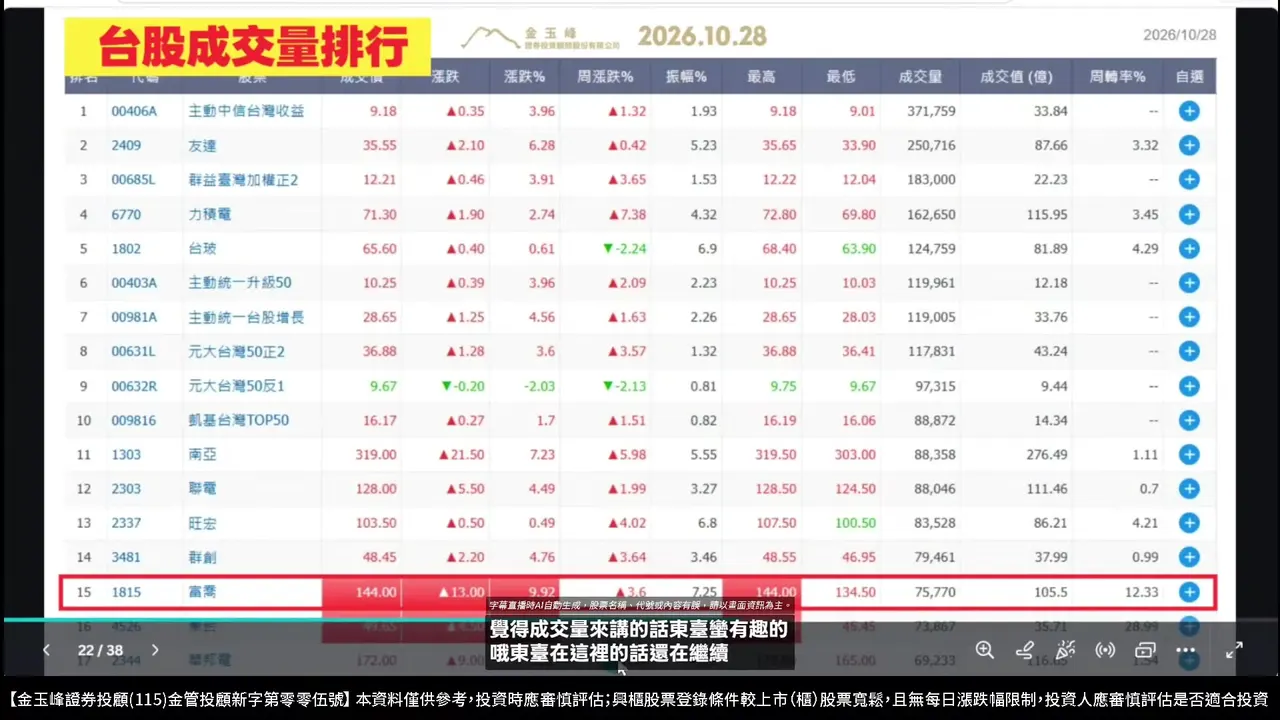
Using the baseball "tap twice to challenge" ball-and-strike review as an analogy for retesting first and then confirming, he mentions a World Series catcher who challenged 4 times in one game and succeeded every time. Taiwan Glass left many upper shadows at the range high, which he doesn't much like; if it pulls back and consolidates, around 63 is about right and there's no need to fear, because the fiberglass cloth shortage has reached a frightening level and investment trusts have been buying consecutively, so a pullback lets you buy at a cost close to theirs.
▶ Watch from here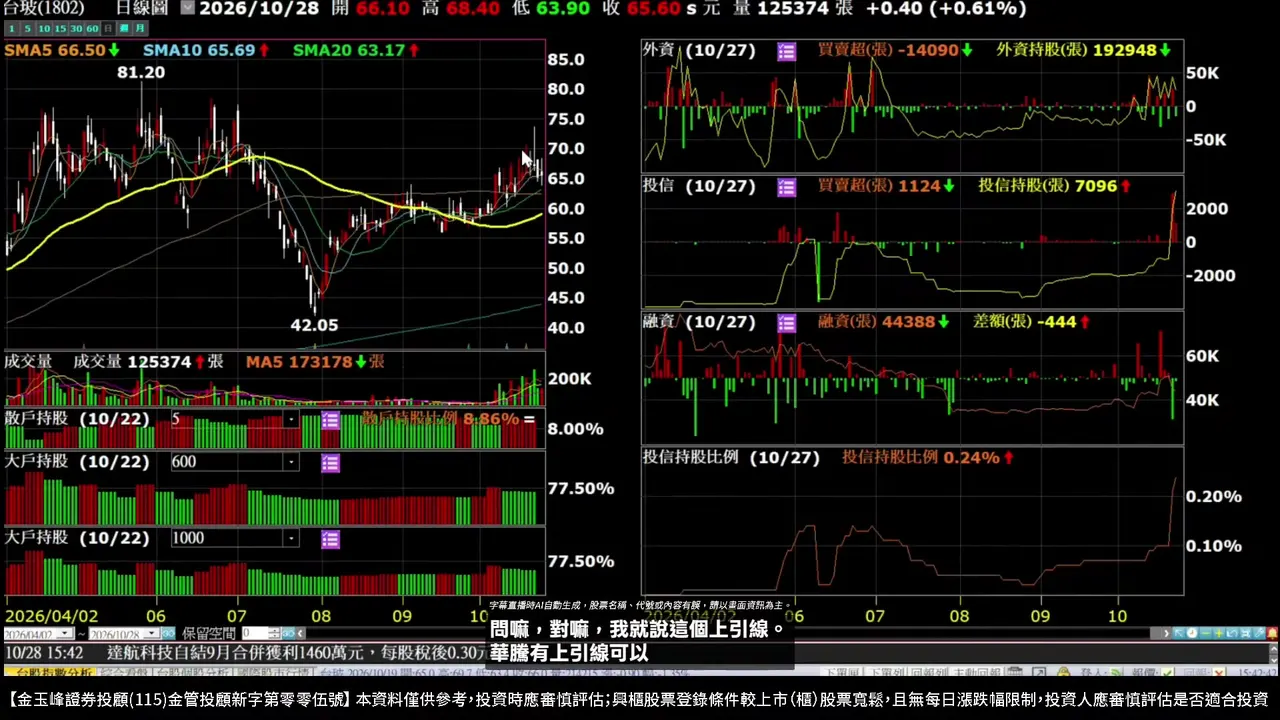
39:45Turnover Rankings and Nan Ya Heat
In the turnover rankings, Elite Material is 7th, Global Unichip 13th and Taiyao 17th; among 1800-plus Taiwan stocks, these ranks are real money. Nan Ya is an ETF constituent and can't be excluded from the ranking, and it held up well in the big drop; in retail heat, Nan Ya is 3rd and Winbond 2nd, so some people seem to be buying memory again.
▶ Watch from here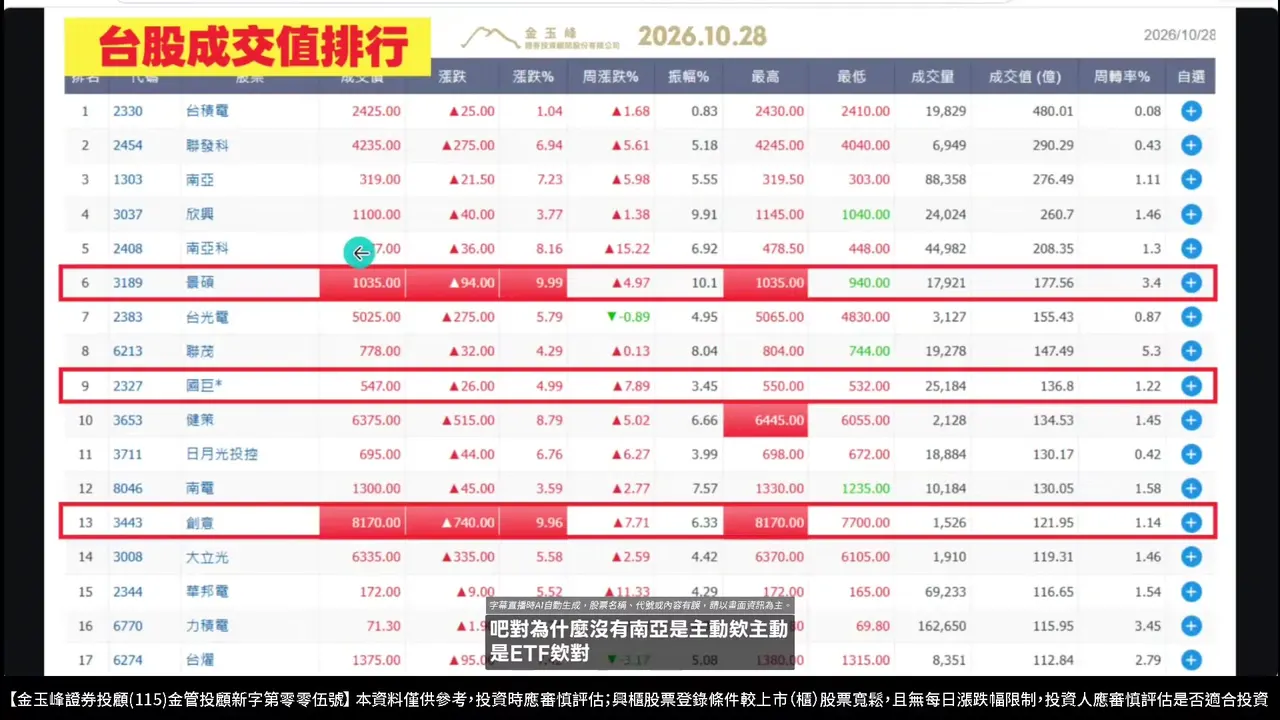
40:45Korean Memory and Compeq Defense
Korea depends on memory, so if Korean stocks don't rebound, don't play the rest either; with Compeq's 3 consecutive black candles there's no need to be too afraid, and 215 is the best defense point; capital is limited, but companies in the same industry should do well together and not put each other down.
▶ Watch from here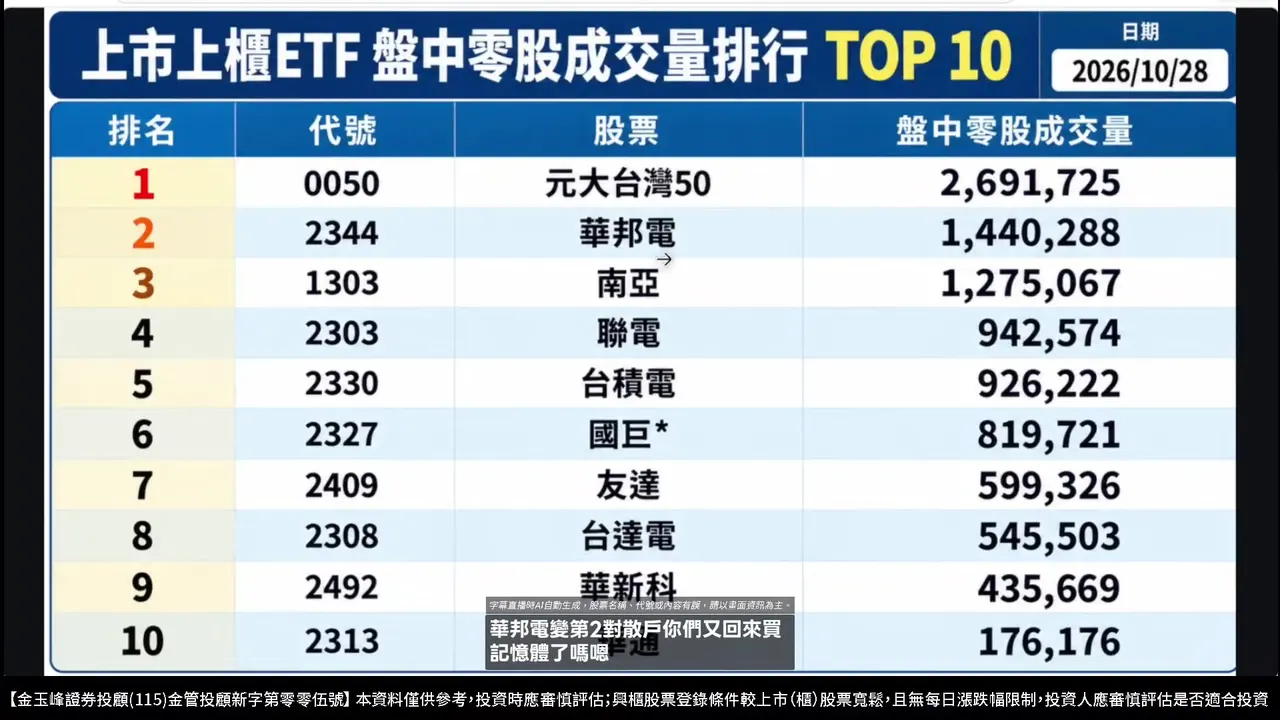
42:45Investment Trusts Add to Packaging and Testing, and UMC
Two active ETFs that sold packaging and testing heavily earlier are now adding to it in sync, buying ASE together, and continuing to buy Gold Circuit Electronics. UMC is still being trimmed, but not with sweeping sells, so it isn't bad; the 120s is a cheap and defensible range, and once it hooks up it's worth watching. Hua Xing Guang, which cleared its restriction today, did decently.
▶ Watch from here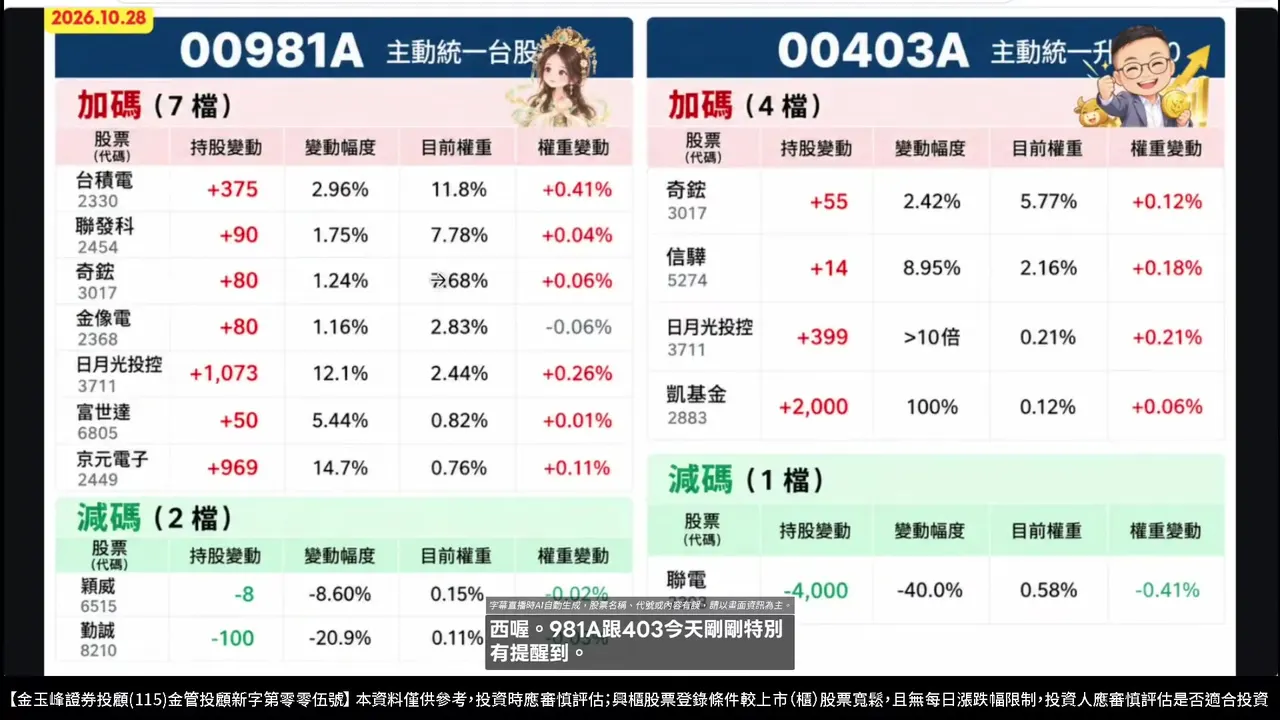
49:30FOMC and AI Capital Spending
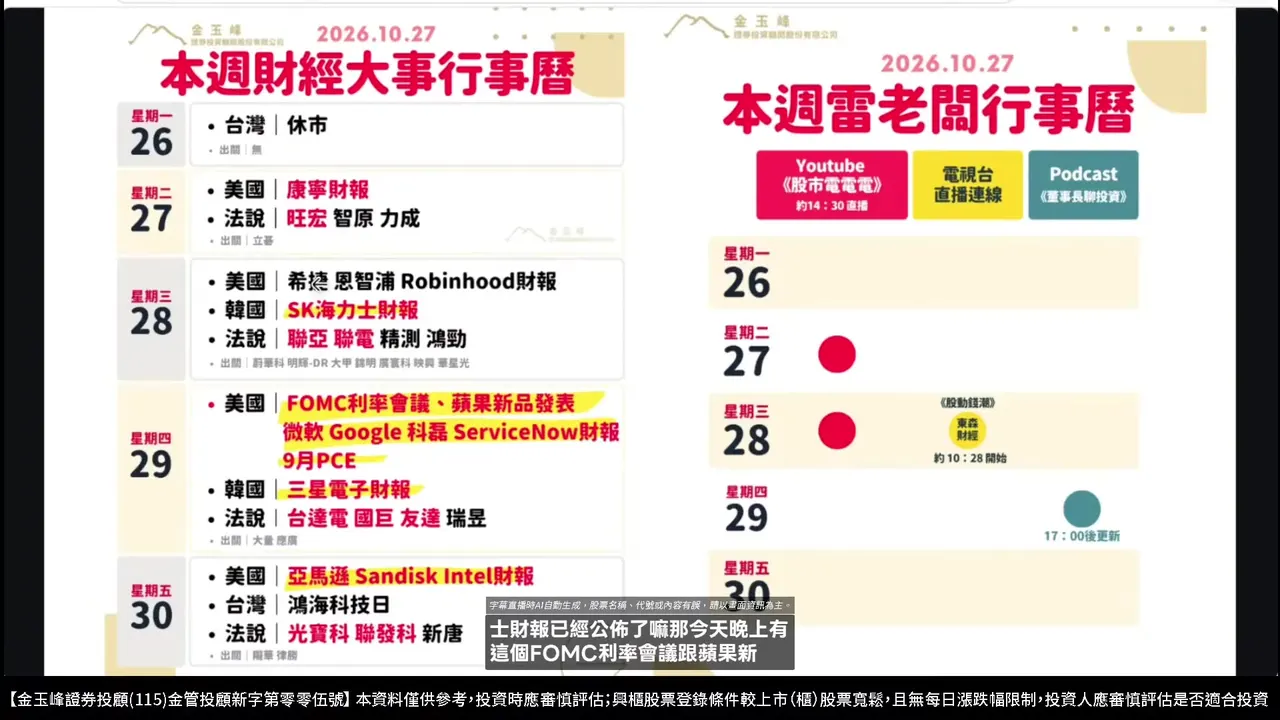
This week brings the FOMC, Apple's new product launch, and earnings from Microsoft, Google, ServiceNow and Samsung, while SK Hynix's earnings are already out. The market is watching whether the bad news that AI giants' capital spending pays back too slowly will keep piling up, and for now it looks like it isn't being piled on again. Musk says payback comes in 9–12 months; if you believe that, the market has also fallen enough, and next we wait for the payback period next year; once the first payback shows up, there is a chance of new highs again.
▶ Watch from here